Dual-core Intel Conroe processors
Author:
Date: 15.08.2006 |
|
Introduction
Three years ago, AMD released a line of processors with the new A64 architecture and immediately won a technology advantage. Athlon64 processors ran at much lower clock speeds than Intel Pentium4 but demonstrated high higher performance. That was especially seen in gaming applications, i.e. in the field which is most common for home-based users. The advantage in speed was won due to the shorter pipeline as well as the integrated memory controller. Intel was struggling to the very best of its power continuously raising the clock speeds of it processors. But ... stopped the race having finally not achieved the 4 GHz threshold. Further rise in the clock speeds was simply impossible: the heat emission went beyond all the reasonable boundaries.
To be fair, we should note that Intel's latest processors produced following the 65 nm process technology smoothed the problem of power consumption a bit. But Intel failed to grab the performance crown. Therefore, AMD was gradually expanding its market share, and in mere three years it overcame the ~25% barrier. In fact, that is the maximum possible market share for AMD because of the lack of production capacities.
Of course, Intel was strongly against this situation. And some time ago there appeared first rumors on the forthcoming new processor architecture. There also appeared first specimens - I mean mobile CPUs Pentium-M on the Dothan core. Manufactured following the 90-nm process technology and running at ~ 2.5 GHz clock speeds, these processors showed a very high operating speed comparable to to that of top-end desktop AMD and Intel processors. Pentium-M proved so highly attractive that some companies prepared matching solutions for desktop systems.
A bit later though, there appeared first information on processors built on the Intel Core 2 Duo architecture, which made the interest to Pentium-M gradually fade. Roughly speaking, the Core 2 Duo architecture is a logical evolution of the Pentium Pro architecture with the use of all Intel's technologies and developments. In particular, the new processors offer a rather short pipeline (14 stages) and are able decoding and executing up to instructions per cycle. For more detail of the Core 2 Duo architecture, read our previous materials. Today, we are focusing on the practical aspects of operating the new processors.
In August 2006 onwards, the following models start appearing in the retail:
| Processor |
Core |
Clock speed, GHz |
Multiplier |
Bus speed, MHz |
L2 cache size, MB |
Typical heat emission, W |
Price, $ |
| Core 2 Extreme X6800 |
Conroe |
2,93 |
11 |
1066 |
4 |
75 |
999 |
| Core 2 Duo E6700 |
Conroe |
2,67 |
10 |
1066 |
4 |
65 |
530 |
| Core 2 Duo E6600 |
Conroe |
2,4 |
9 |
1066 |
4 |
65 |
316 |
| Core 2 Duo E6400 |
Allendale |
2,13 |
8 |
1066 |
2 |
65 |
224 |
| Core 2 Duo E6300 |
Allendale |
1,86 |
7 |
1066 |
2 |
65 |
183 |
| Core 2 Duo E4300 * |
Allendale |
1,80 |
9 |
800 |
2 |
65 |
?? |
* - Core 2 Duo E4300 will appear in the retail even in Q'1 of 2007.
Therefore, Intel has presented two cores of the Core 2 Duo architecture. These are Conroe and Allendale which differ in only the L2 cache size: 4 MB and 2 MB, respectively. Of note is that the L2 cache is shared, i.e each core is able fetching data from the whole cache size. We also mention the processor core Millvile which will have only one core. It is quite probable that value-sector processors will be released on its based (I presume that will no happen earlier than 2007).
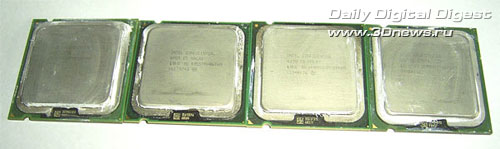
Visually, processors built on the Conroe and Allendale cores do not differ much from other LGA775 processors. In particular, the front side is hidden by a heat-spreader and fully coincides with other processors except the marking.
Just guess which of these is Conroe
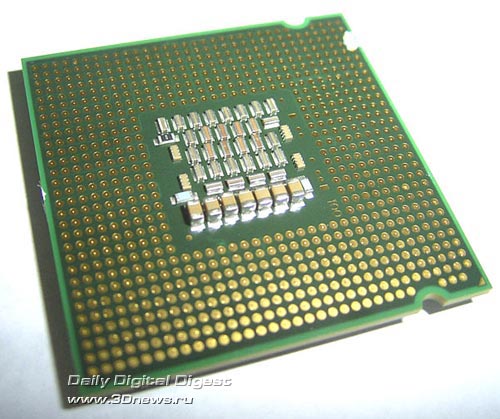
On the reverse side, we can see some slight changes in the positioning of capacitors.
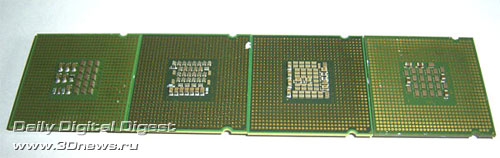
Gallatin, Conroe, Presler and Prescott 2M
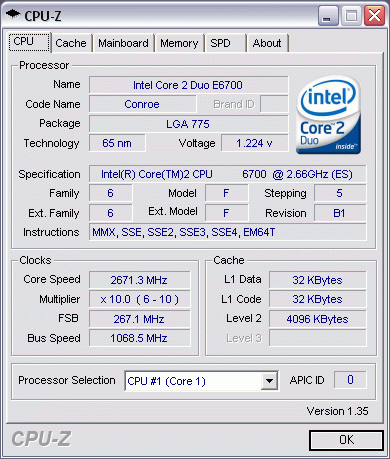
The CPU-Z utility displays the following information:
Just note the CPU stepping: The test specimen is of stepping B1. In fact, all the engineering samples and rare processors of the very first batches have had steppings B0 and B1. But all the processors to be sent to the official sales have stepping B2.
Now let's look into other issues. Which of the listed processors should we buy? The answer is simple - the one you have enough money for. Another important question - which motherboard to choose? At that, there are more fine points. First, we should keep it in mind that the vast majority of LGA775 motherboards are incompatible to Core 2 Duo processors. The thing is, to support Intel's latest processors the power supply module of the motherboard should conform to the VRM 11 specifications. There are few of such motherboards: a couple of motherboards on the base of i975P (Intel D975XBX Bad Axe) and ASUS P5W-DH Deluxe), as well as a few boards on the P965 chipset. Once the P965 has been released, the number of motherboards on its base will be increasing (and they will all be compatible to the Core 2 Duo).
It now makes sense to think which processor to take with overclocking kept in mind. Clearly, you should buy the cheapest, i.e. Core 2 Duo E6300 built on the Allendale core. It is also important to note that although the L2 cache size in Allendale is twice as small as in the Conroe core, the performance difference at a similar clock speed is within 2% (in some applications - up to 5-6%). Therefore, you don't have to worry about the small cache. But what you really have to take care of seriously is the multiplier which is = 7 in the model E6300. That means, to achieve the technology limit 3.5 GHz (provided there is air-driven cooling), we should increase the FSB speed to 500 MHz. That is a really impressive speed: for example, the FSB limit for Asus P5W-DH Deluxe is 450 MHz. Besides, for a stable operation at such frequencies there must be a feature for raising voltage on the chipset's north bridge. Therefore, the selection of a Core 2 Duo motherboard has to be effected really thoroughly. Quite possibly, it's better to spend a bit more to but a more expensive CPU with greater multiplier. In other words, we add 40$ and buy E6400 with the multiplier 8. As a result, to reach 3.5 GHz we should raise the FSB to 437 MHz, which is quite feasible! Therefore, potentially it is just the E6400 model that will be the overclocker's choice until the end of 2006. To be more precise, until the release of E4300 which runs at 1.8 GHz with the system bus speed 800 MHz (QPB). It's easy to calculate that the multiplier of the CPU is set to 9, which substantially facilitates overclocking. Again, this model will be the cheapest of all the Core 2 Duo processors.
Once we are talking about the overclocking issues, let's conduct a small research "Overclocking and heat emission on the Conroe core".
Overclocking and heat emission
We note straight that Conroe and Allendale processors running in the nominal mode have a very low, to modern standards, heat emission. In particular, the lower CPU E6300 at 1.86 GHz has a typical heat emission = 65 W. Of major part in that is the very thin (65 nm) process technology as well as the relatively low supply voltage.
With the Enhanced Intel SpeedStep enabled, the heat emission drops to 22 W. At the same time, the multiplier drops to 6, and the Vcore voltage reduces. Other processors also support this technology which allows reducing the multiplier to 6. So, for most users a boxed cooler would suffice. By the way, the new Conroe core contains 291 mln transistors, with its area being 144 sq.mm.
As regards overclocking using air-driven cooling, then with the Gigabyte G-Power cooler we were able to attain 3.46 GHz clock speed with a minor rise of the Vcore. At the same time, the CPU temperature even when both cores are fully loaded, did not exceed 54°
 |
Top Stories: |
 |
 |
|
MoBo:
|
|
|
|
VGA Card:
|
|
|
|
CPU & Memory:
|
|