Intel Core 2 Extreme QX6850: first impressions

Author:
Date: 16.07.2007 |
|
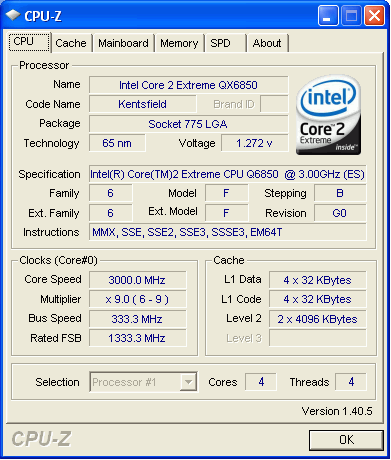
Now that we found out that the differences between the new Core 2 Extreme QX6850 and the former leader Core 2 Extreme QX6800 are about support for the FSB 1333 MHz (instead of 1066 MHz) and secondly about the multiplier which is now equal to 9? (versus 11? in QX6800 and 10? in QX6700), which in in the end affects the increase of the clock speed up to 3.0 GHz (versus 2.93 in its predecessor, and 2.66 GHz in QX6700).
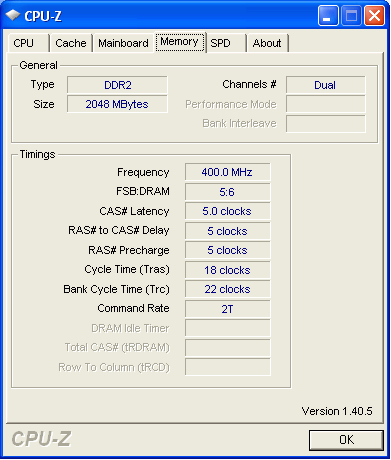
Test configuration
|
Bus
|
PCI-Express
|
|
CPU
|
|
|
MB
|
Foxconn N68S7AA-8EKRS2H (nForce 680i SLI)
|
|
Memory
|
Corsair XMS Xpert DDRII-800 2 x 1Gb
|
|
Video
|
AMD Radeon X1950XT
|
|
OS
|
WinXP + SP2 + DirectX 9.0c
|
|
PSU
|
|
Needless to say, it would be a good idea to present an investigation of the overclocking capability of QX6850 as well as QX6800 which is close at the clock speeds, but unfortunately because of the shortage of time we have to be confined with the scope of the tests. The specifics of the test configuration does not let us run a detailed research and adjust the CPU clock speeds. So we have to merely promise a presentation of detailed results in the forthcoming publications.
Therefore, our today's task made more complex due to the scarce volume of test results is actually not about the re-evaluation of leadership on the market of desktop PCs which has belonged to Core 2 Extreme QX6800 even without today's CPU in question. Today, we won't be able to estimate the advantages which are seen on using a CPU of the higher system bus speed 1333 MHz.
Of course, we won't be able to compare processors of different clock speeds in a "brute-force" way - we only have to estimate the "percentage" of performance scattering of results for the chips QX6700 and QX6850 at the most characteristic test applications. Again, we won't be able to take the 20% difference in FSB speeds as the reference, or ~12% difference in clock speeds (and even to account for the different multipliers at the same time!) - the times of a linear "megahertz races" are well in the past. So today we are publishing the data which is absolute and weakly connected to the possibility to compare data on QX6850, or, if you like, a data template for detailed comparison.
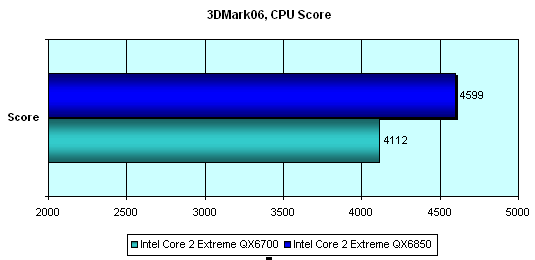
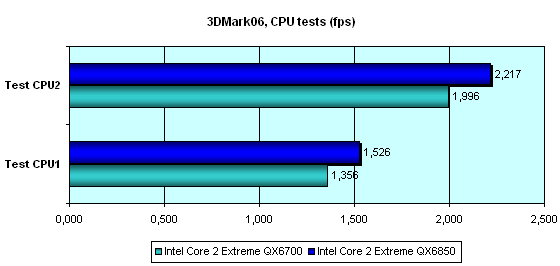
First, synthetic benchmarks. The CPU test integrated into the 3DMark 2006.
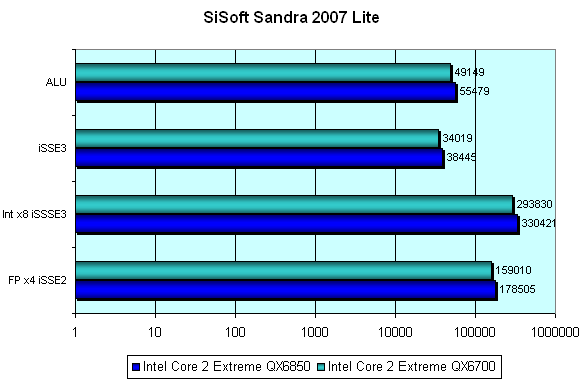
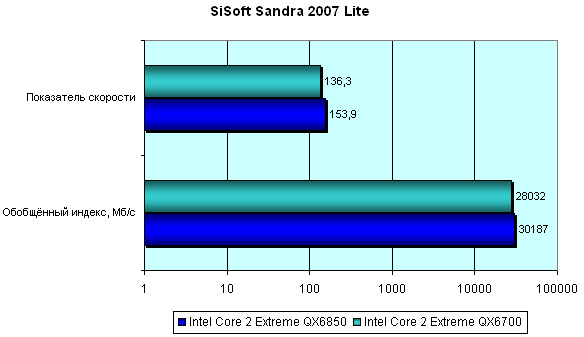
The key CPU tests of SiSoft Sandra 2007 Lite.
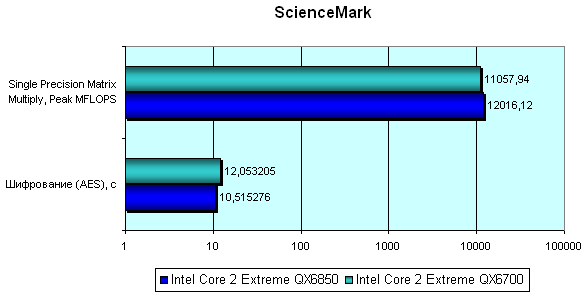
Tests of matrix multiplication following the AES algorithm of ScienceMark.
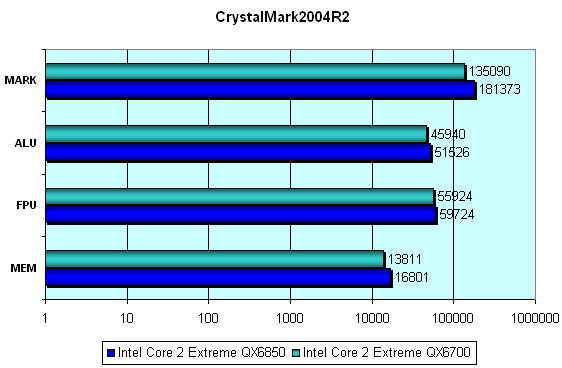
The key tests in CrystalMark.
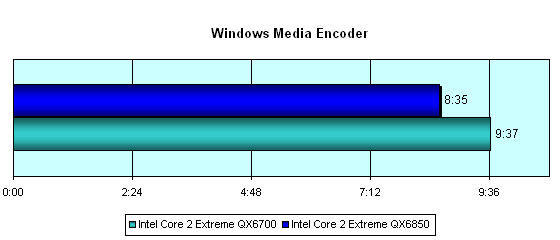
Encoding video data with Windows Media Encoder.
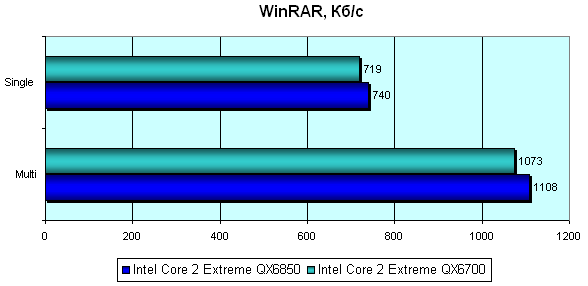
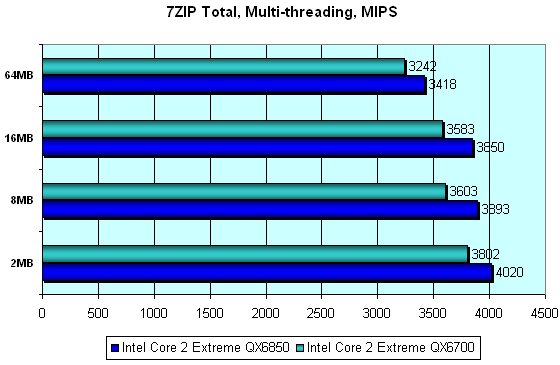
Finally, estimation of data compression rate with benchmarks integrated into WinRAR and 7ZIP.
Repeating it again: today, there can't be any quantitative comparative data on comparing the results of CPU tests which are so different at clock speeds and FSB speeds. However, some interesting results can be seen even from today's material. For instance, the maximum difference is seen in video encoding and archiving - perhaps because these tests are originally optimized for multi-core CPUs. Also impressive is the gap in results in a number of synthetic tests, but we would need an additional investigation to find out which parameter made the most contribution to the performance boost - the clock speed or the FSB speed.
Of course, there were no surprises: in any case, Intel Core 2 Extreme QX6850 will now occupy the top-ranking position in the hierarchy of the company's chips for desktop PCs. It is highly probable that for some time it will be able competing on par with new "non-extreme" novelties with FSB 1333 MHz or, quite possibly, clock speeds over 3 GHz due to the unlocked multiplier, the adjustability of the bus speed, and other overclocking options. By the way, according to some information that has appeared in the Internet, QX6850 has proved successful at overclocking to clock speeds over 5 GHz.
A more detailed investigation into Intel Core 2 Extreme QX6850 at our lab will certainly reveal its overclocking capability, experiments with DDR3 memory, and most importantly will refine the numerical gap of the new flagship from its brethren and the most immediate competitors by AMD. Hopefully, we won't have to wait long to the continuation.
 |
Content: |
 |
|
|
Top Stories: |
|
 |
|
MoBo:
|
|
|
|
VGA Card:
|
|
|
|
CPU & Memory:
|
|
|