Quad-core Intel Kentsfield processors

Author:
Date: 02.11.2006
|
|
Introduction
First of all, a brief contents of the review for those readers who immediately move to the performance diagrams. So, Intel has released a 4-core processor which appears to be two Conroe cores packaged in a single housing. Therefore, in programs that offer optimization for multithreading this processor can provide a 3-fold performance boost. But in programs without such optimization (e.g., 99% of games), its speed will be on par with that of Conroe.
Now let's take a closer look at the new processor. Above all, it is called Core 2 Extreme QX6700, has a LGA775 socket and in theory it should be compatible to a wide range of motherboards. Although according to Intel's official information this processor is able running on only i975X-based motherboards, we are sure that soon the leading manufacturers will announce support for QX6700 by motherboards based on the P965 and the latest versions of nForce Intel Edition. It is quite possible that it will be supported by other chipsets, since QX6700 requires a power supply module meeting the VRM 11 specifications, as well as support by the BIOS.
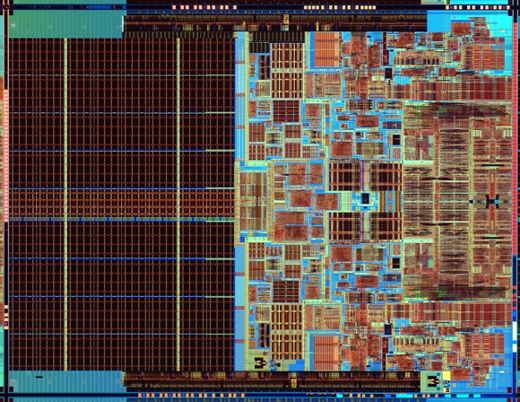
What sense is behind the starting migration of desktop computers towards quad-core processors? The major idea is in the more efficient handling of resource-intensive multimedia applications, including that of entertainment character. However, the character of providing a performance boost implies the need for expansion of software support for multitasking and multithreading, so the trend is linked to not only the hardware part, but it is just at the very start.
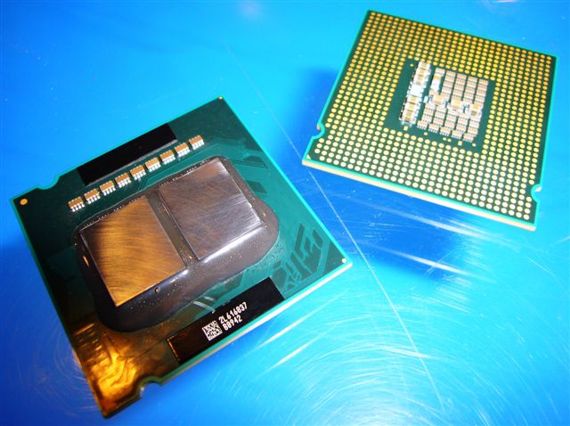
Since the innovation of the Intel Core micro architecture is already described at length in our review Evolution of the multi-core Intel Core processor architecture: Conroe, Kentsfield.., it makes no sense repeating on that subject herein. The most important thing which we would like to note is: the key capabilities of the new-generation architecture implemented in the formerly described technologies - Intel Wide Dynamic Execution, Intel Intelligent Power Capability, Intel Advanced Smart Cache, Intel Advanced Digital Media Boost, and Intel Smart Memory Access - are still topical for 4-core CPU Core 2 Extreme QX6700 in the same way as it is for its 2-core brethren. The only difference is in that now the new Intel Core architecture is implemented in four independent cores on a single substrate, with 8 MB L2 cache (4 MB per each pair of cores), which provides support for four independent physical threads and in theory allows to achieve an additional performance boost (with the adequate operation of the platform's software part).
In our tests, we used the motherboards Intel D975XBX2 ("Bad Axe") and ASUS P5W64 WS Pro (both on the i975X chipset).
Therefore, with support for the QX6700 processor by the motherboard, upgrade is performed only through replacement of the processor. The thing is that the computer industry is fully ready for the emergence of 4-core processors. In practice, this is expressed in a wide assortment of of powerful coolers which are able dissipating 130-150 W, as well as a great number of powerful (>500 W) power supply units.
Remarkably, the emergence of QX6700 has happened merely three months after the emergence of the Conroe Allendale core. Such a high speed of development can be explained by that these processors were developed almost simultaneously. Already at the initial stages of development, the specifications for Conroe were complemented with the requirement of compatibility to the 2-core configuration. In other words, placement of two Conroe cores into a single processor (each core also dual-core) allows producing a 4-core processor. And the small power consumption of Conroe allows fitting within the 150 W limit for the 4-core configuration (official data on TDP for QX6700 tell of 130 W of power consumption).
By the way, this approach to development of dual-core processors continues Intel's tradition. In precisely the same way, the Smithfield and Presler processors were manufactured. By the way, the latter has two Cedar Mill cores, is manufactured following the 65-nm process technology and so far has been the only processor which is able executing 4 command threads simultaneously. The thing is that both the integrated cores offered support for the HyperThreading technology. Therefore, it would be especially interesting to compare performance of Presler versus that of Core 2 Extreme QX6700.
In the end, the new processor has been codenamed as Kentsfield and various diagnostic utilities use just that.
As we see, the clock speed of QX6700 equals 2.66 GHz, the system bus speed is 266 MHz (1066 MHz QPB) and thus the multiplier = 10. The L2 cache size is 8 MB (2 x 4 MB), and the nominal supply voltage may vary within 1.25 V to 1.35 V depending on the stepping.
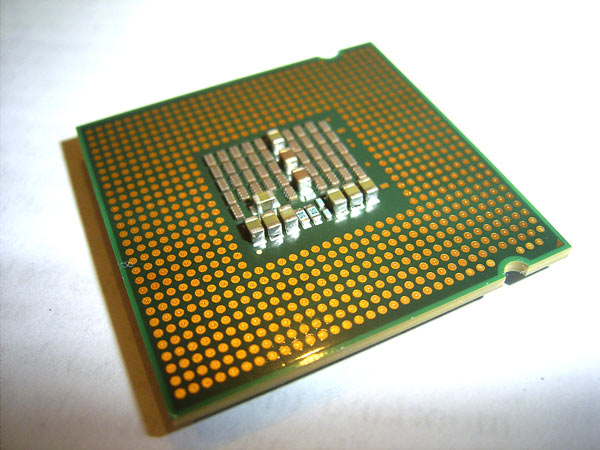
Visually, the new processor makes little difference from its LGA775 brethren. The front side of has no marking at all (except the marking), and on the reverse side the Kentsfield can be recognized by the configuration of capacitors:
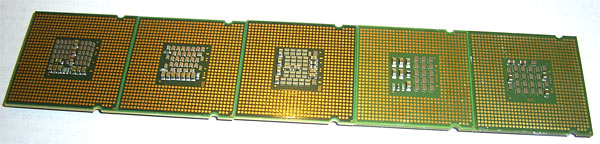 From left to right: Kentsfield, Conroe, Presler, Gallatin, and Prescott 2M
Close view:
Let's digress from the processor for some time and consider Intel's general approach to increasing the performance of its processors. Having burnt its fingers on the NetBurst architecture that called for a serious increase in the clock speed, Intel changed its approach and released a new-generation architecture - the Core 2 Duo. The latter provides a revolutionary leap in performance under a rather small power consumption. At the same time, as numerous experiments with overclocking showed, the margin for raising the clock speeds is simply tremendous (up to 3.4-3.6 GHz). The latter factor would have let easily rubber-stamp all the new versions of processors for another two years (right before migration to the 45-nm process technology). However, the general trends of computer industry require parallel computations. Therefore, Intel's major strategic goal is the development of multi-core processors.
To date, the attitude to 2- (and more) core processors is not unanimous. On the one hand, there is still very little optimized software, and such programs can be found only among professional software. That is, for the home user multicore processors seem to be useless. But on the other hand, the dual-core processor provides more comfortable operation with Windows XP (and other operating systems). But the "comfort" is a subjective thing and can't be expressed numerically. But in my personal experience this "comfort" is tangible enough and allows to recommend just dual-core processors.
Even the dual-core Celeron allows to feel the difference in the comfort of work! By a Celeron I mean cheap Smithfield processors (e.g. again the same dual-core Pentium 805). And the buyer should not be confused by its name Pentium: the performance of Conroe processors is so high that it immediately moves all the other LGA775 processors to the category of low- and middle-end products.
So, in the nearest future we can expect an increase in the number of cores on a single processor. I think this won't happen earlier than 2008 when Intel moves to a new (45 nm) process technology and demonstrates a new processor architecture. I believe by that time we can expect the emergence of first 8-core processors. Therefore, the rise of performance occurs in the following two directions: increase of the architectural performance (i.e of a single core), and increase in the number of cores on a single processor.
I think that time will be the epoch of prosperity for multi-core processors. Optimization for multi-threading will become a mandatory requirement for software development (probably such optimization will be integrated at the level of development tools), and single-core processors will simply vanish away from retail stores. Besides, in 2007 the new operating system MS Vista is released and therefore all the most recent software development is biased towards just this system. And quite possibly that we'll get the first fruits of multi-core system advantages in a matter of a few weeks.
As I already stated, to date there is very little optimized software, and it can be met most often among the 3D graphic processing software, as well as software for encoding streamed data (video and audio), data compression (archivers), and image processing. So, we'll start testing the CPU Core 2 Extreme QX6700 just with these applications. But before we proceed, we consider the overclocking capability of the new processor.
Overclocking and heat emission
Since Kentsfield is made up of two Conroe cores, then it is clear that the potentials for increase in the clock speed will not exceed the limits of the Conroe core. However, placing two cores on a single processor results in that the maximum possible clock speed is restricted by the potentials of the "weakest" core. On the other hand, to manufacture Kentsfield cores, Intel selects only the best-of-breed cores, which tells in favor of overclocking. In general, we can expect that the technology limit is at about 3.5 GHz.
And it proved to be the way we expected: the maximum stable clock speed of our CPU specimen proved to be 3.45-3.5 GHz with air cooling (using the Gigabyte G-Power cooler). At the same time, we should note that the processor successfully started at 3.66 GHz, but stable operation was impossible because of a too high heat emission.
Next
 |
Content: |
 |
|
|
Top Stories: |
|
 |
|
MoBo:
|
|
|
|
VGA Card:
|
|
|
|
CPU & Memory:
|
|
|