GOTVIEW PCI DVD2 Lite and Deluxe: TV-tuners with hardware video compression

Author:
Date: 17.05.2006 |
|
Connection features
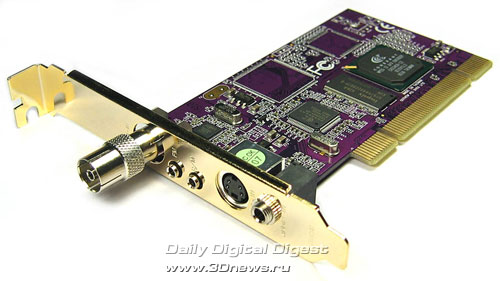
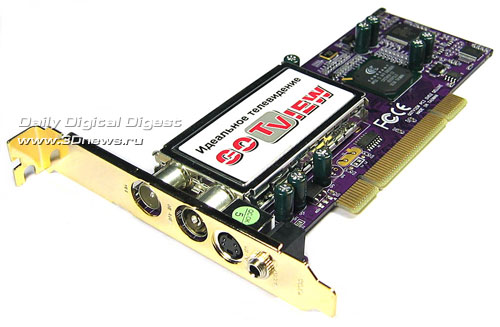
The boards have somehow different connector panels. The GoTView PCI DVD2 Lite has a jack to plug in a TV aerial (interestingly, connected via an adapter from a regular RCA "tulip" plug), an extraordinarily miniature jack to plug in an FM-aerial, a stereo input in the form of a 3.5 mm minijack connector, an S-Video input, and a jack to plug in an external IR receiver.
The GoTView PCI DVD2 Deluxe has jacks (traditional for its form factor) to plug in TV and FM aerials, an S-Video input, and a connector to plug in an external IR receiver.
Using the tuners
Once the drivers were installed, we usually had no problems, and the system detected a new hardware: the tuner GoTView PCI DVD2 Lite and the tuner GoTView PCI DVD2 Deluxe.
As was found out later, both TV-tuners came bundled with software of version 4.0.0.478. The latest software version tested in our test lab was detected also with GoTView USB 2.0 DVD Deluxe (which is by the way very similar to GoTView PCI DVD2 Deluxe at its wiring) and was indexed as 4.0.0.473. Since that time, many new features have been added to the program, and some of them merit a special consideration. These are hardware de-interlacing, writing audio and video streams into separate files, and new methods for sorting channels on a rating basis. The remaining features of version 4.0.0.473 were described in a respective review on the full version of the programs, so we are not dwelling at the operation specifics so as not to repeat.
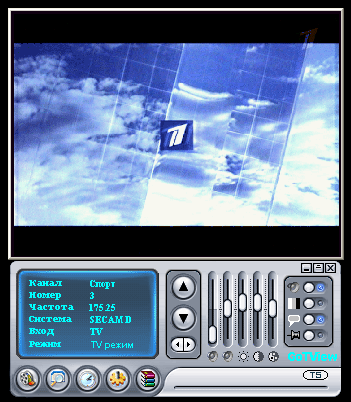
It suffices to say that the manufacture has done a great job and perhaps implemented in the software suite everything GoTView are capable of. For instance, there have been implemented customized settings for each channel - all settings for audio, image, encoding type, noise suppression; there is a possibility to scan any specified frequency range in a selected increment; there is also the full-featured PIP tool - "picture in picture", the visualized pattern of program schedule updateable via Internet and a scheduler have been meticulously polished to perfection; there have also been implemented such features like networked broadcast and a motion detector. That is, the proprietary software has virtually "inspired a soul" into the hardware "rig" by GoTView - the "soul" most TV-tuners on the Russian market to date lack, and even some analogs with world's renowned brand names. But let's not dwell on the description of this software product (those who read about it know everything about it now, and those who didn't and are interested now can resort to respective reviews). Let's better turn to the quality of received image and other features of these new tuners.
The tuners were tested on a computer of the following hardware configuration: CPU - Athlon 1200, MoBo - Albatron KX600S Pro, video - GeForce4 MX440, memory - 256 MB DDR333, ОS - Windows XP Pro Rus SP2. A shared public area was connected to the cards.
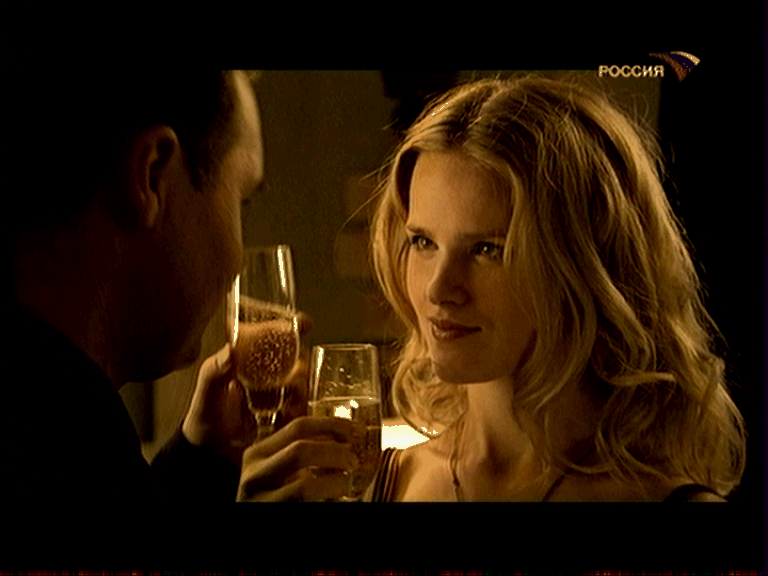
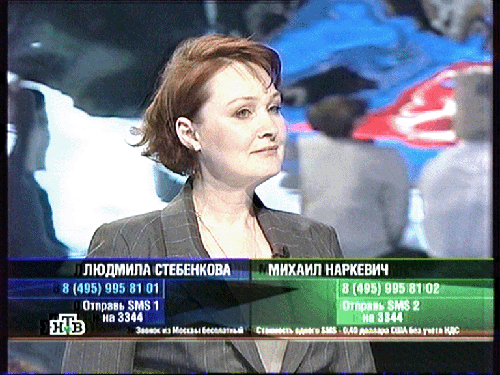
The first thing to note is that there was absolutely no difference seen to the naked eye in the received signal between the semiconductor RF-unit of PCI DVD2 Lite and the analogous MK5 in PCI DVD2 Deluxe.
Screenshots for GoTView PCI DVD2 Lite
Screenshots for GoTView PCI DVD2 Deluxe
Anyway, it's still half work to achieve a stable operation at a strong signal. Russia's reality is such that many have a too weak signal level. The analogous RF unit did its job well enough, albeit with some noise on the screen, but it did. But how will a semiconductor selector switch will behave in such a difficult situation? As the tests have shown, no difference is seen even under a poor signal. The noise level on images provided by the cards is almost identical. The conclusion is evident then - semiconductor selectors will have the future since they have attained a high reception quality, and the cost of their batch production is essentially lower.
Both the cards stand out with a high level of hardware-powered noise suppression. Of course, we shouldn't expect that filtration will save against any noise. The noise won't disappear under a very low signal level. But these TV tuners will certainly help eliminate some "snow" noise against the background of summer views.
The deinterlacing filters of both the cards provide the user the opportunity to select the suitable operation mode depending on the image dynamics. At the same time, there is the possibility to plug in both software-driven and hardware filters. Of the software-driven filters, there are Bob and Blend, of the hardware filters - Bob, Weave, and the automatic filtration mode. As the tests have shown, in most cases the automatic mode is enough. At the same time, there are some jagged lines of image, but the noise is not really significant.
On the whole, the reception quality of both video cards is comparable enough, even indistinguishable to the eye, and deserves a top mark. The same applies to recording from external sources. For the MPEG-2 hardware recording, the manufacturer has implemented a unique feature for cropping the work area of the image in the bottom part of the screen. The user can adjust the number of cropped lines at own discretion. Besides, it is nice to see that video content can be captured to files of a manually selected size. Once one file is full, the recording goes on continuously into the next file. This feature is quite useful when files are generated for delayed recording on disks. Some image parameters like brightness can be adjusted while recording a TV program.
During operation, the cards use up the CPU in equal extent - by 40-50% depending on the number of filters connected (provided that TV tuners are installed on a test platform of the above hardware configuration). That is really not bad at all even for such a middling and weak computer. The MPEG-2 recording using hardware compression does not result in the rise of load at all. But to record in MPEG-4, you would need a different processor - in the test configuration the usage was not lower than 100%, so correct recording was impossible. It should be noted that the software for the tuners "understands" the software-driven compression codecs installed in the system while recording is done with these codecs. The situation is the same when recording audio - it is possible with any codec installed in the system.
Final words
In our test lab, we've seen many TV tuners by varied manufacturers, but among all the integrated tuners having the PCI interface only the two novelties by GOTVIEW deserve the title of the best product. Just see for yourself - the manufacturer has integrated into both devices six wishes of the manufacturer at a time: good quality of reception, FM-radio, good quality of hardware compression, proprietary design of the tuner, acknowledgement of errors and their correction (through an active online user forum), a full-featured software suite with flexible settings and a full implementation of the board's capabilities. That is the most important thing which makes a tuner a tuner, however hard some eminent brands are trying to mislead us. Now, add to the above listed a stylish design of the board, a good package bundle, excellent "price/quality" ratio (the model GoTView PCI DVD2 Lite in Moscow can be made available at 85 $, whereas GoTView PCI DVD2 Deluxe - at 110 $) and you get something like an ideal tuner. On the Russian market, these models are beyond competition to date.
In conclusion, let me note that the model GoTView PCI DVD2 Lite is more suitable to economic users as well as those concerned about the CPU unit ventilation as well as issues of free space inside. The model GoTView PCI DVD2 Deluxe is more likely aimed at those who are fanciers of time-proven analogous electronics, as well as those who prefer controlling not only the TV-tuner but the PC itself with a remote control.
 |
Content: |
 |
|
|
Top Stories: |
|
 |
|
MoBo:
|
|
|
|
VGA Card:
|
|
|
|
CPU & Memory:
|
|
|