Intel Centrino Duo: new-generation mobility
Author:
Date: 24.01.2006
|
|
For new generations of Intel mobile PC platforms under the common name Centrino , the first quarter has traditionally become the time of official emergence to the world. It seems like just the first month of year will be traditionally the time for that. In 2005, January became the month for announcement of another version of Intel Centrino codenamed Sonoma, and this January – of version Napa. I won't be surprised if the next generation of Centrino – the Santa Rosa, will also take its official launch also in January, but in 2007.
Announcement of a new Centrino version is always the largest event in the industry, but this year Intel decides to merge a number of no less important events concurrently with that announcement. Above all, it is the first official emergence of the innovative technology Intel Viiv for home-based PCs (Entertainment PC).
We will certainly devote one of our further materials to the "entertainment" PCs based on the new Intel Viiv technology which allows to view, control and jointly use digital entertainment media for all the family members. Of course, we will introduce our readers to both the technical points of the Intel Viiv architecture and its specific implementation details - the volume of materials on the subject and specific examples has finally reached a sufficient level. There aren't any doubts that among all other facts the Intel Viiv is obliged to the thrilling success of the mobile Centrino platform for its emergence. In fact, mentioning the Intel Viiv in this article doesn't mean an "abstract talk" because today the following is known for sure: chips of the Intel Core Duo family will operate not only as part of the mobile PC of the Intel Centrino Duo platform, but also in some models based on the Intel Viiv technology.
Inspired by successful sales of Centrino kits for many years, Intel last year decided to re-use the experience of delivering finished and mutually certified base components for building reliable computer systems (not just standalone components) in other sectors – servers, desktop PCs, smart-phones, and communicators. We will see very soon what will come of the idea of turning a desktop computer into an item of household electronics together with TV-sets, audio/video systems, vacuum cleaners, because deliveries of systems based on the Intel Viiv have already started. But that is a matter of another material.
Another event that accompanied the announcement of the new generation of the Centrino platform is Intel's complete rebranding. Putting it in a human, not marketing talk, Intel has started this year with a mass replacement of its slogans and trademark names, as well as changes to the exterior of numerous logos - corporate, branding, product-related.
For those who are used to finding their ways in the PC world by the word "Pentium" heard over the TV are in for uneasy times: they will have to learn new unknown terms which will now be used in combination with the company name.
For reference: Intel's current rebranding is merely the third for the whole history the company has been around. Of the previous versions, we can now recall the Intel Memory brand introduced in 1985, then the Intel Pentium which was introduced in 1987 and further commercialized in 1988, as well as Intel Centrino which was the first try of Intel's in the field of platforms that came into being in March 2003. Try memorizing the below logos: while today they still can be seen on various products, they will be a museum exhibits in quite a short time.
So, what comes as a replacement? In exchange of the old logos, there have come new ones made in a unified style. For instance, this is how Intel's new corporate logos look:
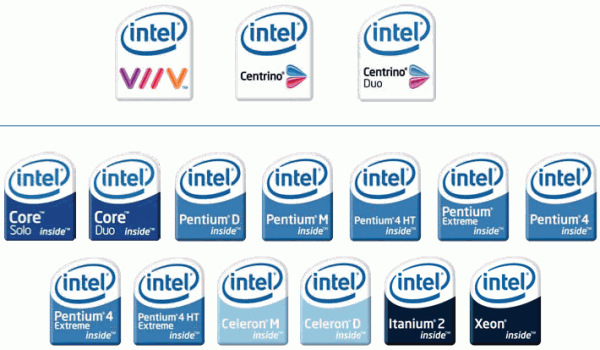
This is how logos for mobile and desktop PC platforms look (above the line) and the logos of Intel's processors for mobile, desktop and server systems:
In the solid residue - the way the inscription of the company name has been changed, the delineation started looking absolutely different, and new brands have come into being. Today, we are talking about introductions for the mobile platform, which are not only for image-making.
The path of Centrino: from the platform concept to the industry standard
The fourth generation of Intel Centrino for mobile PCs in the form of Intel Centrino Duo presented these days used to be codenamed Napa. The key improvements which make the new version stand out from the previous platform codenamed Sonoma can be classified over the four vectors of progress:
-
Performance increase – an increase up to 68% due to the use of new 2-core processors (results of the SPECint_rate_base2000 test)
-
Elongation of the offline battery-powered operation – by up to 28% (according to MobileMark 2005 tests for the processor, chipset and wireless components
-
Building systems in a finer and lighter form factor - reduction in the size of portable PCs by over 30% due to shrinking the physical dimensions of the platform components
-
Expansion of wireless communication capabilities – support for the most recent security standards and wide selection of wireless connections
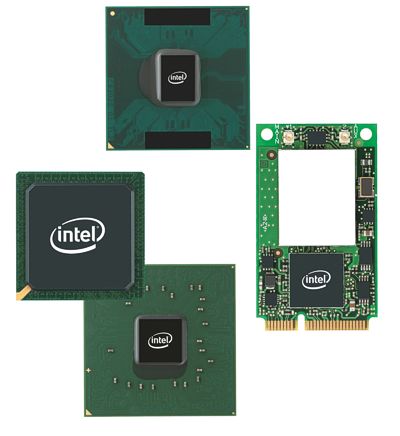
The name of the new platform - Intel Centrino Duo - quite vividly shows its key design feature: use of Intel Core Duo processors, first 2-core Intel chips for mobile PCs (formerly having the working name Yonah) created following the 65-nm process technology. Besides that, the full kit of Intel components to assemble a notebook computer that pretends to bear the Intel Centrino Duo logo, must contain the new-generation chipset Intel 945 Express and the wireless LAN adapter Intel PRO/Wireless 3945ABG with support for 802.11a/b/g protocols.
Prior to going into the technical details, let's finish with the marketing details of the new Intel's mobile platform. In fact, together with the notebooks which bear Intel Centrino Duo logos we'll soon see novelties labeled as Intel Centrino on the retail shelves. The major distinction between these versions, as is easy to guess, is the use of 2-core (Yonah DC) and single-core (Yonah SC) processors, respectively. Moreover, on the market there will soon be notebooks with new 65-nm Intel's processors - both single-core and dual-core, but in combination with third-party chipsets and wireless adapters. As before, such portable PCs can't pretend for bearing Centrino logos, but this time Intel has introduced special new logos for mobile processor brands - Core Duo and Core Solo. Here is a summary table for a distinct definition of the brand marking:
|
Napa platform components
|
| Logo |
 |
 |
 |
|
 |
|
| Platform |
Centrino Duo
|
Centrino
|
-
|
| Processor |
Core Duo
|
Core Solo
|
Core Duo
|
Core Duo
|
Core Solo
|
Core Solo
|
| Chipset |
i945GM, i945PM
|
Third-party
(other than Intel)
|
i945GM, i945PM
|
Third-party
(other than Intel)
|
| Wireless LAN module |
Intel 3945ABG
|
Partners' (other than Intel)
|
But the issue of marking to be used for Core Duo/Solo series processors with the cut-down L2 cache is still "in the air" (I am absolutely sure that chips similar to Celeron M will emerge within one or two quarters). Most likely, the respective logos will just be presented at the moment of their announcement.
Describing the overall specifications of notebooks based on Intel Centrino Duo for mobile PCs, Intel accentuates the improved 3D graphics, use of the HDTV, support for 7.1-channel Intel High Definition Audio with Dolby Digital. On the whole, notebooks demonstrate an increasing productivity due to a higher performance in the multitasking environment and improved facilities for shared work, as well as support for IP-telephony, IP-videoconferencing and prolonged time of offline battery operation.
The new platform also supports Intel Active Management Technology and Intel Virtualization Technology which improve the manageability and security of the PC, with the small dimensions of components making it possible to create notebooks of varied designs within a wide size range. It should be also mentioned that the operation life can be prolonged with the operating costs cut down with Intel Stable Image Program, There is also the possibility to prepare it for Windows Vista due to graphics optimized for the new Aero GUI.
Intel Core Duo and Core Solo processors
Along with the new 65-nm process technology used in the production of Core Duo (Yonah) chips, which allowed to reduce the dimensions of transistors and increase the density of positioning components on the chip, processors built on the Yonah core offer a number of the following characteristics:
- Parallel execution of task branches on two cores with the processor resources distributed
- Integrated L1 cache: 32 K for instructions and 32 K for data
- L2 cache - Intel Smart Cache, 2 MB in size, with support for the Advanced Transfer Cache architecture that provides for efficient usage of cache memory and the processor bus to boost performance of the 2-core system and reduce the power consumption
-
Intel Digital Media Boost - a new item in the processor architecture to optimize processing of instructions of the Streaming SIMD Extensions 2 class (SSE2) and Streaming SIMD Extensions 3 (SSE3), which offers a much higher performance for resource-intensive tasks - processing audio/video, images, 3D graphics, or scientific computations
- The Advanced Branch Prediction architecture which combines three types of prediction– Global, Bi-Modal, and Loop Detector. The processors selects the most optimum algorithm automatically, which cuts down the number of mis-predicted branching
-
System bus of 667 MHz speed, optimized for power consumption - uses the Source-Synchronous Transfer (SST) protocol for transferring addresses and data synchronously, which provides for increased bandwidth and data transmission at a speed as 4 times as much of the system bus speed. The Advanced Gunning Transceiver Logic (AGTL+), a version of the GTL+ technology, with additional power-saving
- The Intel Dynamic Power Coordination with the Dynamic Bus Parking feature - "on-demand" coordination of the cores performance. Advanced features for reducing the power consumption due to the Dynamic Bus Parking allow cutting down the chipset's power consumption while the processor is running at reduced clock speeds. The Intel Dynamic Power Coordination allows each core to switch to the Halt, Stop Clock, and Deep Sleep states dynamically, and in the 2-core mode – synchronously to the Deeper and Enhanced Deeper Sleep modes. The distributed logic of the chip's power consumption control coordinates operation of the Enhanced Intel SpeedStep mode as well as switching between the C-states, which results in low supply voltage operation for Core Duo chips and minimum heat dissipation in the active state
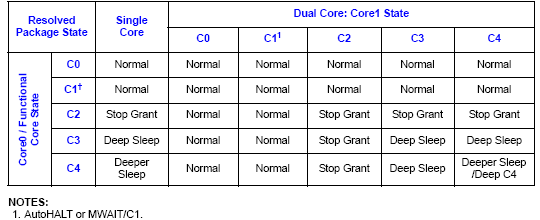
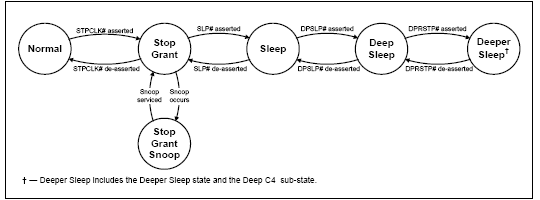
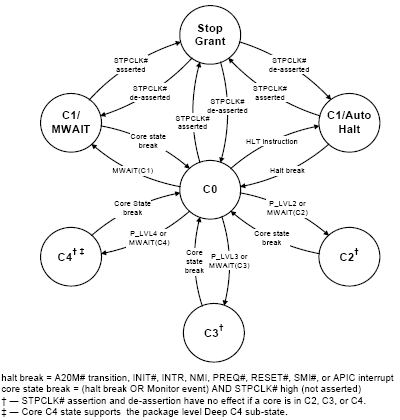
- The advanced Intel Deeper Sleep technology with the Dynamic Cache Sizing feature - implies that the core voltage on the processor can be reduced to a level even less than that defined by the Deeper Sleep technology. Dynamic Cache Sizing – a new power-saving mechanism that allows the Intel Smart Cache system to disengage the system memory dynamically on demand or whenever it is not in use
- Support for the new generation of supply voltage control system - Intel Mobile Voltage Positioning (Intel MVP VI) optimized for 2-core mobile chips
-
Intel Advanced Thermal Manager using the Digital Temperature Sensor. Intel Advanced Thermal Manager is in charge of a more precise control of thermal modes and more precise control of acoustic performance of the PC
- Support for Execute Disable Bit
-
Intel Virtualization Technology - hardware extension for client and server systems, which combined with respective software allows to raise performance and efficiency of concurrent use of a number of corporate and user applications
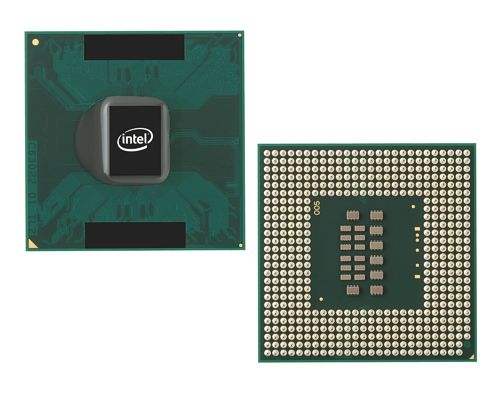
- Options of the housing make: Intel Core Duo - Micro Flip-Chip Pin Grid Array (Micro-FCPGA), for 479-pin ZIF-connector (Zero Insertion Force), more known as mPGA479M, and Micro Flip-Chip Ball Grid Array (Micro-FCBGA) for assembly with soldering, Low Voltage and Ultra Low Voltage Core Duo - Micro-FCBGA
Commenting on the changes that have appeared in the Yonah chip as compared to the previous generations, apart from implementation of the 2-core mechanism with shared distributed resources, we can also note the increase of the bus speed– from 533 MHz in the Dothan core to 677 MHz in Yonah, as well as the newly added support for SSE3 instructions, plus the mechanism of merging micro operations SSE, SSE2 and SSE3 on the background of improved algorithm for floating-point computations and some other instructions of the SSE set.
Of the huge set of new "4 Ts" technologies which includes the LaGrande hardware security, Vanderpool virtualization, support for 64-bit EM64T extensions (Extended Memory 64 Technology, i.e. Clackamas) and multithreading on the level of a single core - Hyper-Threading, the Intel Core Duo chips feature in support for the Vanderpool, which is still at the level of future implementation. Anyway, we shouldn't dream of the LaGrande implementation until the Microsoft Vista (Longhorn) has been released, whereas support for EM64T and the 36-bit of physical address (64 GB) memory space seems to be implemented in Merom cores. Frankly, for those who are into using Core Duo chips according to its intended use – in notebooks, it's not a great loss, but those who are after building new blade-servers will have to be content with what's there or wait for the next generation of chips. With Hyper-Threading, the situation is still the same: until the SMT-architecture is implemented, we'll use 2-core Yonah in the 2-thread mode due to two cores.
A few words on the scheme for marking the new generation of Intel mobile processors - the so-called Processor Numbers. Marking of all Intel Core/Core Duo chips is made up of the single-letter prefix and a 4-digit number. The letter has a direct connection to the classification of the TDP chip. Currently, there are four letters reserved for Intel Core/Core Duo processors:
- E - TDP over 50 W
- T - TDP about 24 - 49 W
- L - TDP about 15 - 24 W
- U - TDP below 14 W
The first digit of the 4-digit index stands for the number of cores: the 2-core Intel Core Duo (Yonah DC), therefore, is indexed as 2XXX, whereas the 1-core Intel Core Solo (Yonah SC) as 1XXX. The remaining three digits stand for the performance index relative to other chips of the family, in 100 increments, although I wouldn't be surprised if the increment turns smaller once new buses or other improvements to the cores come up.
To date, the line of 2-core Intel Core Duo processors includes the chips T2300, T2400, T2500 and T2600 which sell at the wholesale prices (for 1000 pcs onwards) set to $241, $294, $423, and $637, respectively. The Core Duo T2700 chip of 2.33 GHz clock speed is expected to be released in the second half of 2006, most likely in the third quarter, then we can expect the news of the emergence of first Merom chips. The family of single-core Intel Core (Yonah) processors is currently represented by one chip - the T1300 (package FCBGA6/FCPGA6) which offers 2 MB of L2 cache, supports the 1.66 GHz clock speed and FSB 667 MHz (wholesale price - $209).
At the same time, Intel has also started deliveries of Low Voltage 2-core Core Duo L2400 and L2300 processors which offer 2 MB of L2 cache, support for 667 MHz FSB, and clock speeds 1.66 GHz and 1.50 GHz ($316 and $284, respectively). To be fair, I note that Intel's documentation also mentions the first Ultra Low Voltage 2-core Intel Core Duo U2500 processor, but it is not yet included into the price list, so I can't yet tell the specifications, except that the system bus of Ultra Low Voltage Intel Core Duo processors runs at 533 MHz, with the nominal clock speed being 1.06 GHz. They say that U2500 along with its single-core brother Intel Core Solo U1300 will appear soon enough.
As regards the wholesale price of the kit required to obtain the Centrino Duo/Centrino logo, let me bring in a couple of examples. The "maximum kit" comprising a processor T2600, integrated Intel 945GM chipset, and a Wi-Fi module Intel PRO/Wireless 3945ABG will cost $706; a kit made up of a single-core T1300, discrete Intel 945PM and Intel PRO/Wireless 3945ABG adapter will cost merely $274 of wholesale price. For details of the list with the additional price info, read the official Intel's price-list page.
The key specifications of all the new-generation Intel mobile chips have been summarized into the below table.
|
Key specifications of Intel Core Duo/Solo platform processors
|
|
Max performance
|
Battery power supply
|
|
Brand
|
CPU
|
Clock speed
|
TDP
|
Core
|
Clock speed
|
TDP
|
Core
|
| Core Duo |
T2600 |
2.16 GHz |
31 W |
1.63 - 1.3 V |
1 GHz
|
13.1 W
|
0.95 V
|
| T2500 |
2 GHz |
| T2400 |
1.83 GHz |
| T2300 |
1.66 GHz |
| L2400 |
1.66 GHz |
15 W |
1.21-1 V |
| L2300 |
1.5 GHz |
| Core Solo |
T1300 |
1.66 GHz |
27 W |
1.63-1.3 V |
As you see, things have not yet got round to chips with TDP of 50 W, however, it is probable that such chips will work as part of notebooks of the DTR class (Desktop Replacement) or in systems of the Intel Viiv platform. Processors of the ULV class will fall within the category indexed U, while the classical versions - within the class T, and LV versions - within the L category.
I'd like to draw your attention to the fact well seen from the above table: the clock speed of all the new Intel Core Duo/Solo processors with the SpeedStep technology enabled drops to a level below 1 GHz. Despite that the TDP of 2-core Core Duo chips is normed at 31 W, in the saving mode at the core voltage 0.95 V the chips are able "fitting within" the TDP at merely 13.1 W, which can be called an excellent indicator for such an important component of the new generation of notebooks.
According to the documentation for the previous generation of Centrino platform, Dothan processors offer TDP at about 27 W, the LV of the Dothan version - about 10W and ULV of the Dothan version - about 5.5 W. With Yonah cores, the classification turns somehow complicated: the TDP of a typical 2-core Yonah DC chip of T class is normed at 31 W, for the single-core Yonah SC - at 27 W, of the 2-core LV Yonah DC chip - 15 W, the ULV version of Yonah DC chip - 9 W, single-core Yonah SC chip - 5.5 W. As you see, there is some reduction of the dissipated power even among 2-core chips as compared to their 1-core predecessors. However, we won't be happy for long: the new generation of 2-core Merom chips will offer the TDP of about 34 W, which will make the indicator get closer to 35 W in the good old Pentium 4-M of three years age.
Next
 |
Content: |
 |
|
|
Top Stories: |
|
 |
|
MoBo:
|
|
|
|
VGA Card:
|
|
|
|
CPU & Memory:
|
|
|