MSI MEGABOOK S270

Author:
Date: 01.12.2005
|
|
The era of Intel's absolute monopoly for mobile platform processors seems to be coming to an end. The situation started changing with the emergence of mobile versions of AMD Athlon 64 on the market. The thing is, these processors are suited for notebook PCs no worse than mobile Intel Pentium 4 and are able pressing Intel at that. Talking about the power-consumption, at that AMD with its minimum 25W (in some chips) has neared 21W in Pentium M (those with the 400 MHz bus), but not the LV and ULV series.
MEGABOOK S270
On the other hand, AMD Turion 64 as well can be installed into this small-sized notebook whose heart is the mobile version of AMD Sempron. Remember that the model is a sister to MSI S260 notebooks made on the Intel Centrino platform.
Specifications:
|
Processor
|
Mobile AMD Sempron 3000+ (1.8 GHz)
|
|
Chipsets
|
ATi RS480M + ATi SB400
|
|
Memory
|
256 MB DDR SDRAM (maximum 2 GB)
|
|
LCD
|
12.1" TFT WXGA (1280x800)
|
|
Graphics and video module
|
ATI RADEON XPRESS 200M
|
|
Audio
|
AC'97 2.2, compatible to SoundBlaster
|
|
HDD
|
40 GB (TOSHIBA MK4025GAS)
|
|
Optical drive
|
DVD Combo/ DVD Dual Layer
|
|
Communication port
|
Integrated 10/100 Mb/s Ethernet LAN module / Modem
Integrated 802.11 b/g WLAN controller
|
|
PC Card connector
|
PCMCIA2.1, Type II * 1
|
|
Card reader
|
MMC/SD/MS card reader 3-in-1
|
|
I/O ports
|
VGA Output (D-Sub, 15-cont.)
USB 2.0 х3
IEEE1394
Microphone input
Headphone output
Modem port
LAN port
|
|
Power supply adapter
|
Universal, 19 V DC, 65 W / Input: 100~240 V AC, 50/60 Hz
|
|
Battery
|
Li-Ion 4 cells, 2200 mA*hr, 65 W.
Over 3.5 hrs of standalone operation over Mobile Mark 2002
|
|
Dimensions and weight
|
Dimensions: 303 x 225 x 26~28 mm
Weight: 1.9 kg
|
|
Approximate price
|
1100 $
|
Design and exterior:
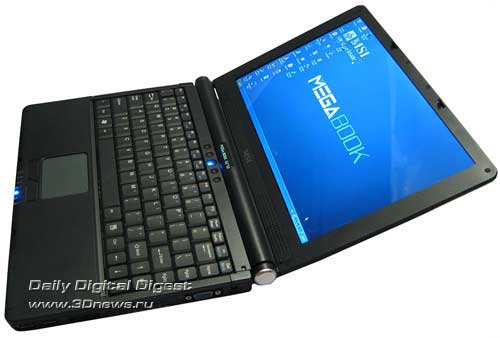
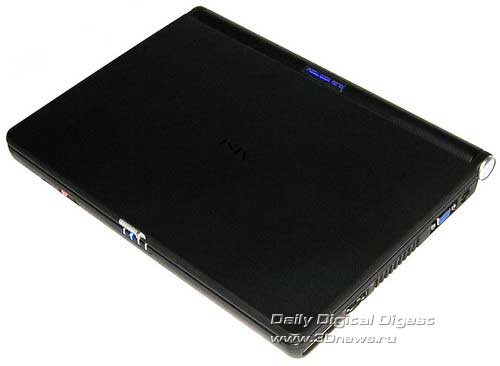
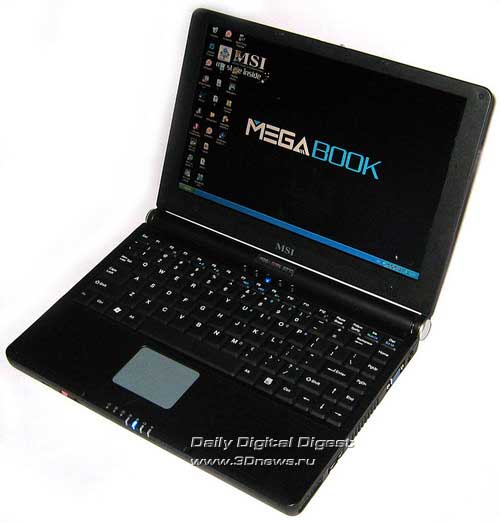
Except some decorative components, the housing both inside and outside is self-colored. It is made of black matt plastic, although the manufacturer offers a different make of the notebook - with white housing. The latter is most likely to appeal to ladies - the S270 version is light enough and very compact. A computer like that will be a perfect machine that the user will carry anywhere all the time - be it a far travel or just a journey around the town.
We can't say the design of the laptop is eye-catching or pretentious - all is too strict at that. But anyway the notebook looks a bit simplish, unlike the ideal of the classical strict black style seen in IBM notebooks.
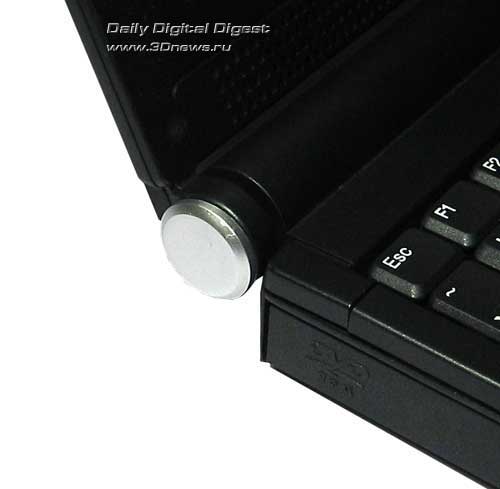
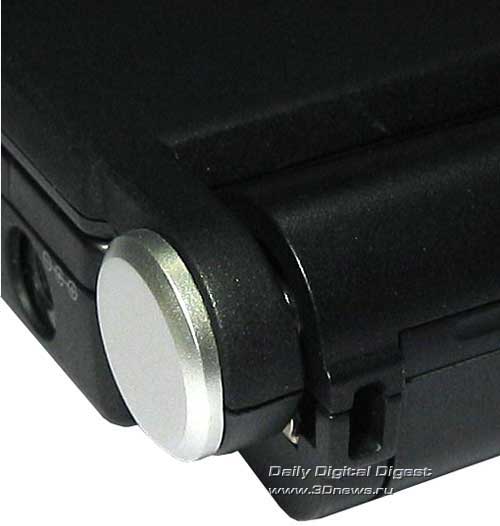
On the lid of the notebook in the center, there is a company logo, with the lid itself fastened to the cylindrical part of the housing with two hinges. On the ends of the pivot pin there are silvery tip washers.
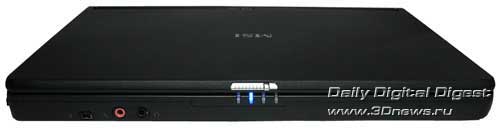
The lid is closed with a traditional movable latch located in the center of the front panel. When in the closed state, the lid is linked reliably in two places with movable hinges. There is almost no gap between the lid and the housing.
Besides, on the front panel there are audio connectors for a 3.5 mm minijack to plug in a microphone, as well as headphones or external audio system. Beside then, there is an IEEE1394 interface.
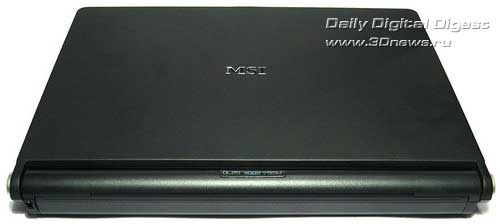
Because of the removable battery, the rear face has no connectors or interfaces, except the jack for plugging in a Kensington security lock located near one of the display hinges.
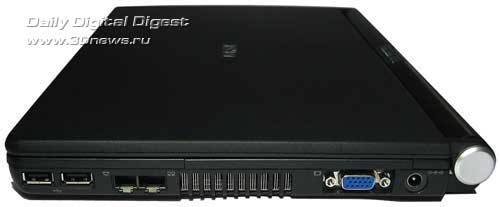
The right-hand board near the front edge is equipped with two consecutive USB2.0 ports behind which there is a couple of communication interfaces to plug the notebook to the LAN or telephone line. Near the rear edge, behind the vent holes, there is the D-Sub interface to plug the computer to an external monitor, as well as a connector to plug in a power supply adapter.
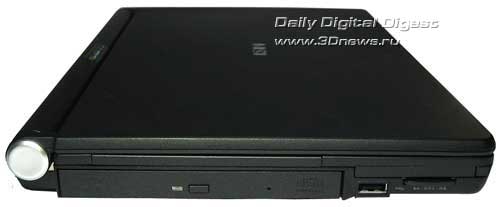
Except the only USB 2.0 port, the left-hand side is fully left for reading devices and expansions - an optical drive, a card reader, and a PCMCIA 2.1 adapter.
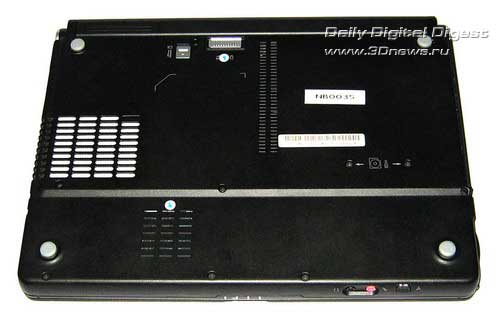
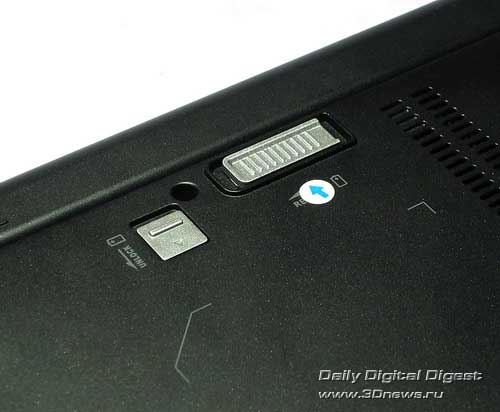
The bottom side looks somehow unusual. The thing is that here you can't see traditional compartment lids to access various devices. Such an approach to the independent upgrade is not clear enough, and can't be to the advantage.
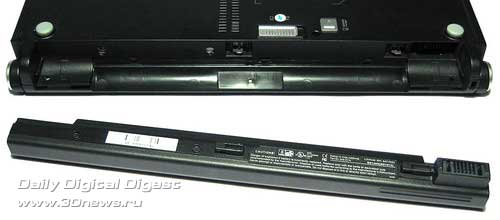
The battery deserves a special mention. It is fastened in a traditional way - with a latch key and a blocking movable key.
It looks unusual indeed. The semi-cylindrical small "stick" does not look like a battery at all.
Nevertheless, its capacity is 2200 mA*hr, which is not much at all but not critically little. But the notebook comes bundled with one more battery of 4400 mA*hr capacity, which failed to arrive to our tests.
On the whole, the package bundle is not bad at all, although the closely spaced USB ports as well as the too close proximity of the third YSB port to the optical drive and the card reader can't be regarded as an advantage.
Interior
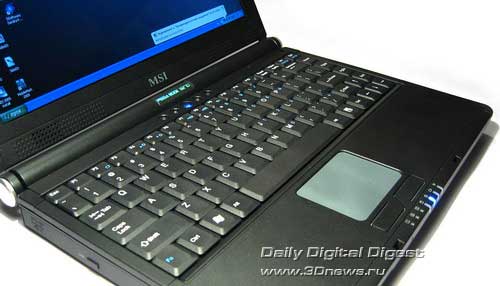
Like on the exterior, black color prevails under the notebook lid. Even the keyboard is made in the same tone with color of the device housing. The keyboard offers good convenience of work - every key is of good tactile feedback and is well positioned on the upper part of the housing. Owing to that, there is enough space under the wrist.
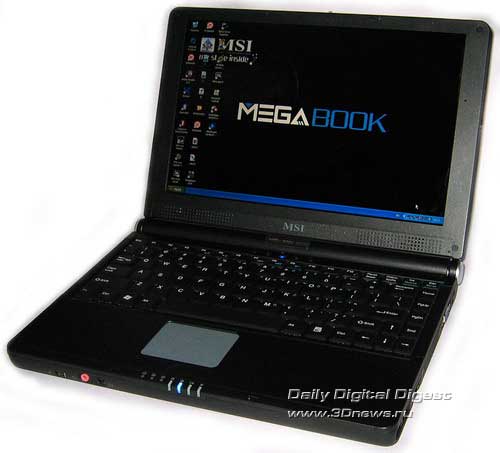
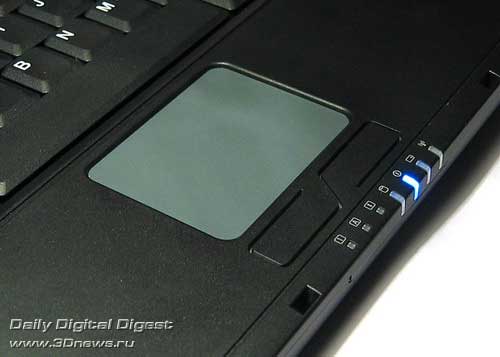
The touchpad is quite classical, slightly shifted to the left. But the buttons are not ordinary. They are of a peculiar shape which hard to describe in words - better look at the photo.
Unfortunately, the buttons are too narrow, so some time needs to pass before you feel the comfort of handling them. At the start, the fingers touch the panel with seven operation indicators and not the buttons. Interestingly, three of them are really small - they are seen only with the lid open (Caps Lock, Num Lock, and Scroll Lock), and four are made to look out into the front panel, so are seen only with the lid closed (these are power indicators, battery indicators, and those indicating activity of the HDD and Wi-Fi).
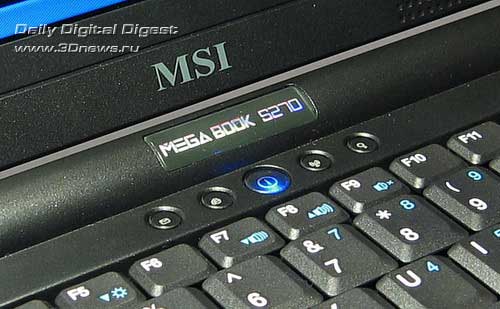
Above the keyboard, symmetrically to the center there are five round control buttons, and the central one (Power) is not only of larger size but is illuminated with bright blue backlight. The display of the notebook has a wide enough framing, with plastic grids of integrated speakers positioned in the bottom part.
On the whole, the design of the novelty, positioning of the main controls, as well as the manufacturing quality of all the components deserve a high enough assessment.
Next
 |
Content: |
 |
|
|
Top Stories: |
|
 |
|
MoBo:
|
|
|
|
VGA Card:
|
|
|
|
CPU & Memory:
|
|
|