abit I-N73HD and MSI P6NGM (NVIDIA GeForce 71хх)
Author:
Date: 15.05.2008
|
|
BIOS
The BIOS of abit I-N73HD is based on the Award BIOS Phoenix version, with the BIOS of MSI P6NGM based on the AMI BIOS version.
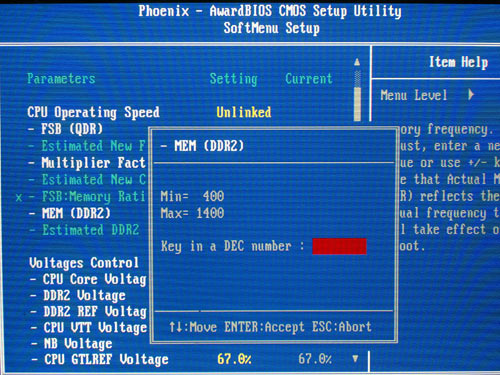
In the respective subsection, the user can install the required memory latency timings:
By the way, the frequency of the memory can be set both automatically and manually. One of the advantages of NVIDIA chipsets is in that the memory frequency does not depend on the FSB speed.
Now look at the system monitoring section. In this regard, the capabilities of the abit board are much wider: the board is able detecting more temperatures, keeping track of the speed of a greater number of fans, and the FanEQ is more advanced than the standard SmartFAN in the MSI board.
System monitoring of the MSI board:
Besides, the boards allow the user to leverage all the technologies implemented in Intel's latest processors. At that, the abit board takes a lead:
Finally, we note the feature for controlling the memory capacity allocated for the needs of the graphic core:
In the BIOS of the MSI board, there is the respective option, however in this version of the firmware you can't change its value.
Overclocking and stability
The PWM of abit I-N73HD is implemented following a 4-line scheme in which there are for 680 mkF, two 820 mkF, and five 1000 mkF capacitors. The power converter of MSI P6NGM has a 3-line scheme; used are eight 680 mkF and three 1000 mkF capacitors.
Now on to the overclocking features.
| Board |
abit I-N73HD |
MSI P6NGM |
| Multiplier adjustment |
+ |
+ |
| FSB adjustment |
within 100 MHz to 625 MHz (1 MHz) |
within 100 MHz to 625 MHz (1 MHz) |
| Vcore adjustment |
within 1.3375 to 1.715 V (0.025 V) |
- |
| Vmem adjustment |
within 1.8V to 2.5 V (0.05-0.1V) |
within 1.8 to 2 V (0.02 V) |
| Vdd adjustment |
within 1.36 V to 1.87 V (0.04~0.08V) |
- |
| Vpcix adjustment |
- |
- |
| Vtt adjustment |
within 1.2 V to 1.58V (0.03~0.08V) |
- |
| PCI-E adjustment |
- |
- within 100 MHz to 200 MHz (1 MHz) |
We note the specific traits of the motherboards at overclocking. Above all, in case of unsuccessful setting of the parameters the boards hang up deadly and have no mode of the "emergency" start-up with the nominal settings. That is rather strange because the chipsets of the GeForce series support this feature.
Another special trait of NVIDIA chipsets is implemented on both the motherboards. Namely, the memory frequency can be set both dependent and independent of the FSB speed:
Now let's look at the practical results of overclocking. The maximum stable FSB speed for the abit board is 390 MHz, and for the MSI board - 400 MHz:
In fact, the more powerful overclocking tools of the abit board don't work since we produced the worse result than that on the MSI board. In fact, the FSB=390 MHz can be regarded as quite good a result because it is higher than the result for Gigabyte 73UM-S2H and 73PVM-S2H (although for the half year engineers at Gigabyte must have optimized the BIOS and raised the overclocking capability of these products).
Coming back to abit I-N73HD and MSI P6NGM, we note that none of them allows adjusting the frequency of the integrated video core.
 |
Content: |
 |
|
|
Top Stories: |
|
 |
|
MoBo:
|
|
|
|
VGA Card:
|
|
|
|
CPU & Memory:
|
|
|