ASUS Maximus Formula Special Edition (Intel X38)
Author:
Date: 16.12.2007
|
|
Performance tests
When determining the starting FSB speed, it turned out that the board overstated it by as much as 1.3 MHz.
In our test setup, we used the following hardware:
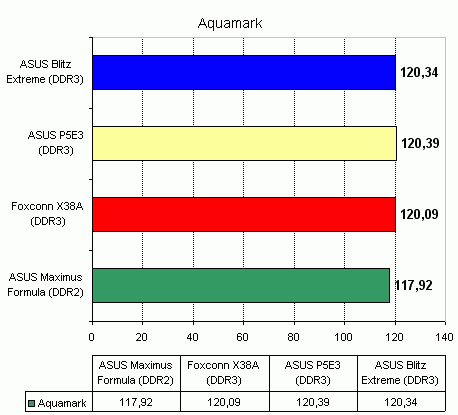
Let's first take a look at the results of synthetic benchmarks.
Now on to the gaming benchmarks.
Final Words
ASUS Maximus Formula is another model of the Republic of Gamers series, one of the best. Products of this series are aimed solely at computer enthusiasts willing to spend more for various proprietary technologies by ASUS. At the same time, the quality of the boards are at the highest level, which makes it possible to recommend this series also for users who prefer high operational stability (for this category of users, ASUS offers motherboards of the Professional series). The only "scabbed sheep" in the herd of the Republic of Gamers was the Commando (P965) motherboard which cost $100 more than ASUS P5B Deluxe WiFi, and instead of the powerful expansion options it offered a lot of blinking LEDs.
The next generation of Republic of Gamers was represented by the two Blitz models: one with support for DDR2 (Formula), with the other one - for DDR3 (Extreme). Again, these two boards cost more than their rivals (among the other ASUS boards), although the difference is merely ~$30. But at the same time, along with the LEDs, the user got a number of unique features and capabilities inaccessible to users of other motherboards. In particular, that is an integrated system of water-powered cooling of the chipset (the water block on the north bridge). Secondly, the extended ranges of voltage adjustment, with a more precise increment. Thirdly, it is the Crosslinx technology which provides a symmetrical distribution of PCI Express bus lanes between the two video cards (owing to the additional video chip). Fourthly, the 2-phase power converter for the power supply of the memory. Therefore, we absolutely safely recommended these boards for purchase (to be more precise, only one which supports DDR2).
Finally, we now move on to Republic of Gamers based on X38. While developing motherboards of the Maximus series, engineers at ASUS used the most recent developments (e.g., the 2-phase power converter for memory modules), and some others even managed to improve (the water block is combined with a really massive radiator). Therefore, the board almost has no shortcomings (except the package bundle) and even the price is at quite an acceptable level.
Now, regarding the price. Due to the novelty and high cost ($50) of the X38 chipset, motherboards by almost all of the manufacturers are priced at about $300. In the end, ASUS Maximus Formula (SE) motherboards priced at 300 - 320 USD look quite attractive. And we recommend just the Special Edition version with the integrated water block, since the massive radiator on the chipset provides a superb cooling level even without a water-powered cooling system. And that will let overclock the system immediately after purchasing the board. Then you can choose the right water-powered cooling system without haste and overclock the board to the full.
In conclusion, we note that the marketing people at ASUS have ceased pulling the users by the leg: now motherboards with powerful expansion options cost higher. These are primarily the models Maximus Extreme (with three PCI Express x16 slots) and P5E3 Deluxe/WiFi-AP (3? PCI-E x16 + support for WiFi) that cost about 350 - 400 USD. Since these two boards support solely the DDR3 memory, they can be of interest to well-off users only. The most balanced and affordable of ASUS boards is the ASUS Maximus Formula (Special Edition) model.
Conclusion
Pros:
- high stability and performance;
- 8-phase CPU power scheme;
- 2-phase memory power scheme;
- two PCI Express x16 v2.0 slots;
- support for SerialATA II/RAID ( 6 lines; ICH9R);
- support for one P-ATA link (JMB363);
- two LAN controllers (Gigabit Ethernet);
- support for USB2.0 (12 ports) and IEEE-1394 (Firewire, 2 ports);
- a wide selection of ASUS' proprietary technologies (PC Probe II, EZ Flash 2, CrashFree BIOS 3, MyLogo2, Q-Fan 2, etc.);
- additional set of AI Proactive technologies (AI Overclock, OC Profile, AI Net 2, etc.);
- fluid passive/active system for cooling the chipset and the power supply module;
- Power and Reset buttons;
- reasonable price.
Cons:
- the package bundle does not match the high-end level of the product;
- flaws in the overclocking part.
The board's specific features:
- 8-channel audio subsystem is on the SupremeFX II board;
- on the rear panel, there are six USB 2.0 ports and a button to clear the CMOS; no LPT and COM ports, no PS/2 for the mouse;
- Discuss the material in a conference
 |
Content: |
 |
|
|
Top Stories: |
|
 |
|
MoBo:
|
|
|
|
VGA Card:
|
|
|
|
CPU & Memory:
|
|
|