ASUS P5E3 and MSI X38 Platinum (Intel X38)
Author:
Date: 05.12.2007 |
|
BIOS
The BIOS of both the motherboards is based on the AMI BIOS version.
The section in charge of memory operation settings looks like this:
The next important parameter that affects the performance is setting the memory operating frequency.
Now look at the system monitoring section.
Both the motherboards display the current temperatures of the CPU and the system, and offer the feature for adjusting the rotational speed of the CPU cooler as well as additional fans, depending on the CPU and system temperatures.
Both the motherboards are able retaining and loading BIOS settings as profiles.
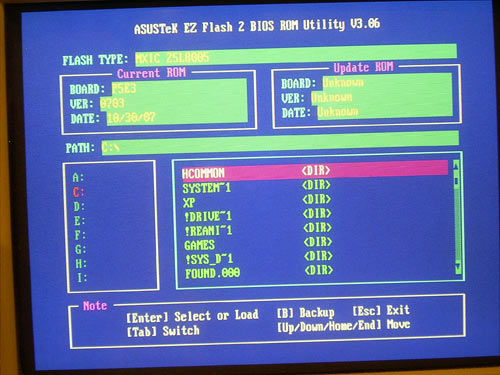
To handle the BIOS, the ASUS motherboard offers the integrated EZFlash 2 utility:
We also note the feature for displaying the BIOS settings in multiple languages, and a section to control the functions of Intel processors:
Overclocking and stability
Before we move on to overclocking, let's look at the power converters. The PWM of the ASUS board offers a 8-phase scheme in which there are eleven 561 mkF capacitors. The PWM of the MSI board uses a 8-phase power scheme, in which there are eleven 820 mkF and two 470 mkF capacitors.
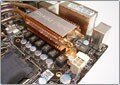
On the ASUS motherboard, all the PWM components are equipped with radiators, with only half of these on the MSI board. Besides, the user of ASUS P5E3 can raise the cooling efficiency through installation of an additional fan (available in the package bundle):
Now on to the overclocking features. On the ASUS motherboard, all the relevant features are gathered in the "Ai Tweaker" section,
an on the MSI board - in the "Cell Menu" section.
| Board |
ASUS P5E3 |
MSI X38 Platinum |
| Multiplier adjustment |
+ |
+ |
| FSB adjustment |
within 200 MHz to 800 MHz (1) |
within 200 MHz to 800 MHz (1) |
| Vcore adjustment |
within 0.85 to 1.7 V (0.00625 V) |
within 0 to +0.75 V (0.0125 V) |
| Vmem adjustment |
within 1.5 to 2.3 V (0.02 V) |
within 1.5 to 2.75 V (0.08 V) |
| Vdd adjustment |
within 1.25 to 1.75 V (0.02 V) |
within 1.25 to 1.83 V (0.08 V) |
| Vsb adjustment |
1.05 V; 1.2 V |
within 1.5 to 1.8 V (0.06 V) |
| Vtt adjustment |
within 1.2 to 1.5 V (0.02 V) |
within 1.2V to 1.44V (0.04-0.05V) |
| PCI-E adjustment |
within 90 MHz to 150 MHz (1) |
within 100 MHz to 200 MHz (1) |
We note the following traits of the motherboards at overclocking. First, programmers at ASUS and MSI have added the feature for highlighting the parameters exceeding the range of safe overclocking (in their opinion) with different colors. Also, the ASUS board lacks the ASUS NOS (Non-Delay Overclocking System) technology which used to be implemented on almost all the previous models by this manufacturer. A similar feature is implemented on the MSI motherboard and is named D.O.T. It allows overclocking the system by ~73%.
Now let's look at the practical results of overclocking. The maximum stable FSB speed in the ASUS board is 536 MHz; that for the MSI board - 444 MHz.
We should note that motherboards based on X38 are rather reluctant to overclock. This is seen from the fact that attempts to raise voltage on the north bridge result in the impossibility to start the system at even relatively low and stable frequencies. Besides, attempts to adjust the memory frequency also affect the overclocking negatively. In the previous motherboards based on X38 (these are the Foxconn and Gigabyte models), we also came across the same problems. Here we make a preliminary conclusion that Intel has somehow overcomplicated things with the X38 chipset, and the current stepping of this chipset is not meant for serious overclocking.
On the other hand, we can look differently at this situation. See for yourselves: the ASUS motherboard overcame the FSB = 533 MHz without raising voltage on the north bridge and the FSB. Only motherboards based on P35 could boast such results. That may mean that the overclocking capability of X38 is higher than that for P35; it's simply because the manufacturers have not yet learned how to "cook it right". Therefore, we can expect that in two-three months the engineers will polish the BIOS, and X38-based motherboards will take a lead over the competitors. However, it must not be ruled out that to produce higher results the manufacturers will have to produce new revisions of their motherboards.
 |
Content: |
 |
|
|
Top Stories: |
|
 |
|
MoBo:
|
|
|
|
VGA Card:
|
|
|
|
CPU & Memory:
|
|
|