ASUS P5E64 WS Professional vs. MSI X48 Platinum
Author:
Date: 27.02.2008 |
|
Performance tests
When determining the starting FSB speed, it turned out that MSI X48 Platinum overstated it by 1.5 MHz.
In our test setup, we used the following hardware:
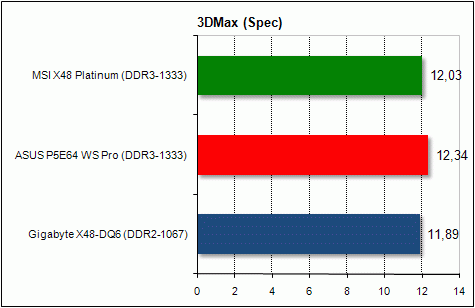
Let's first take a look at the results of synthetic benchmarks.
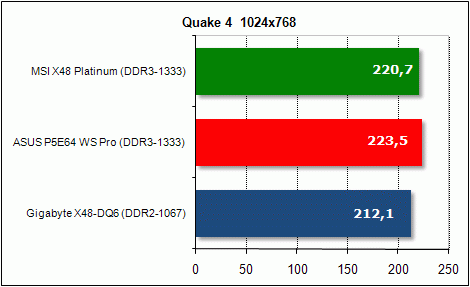
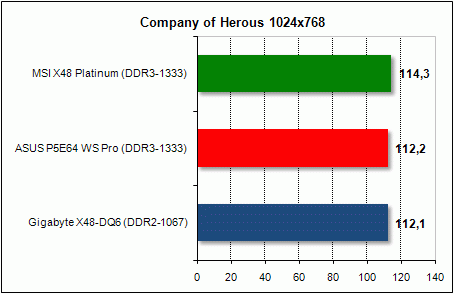
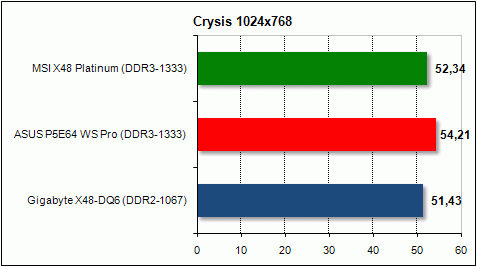
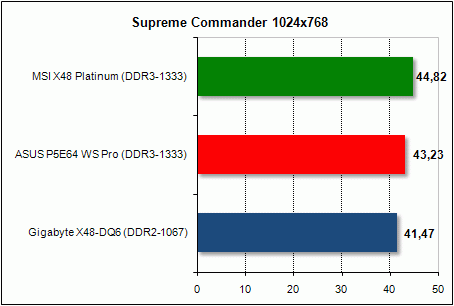
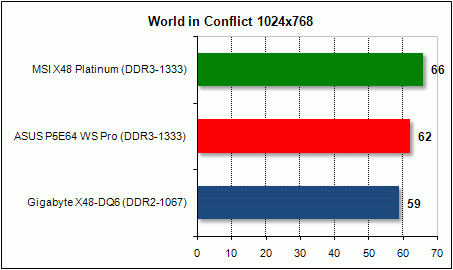
Now on to the gaming benchmarks.
Tests of application software.
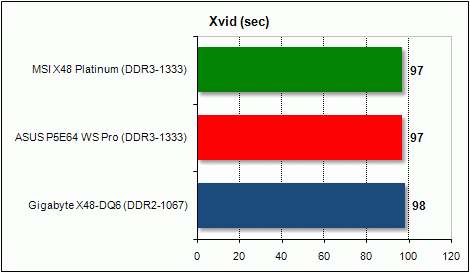
Video encoding (DivX, Xvid) was measured in seconds, i.e. the less the better.
Data compression (WinRAR) was measured in MB/sec, i.e. the more, the better.
Final Words
Summing it up, we note the most important point: the functionality and specifications of both the boards are practically similar, and we were unable to choose the best. In particular, the expansion options are identical: each of the boards offer four PCI Express x16 slots, two Gigabit Ethernet controllers, and support the Firewire bus. The only substantial difference is in that the ASUS' board supports ten (!) SerialATA II link, whereas the MSI board - eight links. In terms of overclocking, both the boards demonstrated a stable operation at FSB > 550 MHz, which shows their high quality.
In fact, if we recap all the differences, then the ASUS' board takes a minor lead: the package bundle is a bit better, a bit richer BIOS settings, with the overclocking results 10 MHz higher. On the other hand, the MSI's board is based on the "fresher" X48 chipset, whereas X38 on the ASUS' board. But there is no fundamental difference at real operation between these two boards.
As a result, with equal confidence we can recommend any of these boards for purchase. However, we note one point: ASUS P5E64 WS Professional and MSI X48 Platinum operate only with the rather expensive DDR3 memory whose retail price completely destroys all the advantages of these products. In fact, extra 200-300 dollars for professional users is not a fortune paid for the chance to fit four video cards within a single system.
By the way, prices for DDR3 modules have gone down essentially these days. In particular, 1 GB PC3-8500 (1066 MHz) can already be made available at ~$140, PC3-10667 (1333 MHz) - at ~$190, and PC3-12800 (1600 MHz) - at ~$270. Moreover, first PC3-14380 (1800 MHz) modules have hit the retail. And ASUS P5E64 WS Professional does support them. Needless to say, the prices for DDR3 relative to DDR2 are still very high. In particular, a single 1 GB DDR2-PC6400 module costs about $40. But this trend inspires some optimism regarding the future of DDR3 and increases the urgency of motherboards with support for this type of memory.
ASUS P5E64 WS Professional vs. MSI X48 Platinum
Conclusion
Pros:
- high stability and good performance level;
- four PCI Express x16 slots;
- support for SerialATA II /RAID ( 10 links; ICH9R + 88SE6145);
- support for one P-ATA link (Marvell 88SE6145);
- Integrated 8-channel audio and two LAN (Gigabit Ethernet) controllers;
- support for USB2.0 (12 ports) and IEEE-1394 (Firewire; 2 ports);
- passive system for cooling the chipset and the power supply module;
- wide selection of ASUS' proprietary technologies (PC Probe II, EZ Flash 2, CrashFree BIOS 3, MyLogo2, Q-Fan 2, etc.);
- additional set of AI Proactive technologies (AI Overclock, OC Profile, AI Net 2, etc.);
- diagnostic POST-module (+ buttons to power-on and reset).
Cons:
The board's specific features:
- excellent results of overclocking the CPU and the memory.
|
Pros:
- high stability and good performance level;
- four PCI Express x16 slots;
- support for SerialATA II/RAID ( 8 links; ICH9R + Sil 5723);
- support for one P-ATA line (Marvell 88SE6111);
- Integrated 8-channel audio and two LAN (Gigabit Ethernet) controllers;
- support for USB2.0 (12 ports) and IEEE-1394 (Firewire; 2 ports);
- passive system for cooling the chipset and the power supply module;
- wide selection of MSI's proprietary utilities (POST diagnostics, D.O.T., BIOS profiles, etc.);
- integrated POST-diagnostic module;
- Power-on, Reset, and Clear CMOS buttons;
Cons:
The board's specific features:
- excellent results of overclocking the CPU and the memory.
|
- Discuss the material in the conference
 |
Content: |
 |
|
|
Top Stories: |
|
 |
|
MoBo:
|
|
|
|
VGA Card:
|
|
|
|
CPU & Memory:
|
|
|