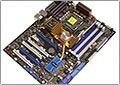
ASUS Striker II NSE (NVIDIA nForce 790i SLI)
Author:
Date: 13.06.2008
|
|
BIOS
The BIOS of ASUS Striker II NSE is based on the Award BIOS Phoenix version.
The extended pack of memory settings is in the "Extreme Tweaker/Memory Timing Settings" section:
The parameter in charge of selecting the memory operating frequency is in the section dealing with overclocking settings:
The frequency values are displayed in the quadruple form. By the way, the user does not have to rack brains but simply choose the required memory frequency multiplier (in the Linked mode):
Now move on to the section to do with the system monitoring.
This section is really powerful. First, the board is able monitoring the current temperature of the CPU and the system, the temperature of the chipset (both on the north and south bridges) as well as three temperatures from additional thermal sensors. The user gets the unique opportunity to keep track of the temperature of any system components within reach of these sensors (the sensors are available in the package bundle).
Secondly, the board monitors all whatever voltages of the system:
Thirdly, the board monitors the speed of all the eight(!) fans which can be plugged in,
and controls their speed (except the PWR_FAN) using the Q-Fan feature:
We also add that you can do the system monitoring from within Windows with the PC Probe2 utility.
It should be noted that the user gets access to all the technologies supported by modern processors,
as well as displays the BIOS settings in multiple languages:
Another point to note is the support for the MyLogo 3, a feature for changing the boot-up image (POST-screen), as well as the CrashFree BIOS 2, which allows restoring the damaged BIOS firmware using the image on a diskette, flash disk, or a CD (note that the first Striker supports the more advanced Crashfree BIOS 3 which allows restoring the firmware via a flash drive as well).
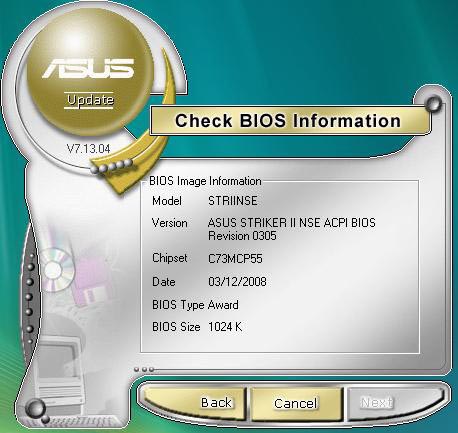
The BIOS version can be updated in a number of ways. First, make use of the AWDFLASH (DOS) and ASUS Update (Windows) utilities, and in the latter case the POST image can be recorded into the BIOS with the ASUS MyLogo 3 feature.
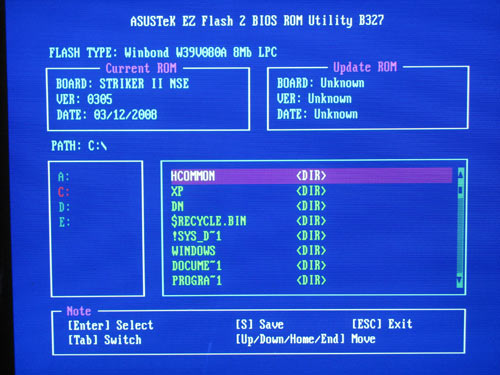
The user can resort to the EZ Flash 2 utility integrated into the BIOS.
We note support for the power-saving technology EPU. The software part is represented by a pack of respective utilities, and the hardware part - with a chip near the CPU connector:
We'll be talking about the efficiency of technologies by various manufacturers later, once we get the hardware required for tests.
In conclusion, we note the OC Profile technology which allows saving all the BIOS settings into memory and loading them on demand.
 |
Content: |
 |
|
|
Top Stories: |
|
 |
|
MoBo:
|
|
|
|
VGA Card:
|
|
|
|
CPU & Memory:
|
|
|