3DNews Vendor Reference English Resource -
All you need to know about your products!
Digital-Daily.com
Digital-Daily

GeForce4 MX ASUS V9180 video card

Date: 12/02/2003


By: Dmitry Zinovyev

ASUS V9180 (NV17, AGP8x)
Chipset NV17 (GF4 MX440-8x)
GPU Speed 300MHz
Memory 567MHz DDR; 64 Mb;
TV Out Yes, integrated in the chip
TV-In yes, based on Philips SAA7114H
Monitor output 2xDVI
Two monitors Yes, nView
Specific features AGP8x
SmartDoctor II - card condition monitoring
TV In/Out block
Price: $140 (PriceWatch.com)

Things with video cards used to be going much better a few years ago. When assembling a computer you didn't have much choice, and all what mattered was the difference in 2D quality. Most computers were equipped with S3Trio64V+ cards having 1 MB onboard that filled the then market. Those who had monitors better than Samsung3ne could enjoy "Windows accelerators" by Matrox which were promoted under the Millenium trademark and enhanced with 4 or even 8(!) MB memory onboard, incredible capacity for that time. No, we don't mean to say the choice was exhausted, but the mentioned cards were real hits. Want crystal-clear image? Here you are - fork out for a Matrox. Want to save? There it is, - a cheap S3 card especially for you.

Many users are still buying computers not for super-cool wired games or drawing smashing 3D animations, but for running regular office applications like MsOffice and 1C. On the other hand, value solutions are also in demand among those into playing games but still are short of budget to buy a quality graphics accelerator. Nowadays, absolutely every company, a player on the video market, does offer low-end value solutions. What is more, it's just the budget offerings which sell in greater quantities and at better quality. Today we'll be looking into video cards based on the nVidia NV17 chips.

The chip

Since its inception, it's been a fashion for NVidia to produce "cut-down" cards, but up to the GeForce3 line that very "cut-down" way was noticeable from the performance and declared specifications only. Today, by a "cut-down card" I am defining the cards whose potentials were intentionally reduced to save production costs and thus push the retail prices down. The MX series was launched at the times of the GeForce2 line which was much slower than the higher-end brother, but didn't differ in functionality in so striking way. With the advent of GeForce3 supporting the 1.1 shaders things changed, and the gap of functional differences between the higher-end NVidia chip and the lower-end brother turned wider. It was not until the release of GeForce 4 Ti when the MX series was updated, so GeForce 4 MX emerged on the market. It would seem the GeForce 4 MX could eliminate the functionality gap (support for shaders missing) although leaving some performance gap. But no miracle occurred, and we saw practically the same GeForce2MX with slightly improved performance.

That is, GeForce4MX-based video cards are becoming increasingly uninviting for modern games where state-of-the-art technologies are used more extensively. That's why at the very start of this review I mentioned office applications, since the GeForce4MX is no longer a card for new-generation games to be released in the near future. Nevertheless, modern games run not bad at all at these chips, but we'll talk of it a bit later.

Note that the new NV17 chip also supports AGP8x still loudly hyped on the retail boxes and whose principles were discussed in our previous reviews. Let me point out that the performance boost gained from using AGP8x in the higher-end powerful chips like Ti4400 and ATI R300 is questionable, - it seems to be no more than a tribute to fashion.

The video card

Again, one more ASUS product found itself on our surgical table. The card proved to be of high quality and with a good package bundle, albeit showing no visual differences from the Reference design, but - talk about it later.


As always, let's start with examining the package. Asus strictly follows its rules, and a whole new series of cards is made with the same design - a big eye straight in the center of the box. Compared with the 9280, only the color spectrum has been changed.


Amusing enough, but the box dimensions as well as the inner plastic housing proved to be absolutely identical to that of the higher-end version, AsusV9280S. Moreover, these cards are fairly alike in the package bundle, so the unsophisticated used might be misled much. In computer shops I have so many times heard this question "Well, why does this card is $100 as expensive while they both are packed and look identically?.." Many choose their video card by the box look-and-feel, some follow the marketing. But... it's time we got down to our card.


There are few differences from the higher-end version. The documentation is the same, but the copy we got describes the AsusV8460. Upon a closer look at the screenshots and the captions, you see the documentation is almost useless, albeit in the Russian translation. For instance, the Devices window shows V2740 based on the Intel740 and during the driver installation it suggests installing RivaTnT2 Model 64. Let me point out straight off - the card does support TV inout, so the bundle has it all to operate Video.


As you can see, the card is again bundled with a smart module to arrange the TV ViVo that comes with a small piece of double-sided sticker which is handy enough for placing it on the CPU unit. There is an adapter to connect D-Sub monitors to the DVI sockets, but I wish they were two. Anyway, talk about it later.

The bundled software:

  • A drivers CD (WDM Capture Driver, Twain Driver, Tweak Utility, SmartDoctor, VideoSecurity, DigitalVCR, VR Viewer, etc)
  • AsusDVD (a software-driven DVD player)
  • MediaShow SE 2.0 (a software suite to prepare presentations)
  • PowerDirector 2.1 ME (a software suite for video editing)
  • Ghost Recon (a game, full version)
  • Black Thorn (a game, full version)
  • Worms Blast (a game, full version)
  • Battle Realms (a game, demo version)
  • IL2 Sturmovik (a game, demo version)

What makes the V9180 different from the V9280S in terms of the bundled software is the lack of the "Virtual Aquarium". The package bundle is extraordinarily rich for a value card. I think it is aimed at the Western consumer who is used to counting every dime and thinks a third-party software kit is a must. Now it's time we looked at the card itself.


As I have already mentioned, the card fully complies with NVidia's NV17 reference design, shows 300MHz of the chip clock speed and 283MHz (DDR567 MHz) on the memory. Amusing enough, but the card has a component even not of the most top-end cards boast - the two DVI connectors to plug in LCD panels. That's why I mentioned the lack of the second adapter - you won't get by without it when plugging two analogous monitors. On the rear panel, there is a connector to plug in a TV splitter.


The chip, of stepping A2, was produced in Taiwan early in September 2002. The chip has a "AGP8x support" mark, similar to that on MX440-8X.


The BGA form-factor memory is made by Samsung and is marked as K4D26323RA-GC33 and, as per the manufacturer's information, features 3.3 ns access time, which is equivalent to 300 MHz. The modules are produced in Korea.

Cooling system

The cooler on top of the chip is large enough and quite good from the technical viewpoint. It does its job quite fine and is designed to control the rotational speed. It's really annoying that memory cooling is missing completely, but if necessary you can solve this problem through installing a third-party memory cooler. This is useful if you either intend to overclock the card or whenever the card needs to be kept cooled when running 3D applications for much longer time. It's worth noting the lack of cooling in the card running under heavy 3D loads results in unstable operation (some artifacts typical of the excessive memory overclocking might come up). The thermopaste between the radiator and the chip is of fairly good quality.

TV ViVo

The TV-Out support is natively implemented in the NV17 chip, so no additional chips are required for the card. But to implement the TV-In, you anyway have got to use external chips. In this case, the TV-In is arranged with the Philips SAA7114H chip:


While testing the TV-In on NVidia cards, we earnestly lamented about the WDM drivers for these chips - it seems like who wrote them either had a poor idea of the field or was a rookie programmer. Not displaying the TV-Standard (PAL, NTSC, SECAM) selection dialog into the Control Panel is a really annoying bug. After that you won't be able to use a third-party program for recording video files that runs via the standard WDM interface, e.g. Microsoft VidCap32.

So there is no other option left than resort to the dubious native ASUS VideoVCR software which seemed to have been made by the guy who had written the WDM driver. Every time you start the program, you have to practice witchcraft rituals to make it work. This time it was a bit easier to make it work than with AsusV9280S. No Wizard is needed for that, and in the Video Source tab of the program Setup it suffices to change the Video Standard into the currently used. The recoding quality is really good, and nothing to complain.

By the way, at the NV30 presentation the same TV-In chip was used in the GeForceFX specimen as the one in this review. It means the video output in the NV30 is also integrated into the chip, and the quality of the Video input remains at the same level. As for the TV-Out: generally, it works fine since it was not spoiled by the hands of programmers developing the Asus VideoVCR, but there is one thing almost unobvious to most users. As I mentioned earlier, there are two DVI-outs on the card, but one of the DVI outputs is shared with the TV-Out. So if you plug the monitor connector into the DVI socket closest to the motherboard, you won't be able to make use of the TV-Out at all. Plug the monitor connector into another DVI and all will be OK. The thing is that all GeForce 4 cards have two RAMDACs, one of them being the main to which the first monitor is connected, and the second monitor is connected to any of the outputs (DVI, D-Sub, TV-Out), in so doing you can use no more than two devices simultaneously. The TV-Out supports resolutions up to 1024x768.

Self-diagnostics: SmartDoctor

The card comes bundled with Asus SmartDoctor 2 that is used for real-time monitoring. Of note is the fact the more expensive and powerful Asus9280S lacked the monitoring tool, while with this card it is there in full. This function used to be provided by Asus for the higher-end Deluxe models. The program allows monitoring the GPU cooler rotational speed as well as the AGP voltage, memory & graphics core temperature. The program also has a utility for overclocking the card, which comes in handy.


Nevertheless, flaws were found even in here. The program sometimes loses track of the card and pops up messages like "no voltage on the AGP bus" or something like all failed :) but in a second all breaks even. Sometimes this problem last longer, in this case it is solved through re-booting the SmartDoctor.

Benchmarks

To test the performance of the AsusV9180 video card based on the MX440 AGP 8x chip, we assembled the two testing systems:

Testing system No. 1 (Hi-End ):

  • Processor Intel Pentium 4 2.8 GHz;
  • Motherboard - Intel 850EMV (i850E, 512 Mb RDRAM PC800), AGP 4x);
  • Sound card Creative Sound Blaster Audigy;
  • HDD Seagate Barracuda ATA IV 7200 rpm.

Testing system No 2 (Mid-Range):

We tested the card's performance in the following benchmarks and applications:

  • Return to Castle Wolfenstein  - Checkpoint demo (OpenGL, Quake 3 core);
  • Unreal Tournament 2003 Demo (Direct3D stress test benchmark);
  • DooM III E3 Demo (extremely resource-hungry overkill benchmark with shaders, bump-mapping, OpenGL and lots of other stuff to be topical by the end of 2003);
  • 3DMark 2001SE (synthetic Direct3D benchmark)

Unfortunately, we were unable to compare its performance in Codecreatures demo - the GeForce 4 MX won't support shaders and that's it.

As I already said, there was nothing to complain about the 2D quality during the tests. At high resolutions with the refresh rate 85 Hz, the 2D quality was on par with that of the whole GeForce4Ti line, i.e. a bit above the average.

3DMark 2001SE

On the one hand, this benchmark is the most impartial since the accelerator is tested throughout the whole range of 3D applications, and the results are made of data received from numerous sub-benchmarks. But this has a reverse side since the result is affected by those sub-benchmarks that were unable to start at GeForce 4 MX series simply because it doesn't support them. During the tests it was impossible to use the Nature scene because allegedly that benchmark isn't quite adequate. Nevertheless:


As is seen from the graph, at low resolutions the card showed pretty poor performance as compared with GeForce 3 as well as the new SiS Xabre 600 chip. Anyway, at higher resolutions things changed and the MX440-8x showed a much narrower performance gap as compared with GeForce 3. What is more, the card performed even better than Xabre 600. As you can see, it's still a long way to go to reach the performance levels of lower-end NVidia's GeForce 4 Ti4200.


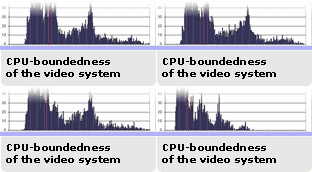
This graph is meant to assess the processor dependence of the card. At low resolutions the gap is wide enough, but as we go up the resolutions scale the less the difference is and becomes almost identical at high resolutions. It means if the card is subject to heavy loads the result won't strongly depend on the processor, but at lower loads the results gap will be more vivid.

Return to Castle Wolfenstein

Albeit an OpenGL benchmark, the RTCW can't be regarded as a complex test suite. It has little of geometry and lightmaps, anyway it is a good chance to display the FPS ranking of the card.


Albeit the GeForce 4 MX440 performance is not identical to that for GeForce 3, it is at least comparable within the wide range from low up to highest resolutions. The Xabre 600 doesn't stand out although it is generally faster than GeForce 3, not to mention the low resolution. But that the results are identical at the 640x480 resolutions at all the NVidia chips can only be explained by the processor dependence, i.e. the load upon the video is not a strong point of this test. This is what was confirmed by the following graph:


The situation is very similar to the 3DMark, but the gap is much wider. Moreover, the MX440 installed on the AMD-based test system takes up full processor resources at the first two resolutions (three, no data for 800x600 is given, but it is identical and doesn't change the trend). That is, if you intend to play Q3-base games on a weak processor (if we can regard the AMD XP2000 a "weak" processor), then you are in for disappointment - you won't get super-high FPS. The high FPS at games with simple geometries completely depends on the processor resources, and even the MX440 is already in bad need for a powerful processor. In future, this situation will be more noticeable since the release of new-generation video cards will make the issue of processor dependence sharper. But this is also a good reason to be pleased, since this effect can be made use of to the benefit like enabling such functions like antialiasing and anisotropic filtering that improve image quality essentially. Their involvement does not affect the performance in the least. For example, having enabled 2x-antialiasing at 640x480 in the GeForce 4 MX 440-8x you won't get any changes in the FPS - it will be the same.

Unreal Tournament 2003

This benchmark is an exact antithesis to the previous. It is a real torture for the accelerator and the processor, but the video component gets the maximum of the whole load, much more than in the previous test.


Note that the performance of the MX-card is lower than that of the higher-end brothers by approximately the same number of percents. This means the accelerator is loaded to the full, and the big performance gap between the GeForce 3 and GeForce 4 Ti can be explained by the differences in the chip architectures and by the different ways some DirectX functions are emulated because the MX-series has no support for them. Also noteworthy is that during the tests of Asus MX440-8x some image artifacts were detected (like no leaves on the palm since they are organized by shaders). Nevertheless, we think with time that flaw will be eliminated either through new respective patches or new drivers for this video card.


As was expected, the graph of processor dependence showed practically identical results. That is, you are most unlikely to get the results higher than that, however powerful processor you installed. In the low resolutions there is some difference though, but I presume 138 FPS at 640x480 is the same absolute limit as in other resolutions. The performance may be slightly higher if the overclock the card itself, which has been mentioned above, but I don't think this will change the general trend.

Doom III Lite

Yes, indeed, many forum readers have been excited at the desire to play DooM 3 with MX-series video card. Some think the final DooM will be optimized after the release and will run much faster than it does now. Others believe as soon as all the currently missing options are introduced into DooM (soft shades, complete physics regardless of location etc.) the game won't run faster than now at least. We are not testing the DooM on the second platform since in our opinion it is a torture and waste of time testing it on a 256 MB RAM PC - this won't produce correct results because the PC is permanently swapping, the results are unstable even though we start DooM four times one after another at the same resolution and identical settings. This is what the real-life tests showed:


The higher resolutions turned out to be un-playable for all the three video cards. Frankly, the card in question simply displayed Doom III slides at resolutions lower than 1024x768. With great reserve, I can say the only playable resolution is 640x480, the gameplay is jerky and slow anyway, not a piece of cake at all. That is, you easily get into trap while 10 monsters are all before; it's no more than just a slide show. It's especially annoying watching all that on a P4 2800MHz - forget about Pentium 3 or processors whose clock speeds are lower than 1500 MHz - they simply will die! So in my sincere opinion, playing DooM with these cards is absolutely useless, although it depends.

Findings

The card left a very ambiguous impression. In terms of functionality, it resembles a pauper in the prince's outfit - the outfit is costly but is shipped with a pauper not suitable for the clothes. The chip is definitely outdated, it's faulty in terms of performance and functionality, although Asus is trying to make up for that by adding two DVI-out's and an excellent TV-ViVo. Monitoring the video card chip with SmartDoctor is ridiculous. With all this detected, the use of AGP8x on the card looks like no more than a tribute to fashion.

During the tests, I recalled an anecdote about S.Freud and his daughter when in the end he said to her "You know, my dear daughter, sometimes a dream is just a dream." Very similar to my case - sometimes we do need "just a video card". Many of us don't play smashing top-end 3D games, nevertheless they do need a computer. In fact, GeForce 4 MX is quite a good match for the past generation games, and at game clubs where you count every dime in fitting out PCs it's the best choice for today.

In the end, we get an output to two DVI monitors, which is very nice for the value sector - you can plug in two modern LCD panels and get an extended desktop to run tables and graphs at high resolutions. Besides, all the other useful Asus functions are there. The 2D quality is quite acceptable even for those doing professional graphics jobs.

The TV-in and TV-out show pretty good quality, I must admit. I would recommend the card to those who are not after top-end performance at modern games, but wish to get a quality video card on the budget.

Pros:

  • Two DVI-Outs
  • Good quality of the TV ViVo with Asus' own splitter
  • Excellent package bundle.
  • Low noise level

Cons:

  • Faulty functionality (no shader support)
  • Buggy software drivers for the TV-In
  • Price a bit too high for products of the GeForce4 MX class

Copyright © 2005 Digital-Daily. All Rights Reserved.
contact - info@digital-daily.com