3DNews Vendor Reference English Resource -
All you need to know about your products!
Biostar And ECS CPU Boundedness Foxconn 9800GTX
About Us | Advertise  
Digital-Daily.com
Digital-Daily

Motherboard
CPU & Memory
Video
Mobile
Cooling
Editorial
Digital
Links

Google
Web
www.digital-daily.com
www.3dnews.ru


Digital-Daily : Video : geforce_7900gtx

Fresh from NVIDIA - 7900GT and 7900GTX

Fresh from NVIDIA - 7900GT and 7900GTX
Author: Dmitry Sofronov
Date: 22.03.2006

NVIDIA 7900GT

Overclocking. Benchmarking. Final words.

Overclocking

We came up against no problems with overclocking the 7900GTX video card. The video card was running safely at 700/1800 MHz (GPU/memory, respectively). As regards the video processor, this frequency is unlikely to be a limit for it. The sample which has been to our laboratory was running at 750 MHz somehow unstably. We could have looked for the more precise value, e.g 720-730 MHz, but because of the time limitation we decided to give up the meticulous search because the overclocking potential for each chip may be somehow different. As regards the video memory, then 1800 MHz is its nominal frequency. Normally, memory made by Samsung overclocks well, that is, it would be possible to get another 100 MHz of boost. But due to the above reasons we decided that 1800 MHz would be quite enough to demonstrate the capabilities of the video card.

Overclocking of 7900GT was done in a somehow different way. Since the video memory is not equipped with any cooling, we did not overclock it. Just to be on the safe side, so to speak. We only overclocked the video processor. Again, we did not look for the stable frequency at 10 MHz precision. We confined ourselves to the 50 MHz increment. The stable frequency which we were able to attain was finally 600 MHz. As you see, the speed boost is not bad indeed - 33% (especially in view of the cooler that was installed on 7900GT). Again, that is not a limit, so it is possible to raise the GPU frequency by another 10-20 MHz.

Benchmarking

Since the G71 is a direct descendant of G70, we were curious to compare the performance of 7900GT/GTX video cards versus their predecessors - 7800GT/GTX, as well as compare the produced results versus ATI's products, which are direct competitors to 7900GT/GTX. Certainly, the competitor to 7900GTX will be X1900XTX, and 7900GT will be measured against X1800XL. The first pair represents the most powerful video cards which ATI and NVIDIA offer to date, and the second pair - products which are closest in price and functionality. Well, off we go.


Test setup
Bus
PCI-E
CPU
MB
Memory
OS
WinXP + SP2 + DirectX 9.0c
PSU

To test 7900GT/GTX video cards, we used ForceWare drivers of version 84.20. The results for 7800GT/GTX video cards were produced with WHQL ForceWare 81.98 drivers. ATI video cards were tested with CATALYST version 6.3 drivers.

Like before, for the convenience of comparison of results, we indicate the nominal operating frequencies of GPU/memory in parentheses after the name of the video card. The frequencies for overclocked video cards are shown with the "@" character. The results for NVIDIA's novelties are depicted in bright green, while those for 7800GT/GTX - with dark green. The results for ATI are depicted in red.

As usual, we start with synthetic benchmarks. This time, we included 3DMark'06 into the set of test packages. So we'll start with it.


NVIDIA 7900GT/GTX

Offering the same set of characteristics as 7800GT but running at a bit higher frequencies, the 7900GT easily takes a lead over 7800GTX. It can expected that such an alignment of forces will remain further for this pair.

In the opposition "7900GTX vs X1900XTX", the winner is NVIDIA's novelty, although the results are very very close. In the battle of top-end video cards, the "little bit close" does count.

Both 7900 series video cards show good response in overclocking. However, the boost in "marks" does not exceed 10%, although the GPU overclocking in 7900GT is well over 30%. We shouldn't be scared by that. The thing is that the final rating at 3DMark'06 is made up of the results for CPU tests, and since we did not change the CPU, the contribution from overclocking the video card to the "piggy bank" of "marks" proves to be somehow lower.. OK. Going on.


NVIDIA 7900GT/GTX

At 3DMark'05, the leadership of X1900XTX remains unshakable, and even overclocking of 7900GTX does not help beat the rival. Again, the results prove very close. 7900GT takes a slight lead over 7800GTX and thus X1800XL.

As is known, every video card has its own "favorite" test at which it shows its best. It seems like NVIDIA video cards favor 3DMark'06, while ATI's video cards - 3DMark'05.


NVIDIA 7900GT/GTX

At 3DMark'03, NVIDIA's video cards have always felt comfortable. 7900GTX easily coped with the nice figure of 20000 "marks" at the nominal frequencies, and overclocked 7900GT easily beat X1900XTX. Let's see how these novelties behave in games.


NVIDIA 7900GT/GTX

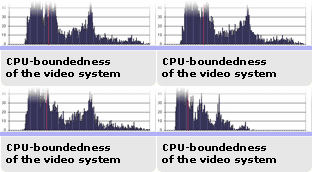
The upper part of the diagram is more likely a diagram demonstrating the CPU-boundedness of results rather than the test of video cards. In the bottom part of the diagram, we see how easily 7900GT surpasses 7800GTX and X1800XL.


NVIDIA 7900GT/GTX


NVIDIA 7900GT/GTX

As the resolution goes up, 7900GTX reaches the summit of absolute leadership. At overclocking, 7900GT looks simply fantastic and competes on par with X1900XTX.


NVIDIA 7900GT/GTX


NVIDIA 7900GT/GTX


NVIDIA 7900GT/GTX

At DOOM3, the picture somehow changes. While 7900GTX takes a minor lead - a fraction of percent - over X1900XTX, then 7900GT is no longer able competing with it even if overclocked. But that is not required of 7900GT - its superiority over the direct competitor X1800XL looks impressive indeed.


NVIDIA 7900GT/GTX


NVIDIA 7900GT/GTX

NVIDIA 7900GT/GTX

At FEAR, the mosaic of results again undergoes changes. We know that FEAR is a very demanding game in terms of graphics and makes intensive use of shaders. At that, X1900XTX is an indisputable leader because it is really hard to compete against its architecture optimized for running just complex shaders. But at 1024õ768 the video card 7900GTX is anyway able to bypass the competitor, although at higher resolutions the X1900XTX remains unattainable even for overclocked 7900GTX. As to X1800XL, the 7900GT won't surrender and takes a sure lead over it.

Conclusion

Summing it up, we can say that with G71 video processor NVIDIA has definitely brought joy to its fanciers, although the top-end video card has not demonstrated an absolute leadership at benchmarks. Success of a product is measured by not only the number of "marks" produced from various benchmarks but also by the popularity among the users. There is every reason to believe that NVIDIA's novelties will certainly succeed at that. See for yourselves - migration to a new process technology has proved successful. Therefore, the prime cost of chips due to the reduction of chip sizes is going down. The reduced power consumption of G71 allows equipping video cards with a simplified (and thus cheap) cooler, while the cards themselves offer a superb overclocking capability. All these taken together will make both regular users and numerous partners of NVIDIA take a closer look at the novelty. While the factor of video card prices does not play a decisive part for the enthusiasts, spending about 300$ for a 7900GT would become an attractive choice for the most part of other categories of consumers.

Content:

  • NVIDIA 7900GTX - Exterior.
  • NVIDIA 7900GT - Exterior.
  • Overclocking. Benchmarking. Final words.


  • Top Stories:
    MoBo:


    ECS X58B-A (Intel X58)
    ASUS Rampage II Extreme (Intel X58)
    MSI DKA790GX and ECS A780GM-A Ultra
    MSI P7NGM (NVIDIA GeForce 9300)
    Intel X58 and ASUS P6T Deluxe
    MSI P45 Neo2 (Intel P45)
    Foxconn A7GMX-K (AMD 780G)
    VGA Card:


    NVIDIA GeForce GTX 295 – a new leader in 3D graphics!
    ECS HYDRA GeForce 9800GTX+. Water-cooled and SLI "all-in-one"
    Radeon HD 4830 CrossFire - better than Radeon HD 4870!
    XFX GeForce GTX 260 Black Edition in the SLI mode
    Leadtek WinFast PX9500 GT DDR2 – better than GeForce 9500GT DDR-3
    Palit Radeon HD 4870 Sonic: exclusive, with unusual features
    Palit HD 4850 Sonic: almost Radeon HD 4870, priced as HD 4850
    CPU & Memory:

    GSkill high-capacity memory modules
    CPU Intel Core i7-920 (Bloomfield)
    DDR3 memory: late 2008
    CPU AMD Phenom X3 8750 (Toliman)
    AMD Phenom X4 9850 – a top-end CPU at affordable price
    CPU Intel Atom 230 (Diamondville)
    Chaintech Apogee GT DDR3 1600


      Management by AK
      Design VisualPharm.com

    Copyright © 2002-2010 3DNews.Ru All Rights Reserved.
    contact - info@digital-daily.com
    Digital-Daily - English-language version of the popular Russian web-project 3DNews