3DNews Vendor Reference English Resource -
All you need to know about your products!
Digital-Daily.com
Digital-Daily

Fresh from NVIDIA - 7900GT and 7900GTX

Author: Dmitry Sofronov
Date: 22/03/2006

NVIDIA 7900GTX - Exterior

Video processor G71

The battle for technology leadership crown between NVIDIA and ATI is not standing still for a minute, although most part of the battle is behind the scenes for the ordinary buyer. Announcements of new VPUs occur normally once every six months, and all this time the companies work very hard at new technologies, architectures processes, etc.

After presentation its video chip R580 and X1900 series video cards on its base in January, ATI rightfully took over the honorable title of a manufacturer of the world's fastest video cards. Certainly, since then all the computer community has been waiting for reciprocal move from NVIDIA. We remember the history of opposition between GeForce 7800GTX and X1800XT. The former was released last summer, and the latter - only in autumn. The performance of these two video cards is matching enough, but ATI's product showed a slight superiority. That time, to keep the leadership crown at speed, NVIDIA made a simple move through releasing the overclocked version 7800GTX which was equipped with the most powerful cooling system and super-fast memory. A trick like that was very hard for NVIDIA to repeat in January after the release of ATI X1900 because the frequency rise potentials of G70 made following the 110-nm process technology was exhausted, and the stocks of overclocking-friendly chips came to an end.

That time, we wondered what the reciprocal move from NVIDIA would be like. Would that be a new core based on a new architecture, or how many pipelines would that offer? It is an extremely challenging task to overcome R580 having 48 pixel pipelines. Or, perhaps that would be a new-generation chip, say, G80? Now we can state with confidence - NVIDIA's new chip is dubbed G71 and, frankly, it can't be regarded as a novelty. In fact, we get some re-styling of the well-known G70 architecture which has moved to the 90-nm process technology.

Let's see what the G71 is like.


NVIDIA 7900GTX

This is how the new NVIDIA's VPU looks like. Interestingly, it has already been the second revision of the G71 chip. The chip was produced on the 5th week of year 2006. Due to the migration to a finer process technology, the chip area has shrunk essentially. To give a better demonstration of the difference, we are bringing in a joint photo with the G70 chip.


NVIDIA 7900GTX

On the photo, you can see the G70 (to the left) installed into the 7800GTX 512 video card, and G71 (to the right). These two chips make a big difference from one another by the exterior. The difference in the core size, as I have already mentioned, is caused by the different process technologies - 110 and 90 nm, respectively. G71 also lacks a limiting frame over the substrate perimeter, which is designed to prevents the core chip from damages. To all appearances, the scrap rate caused by incorrect fitting of coolers has proved to be negligible (or missing at all), so they decided to save on the frame. Another thing of note is the small letter "U" in the marking, which suggests preliminary selection of the most overclocking-friendly G71 chips, like it was with the video card 7800GTX 512. Nevertheless, the incident with disappearance of 7800GTX 512 from the retail is unlikely to repeat for GeForce 7900GTX. NVIDIA's migration to the 90-nm process technology which started with the G72 core (video card on the base of 7300GS) has proved successful.

Long before the announcement of NVIDIA's new video processor, there were rumors about the increased number of pixel pipelines. Numerous sources assumed that to battle the 48 pixel pipelines of R580 NVIDIA would increase the number of pipelines. However, that hasn't come true. The formula has remained as before - 24 pixel pipelines and 8 vertex pipelines. As many as there were in the predecessor - G70. Of course, migration to the fine process technology favored to the rise of operating frequencies. The nominal operating frequency of 7900GTX chip has been set to 650 MHz. As they say, just feel the difference as compared to the standard 430 MHz for 7800GTX. In terms of dry figures, the boost is 51%. But in simple terms, it is by more than 1.5 times. Even as compared to the frequencies of 7800GTX 512, the boost is essential.

Despite the architectural kinship, G70 and G71 do make a difference. However strange it seems, the novelty offers fewer transistors - 279 mln versus 302 in G70. You can only guess what caused such "weight loss" since functionally it hasn't turned worse - even contrary to that. Now each of the two integrated DVI outputs offers support for the DualLink technology and allows enjoying picture at resolutions up to 2560x1600 inclusive. As a joke, we say that in G71 NVIDIA has got rid of those transistors which restricted the frequency rise capabilities. :)

7900GTX

Let's see what 7900GTX looks like. That's just the current top-end is dubbed in NVIDIA's video card product line.


NVIDIA 7900GTX

As you see, GeForce 7900GTX externally looks identical to GeForce 7800GTX 512. The major part in that is played by the cooling system which we have already seen in 7800GTX 512.


NVIDIA 7900GTX

At first glance, use of such powerful cooling seems to be somehow excessive. The thing is, the chip G71 despite its high clock speed features in quite moderate appetites for power consumption. Perhaps, installation of such a cooler is more likely to be a marketing move - the "hi-end has got to be known personally", but a cooler like that is difficult to miss. From the user's viewpoint, that offers more advantages than shortcomings. On the credit side of 7900GTX, there is a completely noiseless operation even under load (the cooler rotates at a constant speed), high efficiency of the heat-sink, and a superb overclocking capability. Of the shortcomings, it is the dual-slot make. But that is unlikely to be a shortcoming for hi-end systems. It's quite probable that in future we'll see a wider spectrum of coolers fitted on 7900GTX, but that will be a real challenge to offer as efficient solution as the nominal cooler.


NVIDIA 7900GTX

As you may have noticed, the reverse side of the PCB is fully identical to the PCB of 7800GTX 512. This suggests that the contact layout in the new chip G71 coincides with that for G71. Hence, in theory we can expect emergence of video cards on the PCB of 7800GTX with a single-slot cooling system. We can only guess if such an interim version will appear or not.


NVIDIA 7900GTX

On removing the cooler, we see that the front side of the PCB as well is fully identical to the PCB of 7800GTX 512. There are some minor differences in the number of components, but they once again prove the smaller power consumption of the new video processor. In the power supply subsystem of the video card on top, a few components have not been unsoldered. Another difference is in that the reference video card lacks the Philips 7115 chip which used to be in charge of the video capture. Once we receive production samples of the video cards, we'll find out if the decision to give up video capture codes was NVIDIA's or if that is a feature of reference video cards.

As was expected, by analogy with 7800GTX 512 the video card 7900GTX offers 512 MB video memory onboard assembled of 8 chips positioned on the front side of the PCB.


NVIDIA 7900GTX

The access time is 1.1 ns, which is equivalent to the nominal 1800 MHz DDR. As we remember, 7800GTX 512 used the same video memory, and its operating frequency equaled to 1700 MHz DDR. In the case of 7900GTX, the memory frequency is even lower - "merely" 1600 MHz DDR. However, its efficient cooling system coupled with the reduced GPU power consumption allows running easily at the nominal 1800 MHz DDR. Needless to say that the memory bus is 256 bit wide, which is evident.

By the general impression, we can say that the GPU is evidently aimed at the minimum production cost. On the other hand, the video card itself offers all the attributes of a top-end product - powerful cooling, extremely fast video memory with quite a margin for speed. Despite such "image-making" luxuries, the recommended price for NVIDIA's new flagship is much lower than in the predecessor - merely $499 versus $649 in 7800GTX 512. Of course, even five hundred dollars is not little for a single video card, but the trend is indeed rejoicing after the old ways when after exorbitant swelling of prices for top-end products they gradually go down. In other words - the "entrance tickets" to the enthusiasts' community have turned cheaper. Who knows, maybe the number of enthusiasts will go up through that. Very soon we'll find out how real retail prices will be different from the recommended. 7900GTX video cards are already widely available on sale and soon should arrive in Russia as well.

NVIDIA 7900GT

NVIDIA 7900GT - Exterior

We are not dwelling on the details of the new video processor installed on 7900GT video cards. That is because on 7900GT there is the same G71 as it is on the flagship 7900GTX. In contrast to the 7800GT/GTX couple, this time NVIDIA decided not to cut down the functionality through reducing the number of pipelines. Perhaps, either the new 90-nm process technology proved so good that there is almost no scrap, or the prime cost of new chips is so low that there is no need to "optimize the illiquid asset". Somehow or other - the video processor on 7900GT is absolutely the same as it is on 7900GTX. Anyway, see for yourselves.


NVIDIA 7900GT

As you can see, the marking differs in only the lack of the letter "U" in the chip name. Interestingly, the chip was manufactured still in January, on the 3rd week of the new year, while the revision being the same - A2. The nominal operating frequency of the chip on 7900GT is 450 MHz, which doesn't make a big difference from the 400 MHz in 7800GT. In view of the fact that on its elder sister the chip runs nominally at 650 MHz, we get an almost 1.5 times as high overclocking potential, of course if the cooling system allows to do that and if there aren't any more serious restrictions like the downstated supply voltage of the video processor. In fact, these two aspects are not a serious obstacle to serious overclockers.

For now, let's look at the exterior of 7900GT and find out what the nominal cooling system can offer.


NVIDIA 7900GT

I think you won't believe me if I say that I was slightly bewildered so see 7900GT for the first time. The major question was just about the very cooling system. Will the unpretentious piece of copper be really able to cope with cooling the chip made up of almost 300 million transistors and running at 450 MHz?


NVIDIA 7900GT

As it turned out, the copper plate with soldered fins (not numerous, by the way) does quite a good job of cooling the GPU. The chip temperature at rest was 42-43 C, and reached 60 C under load. The noise produced by the cooler is almost missing. NVIDIA's new process technology has definitely proved successful.


NVIDIA 7900GT

As regards the PCB, it has been slightly reworked as compared to what we saw on 7800GT. 7900GT has turned somehow shorter. At the same time, the general design and component layout have remained generally intact. Like on the elder sister, a video capture chip is also missing. All the video memory chips not covered with a radiator are positioned on the front side.


NVIDIA 7900GT

The overall memory capacity onboard amounts to 256 MB. Used are chips made by Samsung of 1.429 ns access time, which is equivalent to the nominal frequency 1400 MHz. The nominal operating frequency of memory on 7900GT is 1320 MHz DDR. As you see, that is a bit lower than the nominal. But perhaps it was just the downstatement of the operating frequency plus use of low-voltage memory (1.8 V supply voltage) that allowed to get by without any additional cooling. Use of radiators will let raise the video memory frequency up to 1500 MHz and even higher.


NVIDIA 7900GT

The reverse side of the card does not bring anything of special interest. There is one point to note, though - it turns out that the positioning of fastening holes for a radiator is the same as that in 7800GT. That suggested the idea - would it be possible to use a standard radiator from 7800GT to cool the GPU and video memory on 7900GT? Therefore, it would be possible to raise the video card's overclocking potential substantially. Unfortunately, a standard radiator from 7800GT wouldn't fit on 7900GT. Because of the shortened PCB design of 7900GT the radiator rested against the DVI connectors. However, the possibility to install a more powerful radiator will most certainly be in demand, and we'll evidently see nonstandard and highly efficient coolers in 7900GT series video cards.

The recommended price for 7900GT has been set to $299, which is nice, although that is the price for the North American region. In Russia, the price will be somehow higher, but we'll find out the difference once the video cards has emerged to the retail.

To get a complete idea of NVIDIA's novelties, we have got to examine their performance. Now on to the benchmarking.

NVIDIA 7900GT

Overclocking. Benchmarking. Final words.

Overclocking

We came up against no problems with overclocking the 7900GTX video card. The video card was running safely at 700/1800 MHz (GPU/memory, respectively). As regards the video processor, this frequency is unlikely to be a limit for it. The sample which has been to our laboratory was running at 750 MHz somehow unstably. We could have looked for the more precise value, e.g 720-730 MHz, but because of the time limitation we decided to give up the meticulous search because the overclocking potential for each chip may be somehow different. As regards the video memory, then 1800 MHz is its nominal frequency. Normally, memory made by Samsung overclocks well, that is, it would be possible to get another 100 MHz of boost. But due to the above reasons we decided that 1800 MHz would be quite enough to demonstrate the capabilities of the video card.

Overclocking of 7900GT was done in a somehow different way. Since the video memory is not equipped with any cooling, we did not overclock it. Just to be on the safe side, so to speak. We only overclocked the video processor. Again, we did not look for the stable frequency at 10 MHz precision. We confined ourselves to the 50 MHz increment. The stable frequency which we were able to attain was finally 600 MHz. As you see, the speed boost is not bad indeed - 33% (especially in view of the cooler that was installed on 7900GT). Again, that is not a limit, so it is possible to raise the GPU frequency by another 10-20 MHz.

Benchmarking

Since the G71 is a direct descendant of G70, we were curious to compare the performance of 7900GT/GTX video cards versus their predecessors - 7800GT/GTX, as well as compare the produced results versus ATI's products, which are direct competitors to 7900GT/GTX. Certainly, the competitor to 7900GTX will be X1900XTX, and 7900GT will be measured against X1800XL. The first pair represents the most powerful video cards which ATI and NVIDIA offer to date, and the second pair - products which are closest in price and functionality. Well, off we go.


Test setup
Bus
PCI-E
CPU
MB
Memory
OS
WinXP + SP2 + DirectX 9.0c
PSU

To test 7900GT/GTX video cards, we used ForceWare drivers of version 84.20. The results for 7800GT/GTX video cards were produced with WHQL ForceWare 81.98 drivers. ATI video cards were tested with CATALYST version 6.3 drivers.

Like before, for the convenience of comparison of results, we indicate the nominal operating frequencies of GPU/memory in parentheses after the name of the video card. The frequencies for overclocked video cards are shown with the "@" character. The results for NVIDIA's novelties are depicted in bright green, while those for 7800GT/GTX - with dark green. The results for ATI are depicted in red.

As usual, we start with synthetic benchmarks. This time, we included 3DMark'06 into the set of test packages. So we'll start with it.


NVIDIA 7900GT/GTX

Offering the same set of characteristics as 7800GT but running at a bit higher frequencies, the 7900GT easily takes a lead over 7800GTX. It can expected that such an alignment of forces will remain further for this pair.

In the opposition "7900GTX vs X1900XTX", the winner is NVIDIA's novelty, although the results are very very close. In the battle of top-end video cards, the "little bit close" does count.

Both 7900 series video cards show good response in overclocking. However, the boost in "marks" does not exceed 10%, although the GPU overclocking in 7900GT is well over 30%. We shouldn't be scared by that. The thing is that the final rating at 3DMark'06 is made up of the results for CPU tests, and since we did not change the CPU, the contribution from overclocking the video card to the "piggy bank" of "marks" proves to be somehow lower.. OK. Going on.


NVIDIA 7900GT/GTX

At 3DMark'05, the leadership of X1900XTX remains unshakable, and even overclocking of 7900GTX does not help beat the rival. Again, the results prove very close. 7900GT takes a slight lead over 7800GTX and thus X1800XL.

As is known, every video card has its own "favorite" test at which it shows its best. It seems like NVIDIA video cards favor 3DMark'06, while ATI's video cards - 3DMark'05.


NVIDIA 7900GT/GTX

At 3DMark'03, NVIDIA's video cards have always felt comfortable. 7900GTX easily coped with the nice figure of 20000 "marks" at the nominal frequencies, and overclocked 7900GT easily beat X1900XTX. Let's see how these novelties behave in games.


NVIDIA 7900GT/GTX

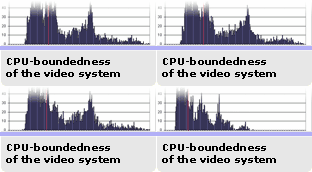
The upper part of the diagram is more likely a diagram demonstrating the CPU-boundedness of results rather than the test of video cards. In the bottom part of the diagram, we see how easily 7900GT surpasses 7800GTX and X1800XL.


NVIDIA 7900GT/GTX


NVIDIA 7900GT/GTX

As the resolution goes up, 7900GTX reaches the summit of absolute leadership. At overclocking, 7900GT looks simply fantastic and competes on par with X1900XTX.


NVIDIA 7900GT/GTX


NVIDIA 7900GT/GTX


NVIDIA 7900GT/GTX

At DOOM3, the picture somehow changes. While 7900GTX takes a minor lead - a fraction of percent - over X1900XTX, then 7900GT is no longer able competing with it even if overclocked. But that is not required of 7900GT - its superiority over the direct competitor X1800XL looks impressive indeed.


NVIDIA 7900GT/GTX


NVIDIA 7900GT/GTX

NVIDIA 7900GT/GTX

At FEAR, the mosaic of results again undergoes changes. We know that FEAR is a very demanding game in terms of graphics and makes intensive use of shaders. At that, X1900XTX is an indisputable leader because it is really hard to compete against its architecture optimized for running just complex shaders. But at 1024õ768 the video card 7900GTX is anyway able to bypass the competitor, although at higher resolutions the X1900XTX remains unattainable even for overclocked 7900GTX. As to X1800XL, the 7900GT won't surrender and takes a sure lead over it.

Conclusion

Summing it up, we can say that with G71 video processor NVIDIA has definitely brought joy to its fanciers, although the top-end video card has not demonstrated an absolute leadership at benchmarks. Success of a product is measured by not only the number of "marks" produced from various benchmarks but also by the popularity among the users. There is every reason to believe that NVIDIA's novelties will certainly succeed at that. See for yourselves - migration to a new process technology has proved successful. Therefore, the prime cost of chips due to the reduction of chip sizes is going down. The reduced power consumption of G71 allows equipping video cards with a simplified (and thus cheap) cooler, while the cards themselves offer a superb overclocking capability. All these taken together will make both regular users and numerous partners of NVIDIA take a closer look at the novelty. While the factor of video card prices does not play a decisive part for the enthusiasts, spending about 300$ for a 7900GT would become an attractive choice for the most part of other categories of consumers.

Copyright © 2005 Digital-Daily. All Rights Reserved.
contact - info@digital-daily.com