Half-Life 2 as a benchmark
Changing the graphics settings(Advanced Video Options)
Half-Life 2 includes the same in-game graphics options as Counter-Strike: Strike: Source, including support for Anti-Aliasing and Anisotropic Filtering. These, and other image quality settings, can be accessed in the Advanced Video Options menu. Some options are also available on the command-line, which will be covered later.
Automatic Configuration When you first run Half-Life 2, it automatically detects your video card, CPU, and other hardware, and configures default settings to ensure that the game runs at reasonable level of performance and quality.
This process is repeated any time a major system component (such as the graphics card, processor, or memory capacity) is changed.
Default resolution, degree of anisotropic filtering and multi-sample anti-aliasing are the settings most likely to be updated after a change of the graphics adapter. Shader Quality and Water Quality may also be affected.
Half-Life 2 looks for your graphics ASIC ID in a file called dxsupport.cfg (in the Half-Life 2bin folder) and applies any settings it finds there. After changing your graphics board, it’s a good idea to run Half-Life 2 and check the “Advanced” section of the in-game video options before running any benchmarks. It is very likely that one or more of the Advanced Video Options will be changed to accommodate the new product.
Reflections (Water detail)
In the Advanced Video Options menu, there are three options for water details - "simple reflections", "reflect world", and "reflect all".
The "simple reflection" and "reflect world" options are not visible much to the eye. In both cases, there are no shadows dropped by trees, chimney-stalks, helicopter, or falling bombs on the water surface. But in the "reflect all" mode in our demo we found only a single bug - the chimney-stalks are not shown. All the other details are there, the realism is incredible.

Reflect All
|

Simple Reflections
|
Benchmarking Results:
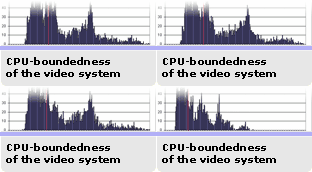
Judging by the results, the video card performance does not affect the shader detail much - it is the processor that does the job. Enabling the "reflect all" mode results is immense load upon the CPU, which complicates the details of the scenes.
Shader detail
The shader detail is presented with the two modes - high and low.
Again we see the CPU-boundedness, but the option does not eat up much of resources - at least in our P4 3.6GHz :-)
The interim conclusion - the game requires a maximum powerful processor. The scene details are definitely over the top.
 |
Top Stories: |
 |
 |
 |
MoBo:


|  |
 |
 |
VGA Card:


|
 |
 |
 |
CPU & Memory:

|
|