| 3DNews Vendor Reference English Resource - All you need to know about your products! |
||||||
![]() |
||||||
|
|
||||||
Half-Life 2 as a benchmarkAuthor: Andrey KuzinDate: 10/01/2005
IntroductionFor many years, confirmed gamers and simply "amateurs", theorists of the industry, and simply anybody slightly familiar with the notion "3D game", have been anxiously waiting for the release of Half-Life2. Around this without doubt most anticipated game of 2004, there were so many assumptions, sometimes fabulous (as it seems now), so many hopes, intrigues that it makes no sense recalling them all - so many of them piled up during wearisome waiting time. Rumors were accumulated, intrigues swirling around.. The eternal arguments among those close to the industry and simply those keen about the current situation on "ATI vs NVIDIA" front finally developed into the discussions "DOOM3 versus Half-Life2" be it in lobbies at a presentation, or at a party over a "wineglass of coffee", or in the analyses of reviewers in the materials of relevant subjects. Awful lots of middling test results produced with whatever alpha-versions or other "stress tests" flooded the Internet. ![]() Of course, those skeptical (especially zealous fans of DOOM 3) may argue for as long as they like about "which game was the top thrill to the public in 2004", but you'd better had a look at the conferences where games worldwide share their views which give a most impartial idea of the votings which we gathered quite recently. Finally, it's there and at last we can get round to sorting out in the heap of assumptions, rumors, intrigues and preliminary results. We now can assess the new creation of Valve from professional viewpoint, that is, to run performance tests for almost all the modern cards by ATI and NVIDIA at the most long-awaited game of year 2004. We start with finding out the fine points in the methodology of tests. Half-Life 2 is very recourse-hungry in terms of the video card performance, it makes intensive use of shaders, and it can't be ignored as a new benchmarking environment. Half Life 2 allows recording real gaming scenes (timedemos). With the recorded timedemos, you can assess various aspects of the Source engine and produce the most precise and impartial readings of the graphic performance. Half-Life 2 benchmarking How-To:For high-end video cards, Half-Life 2 shows extremely high FPS (over 200 fps in some scenes). Graphic rendering is more dependent on the processor resources rather than other components. For HL2, a super-powerful processor is a must! Such demanding processor requirements are vital for handling the advanced physics, details processing, AI, mimics, networked data exchange etc. To produce a precise performance picture in Half-Life 2 as a benchmarking environment, a scene of FPS = 50 or lower should be used. This creates a performance scenario where a 10 fps difference between boards (or between settings) will significantly impact the user experience. The Canal map make heavy use of whatever shaders. Reflection and refraction on the water surface required numerous complex shaders. Before recording your own demos, make sure to verify that performance changes as the graphics settings (resolution, AA, etc.) are altered. Benchmarking Tips
Benchmarking from the consoleMost of the commands required for benchmarking Half-Life 2 are available inside the game, from the console. Here you can load maps, record timedemos, and play them back to measure performance. To enable the console from inside Half-Life 2, use the menus: Options -> Keyboard -> Advanced -> Enable Developer Console You can easily localize your English-language retail version of the game. For that, enter the settings of the Steam engine via the menu and choose your language. Absolutely everything is localizable - game interfaces and even speech. The amount of downloadable content will be large enough. ![]() The ‘~’ key will open the console. Console Commands for Half-Life 2:
To record your own demos, proceed as follows:
The "map"command is very useful if you wish to browse around the maps without walking through the whole game. Use of the console allows tampering and cheating a lot with the game. After all, the console was developed just for debugging the program. For a complete list of cheat codes, look here: Half-Life 2 - Cheats
|
||||||||||||||||||||||||||||||||||||||||||||||||||||||||||||||||||||||||||||||||||||||||||||||||||||||||||||||||||||||||||||||||||||||||||||||||||||||||||||||||||||||||||||||||||||||||
| -console | Allows access to the Half-Life 2 console while in the game (press ~) |
| -nosound | disables sound during the timedemo (note: some sounds are still played as the game launches) |
| -width dimension | Sets the horizontal resolution |
| -height dimension | sets the vertical resolution (i.e. “-width 1024 -height 768”) |
| +mat_antiaslias AA_level | sets the Multi-Sample Anti-Aliasing mode (0, 2, 4, 6). |
| +mat_forceaniso aniso_level | sets the Anisotropic Filtering level ( 1 == none, 4, 8, 16) |
| +timedemo demo_name | Plays the recorded demo as quickly as possible, and will report your framerate. Results are logged to the hl2hl2source.csv file. |
| +timedemoquit demo_name | Plays the recorded demo as quickly as possible and exits once complete. Results are logged to the hl2hl2source.csv file. This command is useful for automated testing. |
| -dxlevel dx_level | Forces your hardware to run a specific shader path (90, 81, 80), if it is capable. This is useful for apples-to-apples comparisons testing on products (such as the GeForce FX line) where DirectX® 9.0 is not the default shader path in Half- Life 2. That is, “–dxlevel 90” forces DX 9.0 shaders, while “-dxlevel 81” runs 8.1 |
| +r_fastzreject on_off | Enables (1) or disables (0) a depth fill pass that may improve performance in graphics-bound (high resolution, or AA + AF) situations. Currently, NVIDIA products default to ON, while ATI products are OFF (based solely upon ASICID recognition). |
Note
Be sure to specify +mat_antialias 0 and +mat_forceaniso 1 for any noAA noAF tests run from the command-line. If you don’t specify a value for these options, Half-Life 2 will use the currently configured settings from the in-game control panel (and these might not be “disabled”). See “Automatic Configuration”.
For benchmarking, we recorded our own demos using the maps "d1 Canals 09" (canal-3dnews.zip - 1,5Mb) and "d1 Trainstation 02" trainst-3dnews.zip - 1,4Mb. The so-called "ATI's official demos" that caused a wave of accusations of cheating no longer work in the current version of HL2.
Calculating water shaders from the first demo makes heavy use of reflection and refraction on the water surface. The helicopter kicks up a spray that is alpha blended, and the sun flare is also blended into the scene.
Performance here is primarily limited by the water shader. The technical comment on HL2 suggests that this map makes use of at least five effects:
The incredible detail of Half-Life 2 is apparent in this scene of a city square (the "trainstation" map in the second demo). The architecture is almost photo-realistic. Watch the windows on the train station for a reflection effect.
This scene is somewhat CPU-bound on higher-end hardware.
We are now moving on to the benchmarking, but before we start, - a few tests to measure the effect of the audio subsystem, memory, and the processor.
In this test, we used an external SB Live sound card, and ATI's most powerful video card - X850XT Platinum Edition. Our tests revealed a strong effect sound produces on the benchmarking results. 10 FPS difference is seen at any resolutions in the Canal scenes.

To take the readings, we set the quality to the maximum level, with the AA and AF disabled.
At the same time, we checked the effect of sound in the configuration with the GeForce 6600GT:

The same picture - a heavy load upon the processor.
This implies an evident conclusion - if we test a video card, the sound must be definitely disabled in the game. If we run system tests, it's a good idea to enable the sound.
In this test, we used the "system demo" - trainst-3dnews + 4xAA/8xAF.

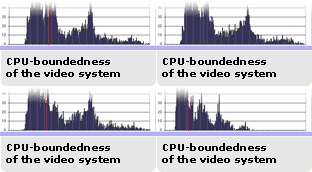
The CPU-boundedness starts decreasing at 1280x1024 and stops at 1800x1440! Surprisingly, these results are for the most powerful ever X800XT that offers well advanced image quality settings... Intel's 600 MHz CPU architecture gives a 10 FPS boost within the range of "independence" on the video card.
For testing purposes, we tampered with the canonical Intel platform through switching the memory to the single-channel mode 2x512 Mb. In the tests, we used ATI Radeon X700XT with the ÀÀ and AF disabled:

There is dependence, albeit minor.
Now we leave one 512Mb DDR2 module in the system:

Basically, 512 MB is quite enough, the game is not demanding for the modern level of memory capacity. There is a drop, but negligible. The CPU-boundedness is much more serious.

Oops, what an annoying surprise! The game is very hard on HyperThreading, which is evident from the results. In fact, such examples are not rare - take for instance Comanche 4. In 2005, Intel and probably AMD will release their first dual-core CPUs and they will have to work quite immensely with software developers until the dual-core architecture is able bringing any boost besides the OS operation.
Half-Life 2 includes the same in-game graphics options as Counter-Strike: Strike: Source, including support for Anti-Aliasing and Anisotropic Filtering. These, and other image quality settings, can be accessed in the Advanced Video Options menu. Some options are also available on the command-line, which will be covered later.
Automatic Configuration
When you first run Half-Life 2, it automatically detects your video card, CPU, and other hardware, and configures default settings to ensure that the game runs at reasonable level of performance and quality.

This process is repeated any time a major system component (such as the graphics card, processor, or memory capacity) is changed.
Default resolution, degree of anisotropic filtering and multi-sample anti-aliasing are the settings most likely to be updated after a change of the graphics adapter. Shader Quality and Water Quality may also be affected.
Half-Life 2 looks for your graphics ASIC ID in a file called dxsupport.cfg (in the Half-Life 2bin folder) and applies any settings it finds there. After changing your graphics board, it’s a good idea to run Half-Life 2 and check the “Advanced” section of the in-game video options before running any benchmarks. It is very likely that one or more of the Advanced Video Options will be changed to accommodate the new product.
In the Advanced Video Options menu, there are three options for water details - "simple reflections", "reflect world", and "reflect all".
The "simple reflection" and "reflect world" options are not visible much to the eye. In both cases, there are no shadows dropped by trees, chimney-stalks, helicopter, or falling bombs on the water surface. But in the "reflect all" mode in our demo we found only a single bug - the chimney-stalks are not shown. All the other details are there, the realism is incredible.
Benchmarking Results:

Judging by the results, the video card performance does not affect the shader detail much - it is the processor that does the job. Enabling the "reflect all" mode results is immense load upon the CPU, which complicates the details of the scenes.
The shader detail is presented with the two modes - high and low.

Again we see the CPU-boundedness, but the option does not eat up much of resources - at least in our P4 3.6GHz :-)
The interim conclusion - the game requires a maximum powerful processor. The scene details are definitely over the top.
![]() |
![]() |
![]() |
![]() |
The picture is definitely awful - it's no good playing modern games without anti-aliasing. We add AA and set the AF to the full:
![]() |
![]() |
![]() |
![]() |
that's better! In the latter case (6xAA, 16xAF), the picture is fully cinematographic and almost photo-realistical. No image artifacts were found. People with poor vestibular apparatus experience problems with such a level of quality - their head goes dizzy :-)
Here goes the "trainst-3dnews" demo used with ATI Radeon X800 XL:
| ATI Radeon X800 XL: NoAA, NoAF | |
![]() |
![]() |
![]() |
![]() |
| ATI Radeon X800 XL: 4xAA, 8xAF | |
![]() |
![]() |
![]() |
![]() |
But with NVIDIA cards things are somehow more difficult. With GeForce 6800/6600 video cards, sporadical artifacts were found. What's more, we were unable to calculate the regularity of there emergence. I mean just the runs of recorded timedemos - nothing like that was found in the game mode.
With PCX5900/5750 video cards, there was another trouble. On changing resolutions, water shaders refused to execute:
There is the only remedy for that - restart the game each time you change the resolution.
And quite awful is the picture with i915G integrated graphics. Formally, this chipset offers support for DirectX9.0, but only formally. Normally, if the core is unable to execute the shader, it simply ignores that. The picture is weird, but anyway you can play with it in whatever games, and only NOT in Half-Life 2: you can start the game with i915G only if absolutely all is reset to zero. We we unable to go further that the menu.
While some recent games look just fine at 800x600, you will find that the appearance of Half-Life 2 benefits considerably from higher resolutions.
For very high-end products, you should find playable 60 FPS at 1600x1200, 4xAA, and 8xAF. Let's bring in benchmarking results for some video cards. Set all to the maximum quality, including water reflections, in the Advanced Video Options menu.
| ASUS AX800 XT GPU: R423 (0.13 micron low-k) Memory: 256Mb Memory type: GDDR3; 256Bit; Samsung 2.0ns Frequencies: 500MHz/1000MHz DDR Bus: PCI-Express x16 Category: Hi-End PCI-E Price: $550 |
![]() |
That is a card of the Ultra Hi-End class built on the ATI R423 chip, made by ASUS. It differs from the reference board in the more powerful cooling system with a bluish illumination.
We used our two own timedemos in the benchmarking - canal-3dnews and trainst-3dnews:


The canal-3dnews features in simpler details (there are less skeletons) and in a huge number of visual effects - therefore, it is more bound to the graphics card performance. The trainst-3dnews is the reverse.
Preliminary conclusion: The canal-3dnews timedemo is more a graphic subsystem benchmark, whereas trainst-3dnews can be used as a general system test.
That is a new product of ATI - the sticker says it was produced on 22 November. The only difference from the XT version is the reduced core clock speed 400 MHz instead of 500, and there is no additional power supply at all. The card is positioned as a killer of the popular GeForce6800GT in the price category below 100$.
Here goes the graphics benchmark - canal-3dnews demo with the sound disabled:

These are "system test" results produced with trainst-3dnews with the sound enabled.

The card gives excellent gaming experience at both 1280x1024 6xAA/16xAF, and at 1600x1200 4xAA/8xAF.
This card is one of the scarcest in today's benchmarking - NVIDIA GeForce 6800GT in the PCI-E version. The price is still unknown. The situation with PCI-E cards is curious enough - on the local gamers' "flee-market" in Moscow there are only X800XT, 6600GT on sale, but you have to rush around a lot in search for the upper clan of PCI-E video cards.

These are "system test" results produced with trainst-3dnews with the sound enabled.

The card showed a fantastic overclocking potential and immediately overcome the 400 MHz (core) speeds of the Ultra. For the memory, we were able to set 1100 MHz, that is, with GT you can attain results which beat even the Ultra version.

But that didn't help much in HL2 - as we can see, the architecture ceiling of the game for NVIDIA cards tested with our two demo scenes proved merely 56 FPS with the sound enabled versus 71 FPS with the sound disabled (who on earth plays without sound?), and the 6800GT is already exhausted to the full, as our benchmarking showed.
We emulated operation of almost GeForce 6800 Ultra Extreme, but for the real version of the Extreme make there was quite a little bit missing.

Therefore, 71 FPS is just the architecture ceiling for HL2 for this system configuration: processor + memory + NVIDIA video card. But the graph itself proved more sloping - results for higher resolutions came into play.

But in a real game with the sound enabled, we were unable to get the desired 60 FPS with the quality options set to the maximum. The best way out is to give up the "reflect all" option and switch to the "reflect world". This will immediately give a 10-15 FPS boost. Reflections strongly affect the performance.
But admit, the picture on the graph is funny. Isn't it dreadful? - A top-end video card at enormous money which doesn't care at all about resolutions, strongly CPU-bound, depends on the architectural specifics of the game, and can't do anything about it!
ATI enjoyed the revenge for DOOM 3 to the full.
| Gigabyte GeForce 6600 GT GPU chip: NV43 (0.11 micron) Memory: 128Mb Memory type: GDDR3; 128Bit; Samsung 2.0ns Frequencies: 500MHz/1000MHz DDR Bus: PCI-Express x16 Category: Middle PCI-E Price: $200 |
![]() |
This card of of the most readily available and dignified representatives of NVIDIA camp that offers the PCI-E interface. It is available in the retail at 200$ and is shipped as a bundle item to DOOM3. From the part of ATI, it is opposed by X700 XT which can be hardly ever found by the common buyer.
Here goes the graphics benchmark - canal-3dnews demo with the sound disabled:

These are "system test" results produced with trainst-3dnews with the sound enabled:

| ATI Radeon X700 XT GPU chip: RV410 (0.11 micron) Memory: 128Mb Memory type: GDDR3; 128Bit; Samsung 2.0ns Frequencies: 475MHz/1050MHz DDR Bus: PCI-Express x16 Category: Middle PCI-E Price: $340 |
![]() |


The 128 MB of memory capacity was not enough for the 6xAA/16xAF mode. While in the case with NVIDIA GeForce 6600GT (that also offers 128Mb) the card simply ignored the settings unacceptable to itself, the X700 XT was persistently trying to overcome them which led to a fall off the game.
| ASUS AX700 Pro GPU chip: RV410 (0.11 micron) Memory: 256Mb Memory type: GDDR3; 128Bit; Samsung 2.0ns Frequencies: 425MHz/860MHz DDR Bus: PCI-Express x16 Category: Middle PCI-E Price: $290 |
![]() |
We have already reviewed the card in "Two Radeon X700 PRO video cards - by ASUS and Gigabyte", so it doesn't make sense repeating. What's worth noting is that for the first time in the industry the GPU chip on the card is covered with a film.


Even Radeon X700 Pro has attained its 103.6 FPS as expected - the ceiling for ATI cards in our configuration.
| ABIT RX600Pro+Guru GPU chip: RV380 (0.11 micron) Memory: 128Mb Memory type: GDDR3; 128Bit; Samsung 4.0ns Frequencies: 500MHz/1000MHz DDR Bus: PCI-Express x16 Category: Middle PCI-E Price: $160 |
![]() |
A very curious product made by ABIT. It differs from the reference design by the additional Guru chip already familiar through other ABIT motherboards. This is the first video card equipped with a chip like that, which is sort of an experiment. Further on, more powerful solutions will be equipped with the Guru-video chip. The chip is in charge of the volt-modding: it allows raising the core voltage thus raising the card performance to a level approximately that of X600XT leaving our editor of the "Video" section without extra incomes engaged in re-soldering video cards :). To prevent probable BIOS damage, there is a backup chip installed. In case the master version turns damaged, the backup automatic re-flashing comes into play and the data is restored.
|
|
Switching between the PRO and XT modes is done with a jumper. A smart solution which still has no analogs. There is the only flaw though - the price. As regards ABIT RX600Pro+Guru, the standard X600XT costs 160$ in retail in Moscow.
Of course, the results were taken in the Guru mode.

As is seen from the graph, the card is of absolutely different level than previous ones. The processor is no longer a factor constraining the performance. The 103.6 FPS have not been achieved. The cherished 60 FPS (comfortable gameplay) can be attained at 800x600 without enabling the quality settings.
We have reviewed seven key PCI-E video cards. Let's now consoldate all the results and if possible add the results for the remaining cards.
Here is a list of video cards that took part in the consolidated benchmarking:
| VGA | GPU | Core/Mem | Memory | Mem type | PP/VP |
| ATI | |||||
| ASUS AX800 XT | R423 | 500/1000 | 256Mb | 256-bit GDDR3 | 16x1, 6VP |
| ATI Radeon X800 XL Ref | R423 | 400/1000 | 256Mb | 256-bit GDDR3 | 16x1, 6VP |
| ATI Radeon X700 XT Ref | RV410 | 475/1050 | 128Mb | 128-bit GDDR3 | 8x1, 6VP |
| ASUS AX700 Pro | RV410 | 425/870 | 256Mb | 128-bit GDDR3 | 8x1, 6VP |
| ABIT RX600 XT | RV380 | 500/760 | 128Mb | 128-bit DDR | 4 1 |
| GeCube X600 Pro | RV380 | 400/600 | 128Mb | 128-bit DDR | 4 1 |
| ATI X300 Ref | RV370 | 325/200 | 128Mb | 128-bit DDR | 2 1 |
| ATI X300 SE Ref | RV370 | 325/200 | 64Mb | 64-bit DDR | 2 1 |
| NVIDIA | |||||
| NVIDIA GeForce 6800 Ultra+ | NV40 | 400/1100 | 256Mb | 256-bit GDDR3 | 16x1, 6VP |
| NVIDIA GeForce 6800 GT Ref | NV40 | 350/1000 | 256Mb | 256-bit GDDR3 | 16x1, 6VP |
| Gigabyte GeForce 6600 GT | NV43 | 500/1000 | 128Mb | 128-bit GDDR3 | 8x1, 3VP |
| ASUS GeForce 6600 | NV43 | 300/500 | 128Mb | 128-bit DDR | 8x1, 3VP |
| Gigabyte GeForce PCX5900 | NV35 | 350/550 | 128Mb | 256-bit DDR | 8 1 |
| MSI GeForce PCX5750 | NV36 | 425/500 | 128Mb | 128-bit DDR | 4 1 |
First off, the overall graphic performance for 15 video cards. We used the demo "canal-3dnews", and in the "Advanced Video Options" menu we set all to the maximum for all the video cards, with the sound disabled.


The maximum options the game supports are 6xAA/16xAF, but NVIDIA cards do not support the 6xAA mode, and although they support the 16xAF, they ignore it switching back to the 8 mode, so we had to revert to 4xAA/8xAF as the maximum mode acceptable to both rivals. The results for seven cards that took part in the detailed benchmarking have been presented on the previous pages.


As we see, X700Pro takes a lead over X700XT, which is seemingly absurd. But the XT version offers 128Mb, whereas the Pro - 256Mb. With the quality settings 4xAA/8xAF, the memory capacity 128Mb is no longer sufficient, so the Pro takes a lead.
Let's discard the dry wording of technical reviews - there have been so much of emotions for the month of benchmarking.
The first what I can't help mentioning is the undisputable leadership of ATI video cards. Their technological ceiling in the game is approximately 1.5 times higher than the competitor's (103FPS vs. 72 FPS). Where such a difference comes from is a question to the developers. Interestingly, the first benchmarks done a month ago showed quite disastrous results which could hardly be called relevant. So we had to patiently wait for adequate drivers and patches. Since then, the sound has been amended, several patches have been released, an update to the Steam client has been brought out, a Russian version has arrived, and the "Half-Life 2: Deathmatch" version has quietly downloaded. The total amount of all the updates and additions has already exceeded 1 GB. All this abundance is accessible to official users only.
It is absolutely impossible to understand what to do in this new reality to Russia's gamers if the fashion for a compulsory Internet connection with 100% online activation will capture other developers as well. Now you won't be able re-installing the OS once more on the benchmarking machine - you would simply jump with horror at the thought of having to download all this wealth again at your own cost. But if you lack a dedicated line, you'd better put the game aside.
By the way, when benchmarking with version 2215 completed and we returned the network cable to the original place, 120 Mb more was downloaded, and the game updated to version 2229.

Another annoying thing - it is impossible to do a repeated installation of the game on a another benchmarking machine: the number turns immediately blocked. So, what to do then? To buy another version for the sake of a dubious pleasure of running an AGP card? :-)
Of course you will - nothing to do about it. They say that the Russian version costs 700 rubles (~24$) versus the generic version at 60$.
The fact is, the game has been released in its raw state, so it had to be hastily brushed up in the emergency alarm mode. As it is always the case with games and web sites - they are never 100% ready for release. The process of fixing is endless. Simply there has come the moment when you are heavily pressed by circumstances and deadlines. You've got to release it as is and sort out with the bugs later on. It's a bit annoying, because the project was so much long-awaited. Anyway, the game was planned for free distribution with Radeon 9800XT cards, wasn't it? But we had to resort to coupons. At the luxurious announcement of X800, no promises were given any more - they simply showed just another raw demo. They are in time just for X850, six years after the start of development.
By the way, having written the phrase "the game was planned for free distribution with Radeon 9800XT cards", I recalled I must have saved a couple more coupons deep in my stores together with the sent specimens. I dug into and found them :)

Three games of the past year will enter the history as industry locomotives - FarCry, DOOM3, and Half-Life 2. They all proved to be must-haves at test labs. While all was clear with DOOM and Half from the start - the developers will draw a close attention to graphic technologies promoted by the sponsor, the guys from Croatia no one knows where they come from gave root to a truly hot battle. The echoes of it were anxiously discussed in the lobbies of every techno forum and sessions.
Who will be the favorite of the forthcoming year? The release of FarCry, DOOM3, and Half-Life 2 is not yet an end or beginning - just a minor milestone in the endless race. Let's wait and see :-)
So what about the game itself? Can HL2 be used as a benchmarking tool? Basically, yes. But provided some conditions are met. First, a meticulous preparation of timedemos. If we benchmark just a video card, the the canal map is better to use, with the sound definitely disabled. If we benchmark the platform, the scene should offer maximum details, with the sound enabled. As was already mentioned, the game requires the most powerful processor among the available - it's no good running the benchmarks with P4 2.4. Lastly, according to independently produced benchmarking results, the AMD platform is more amenable to HL2. In our forthcoming material, we will definitely verify that.
Now, bye to all, and finally I can get round to playing my favorite "Half-Life 2: Deathmatch". See you next time on the servers!
| |||||