A Roundup of cheap coolers for powerful processors (SocketA): Q1-2`2003

Introduction
This roundup is about cooling new AMD processors built on the Barton core. Reminding it to you that this core is a modified Thoroughbred with the L2 cache size increased to 512K. While on the date of release these processors were aimed at the high-end sector, after the recent price reduction they became affordable to the mainstream user as well. The lower-end model - Athlon XP 2500+ - is currently priced at below 100$ (as per PriceWatch.Com).
So today we'll be looking into cheap coolers priced below $13. Mind you, some might think it's a bit too high for a piece of metal with a propeller attached, but keep in mind that Barton processors run a bit hotter than Thoroughbred ones. Besides, prices for AMD processors are going down swiftly, so a good cooler has got to do its job in a "future-proof" way :). In other words, when upgrading to a newer and faster processor we shouldn't worry about replacing the cooler.
Now regarding the measurement procedure. Without any noise measurement instrument on hands, I am going to assess the noise levels and rate it in score points. That is, the higher the score, the higher the score, the quieter a cooler is. Such assessment is quite subjective. I must the author (myself :) is very sensitive to the noise level since the computer is running on a 24/7 basis and must not distract from good night's sleep. Now regarding the temperature. The processor temperatures and fans' rotational speeds were gauged with the Motherboard Monitor v5.2.0.0, and the testing system was assembled in an Inwin S506 housing. If a cooler had a related thermal interface, then the thermal interface was removed and then we measured the noise with the silicon-organic paste KPT-8. The processor was heated up with the BurnK7 software, with Athlon XP with the integrated thermal sensor used as the test processor. That gave a very high precision at measuring the temperature.
By the way, while almost all of the SocketA processors are equipped with the internal thermal interface, this can't be said about their support by motherboards. Only very few allow user keeping track of the core temperature. Recently, it's becoming increasingly popular among manufacturers to implement onboard hardware protection against overheating (normally, at the 100-110C), with the core temperature monitoring completely disabled. As we'll see in this roundup, this function is of paramount significance to the overclocking.
While describing the cooler I'll draw your attention to the fastening convenience. Also don't forget about such factors like fastening reliability, radiator size, material used, exterior, processing quality etc. Most of these are fairly subjective as well (especially, the exterior :), so I'll try to present as more illustrations as possible.
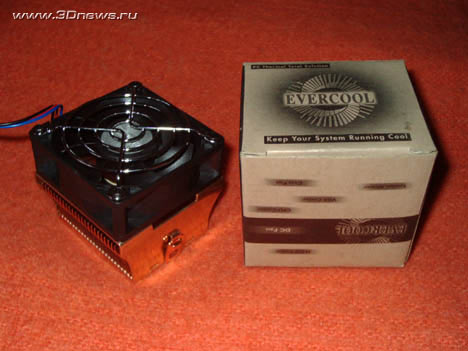
Evercool CUD-725
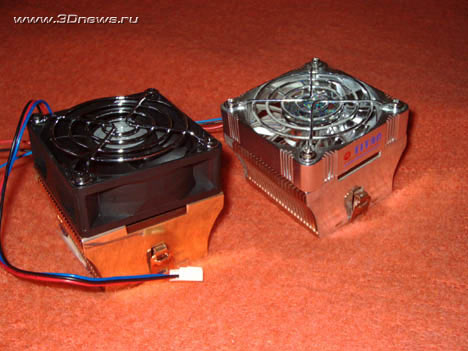
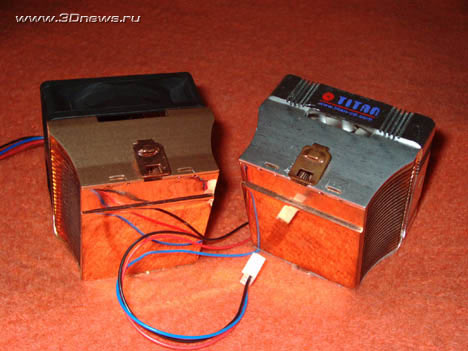
Upon removing the cooler out of the package (coarse cardboard) I noticed its striking similarity with the Titan TTC-CU5TB cooler. Both coolers are equipped with completely identical radiators with the same fastening scheme.
As you can see, the differences between the coolers are only in the fan - and we'll dwell on it in greater detail.
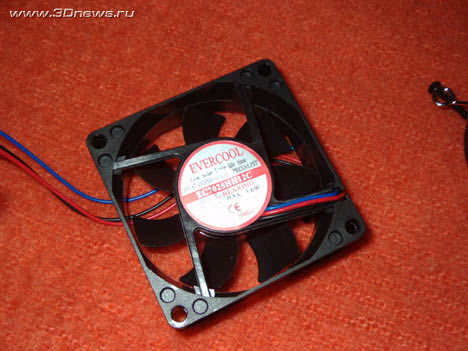
The fan's dimensions are 70x70x25 mm, with the 4200 rpm rotation speed. The air flow that's generated amounts to 42.08 CFM, with the noise level not exceeding 32 dBA. For comparison: the aluminum fan on Titan TTC-CU5TB offers 3500 rpm rotation speed, produces 28 CFM air flow and creates a 28 dBA noise level.
However, these are just paper data of the manufacturer (which sometimes may not be true to life). Under real conditions, the noise coming from both coolers may be enormous. As you remember, in the roundup on Tital cooler I made a conclusion that the cooler can be recommended for buying only if you have a rpm reducing device. So the same recommendation applies to Evercool CUD-725 as well.
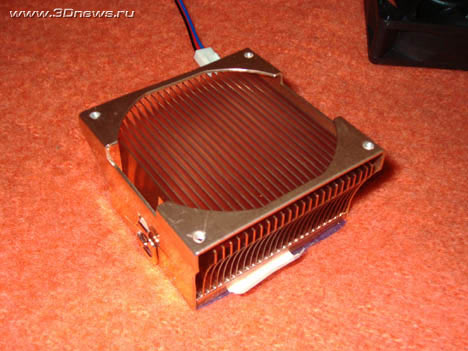
You can reduce the rotation speed absolutely safely - the cooler offers a very good copper radiator, with a large number of thin copper fins and well-polished base.
The processing quality of the base is indeed impressive. Upon removing the protective film (another similarity of Evercool and Titan coolers) in the base, you can watch everything like in a mirror-glass.
Over two dozen copper fins are welded to the base, each having around 1 mm in thickness. To increase the rigidity of the fins, 2 holes are extruded in each of them, with the edges of the holes touching the adjoining fins. As a result, this creates an illusion of two copper tubes.
There is a special metal frame to fasten a fan on the radiator.
To make the cooler look more formidable, the frame is painted to copper color. Actually, I didn't like the fastening of the frame to the radiator - upon some pressure the frame might slip off the fastening ledges.
Here is the interim conclusion: the cooler suits to cooling any SocketA processors (including those overclocked). Among the shortcomings, of note is the high noise level in the nominal mode as well as the unreliable fastening of the frame.
Next
 |
Content: |
 |
|
- Evercool CUD-725
- Evercool CUE-610
- Igloo 2320Pro
- Ajigo MF034-032 (AMD Box)
- Titan TTC-D5TB(F)CU35
- Thermaltake Volcano 8(SE)
- Titan TTC-CU6TB
-
Tests and conclusions
|
Top Stories: |
|
 |
|
MoBo:
|
|
|
|
VGA Card:
|
|
|
|
CPU & Memory:
|
|
|