Power supply unit FSP ZEN 400: perfectly noiseless power

Author:
Date: 20.04.2007 |
|
It is unlikely that some of our readers have not heard about the FSP trademark under which power supply units by FSP Group (Taiwan) have been sold for over ten years. The company is widely known worldwide not only as a developer and manufacturer of various power supply systems and units under its trademark. High percentage of FSP produce is manufactured and shipped on OEM/ODM contracts. So, if there is no FSP marking on your PSU, it is highly probable that it came off the assembly line of this company.  Today on our test bench we are having a very interesting retail novelty of the company - the power supply unit FSP ZEN 400. Above all, it is remarkable for its fan-free, absolutely noiseless cooling system, which is not typical for a 400 W PSU even despite all the variety of modern choice. Today on our test bench we are having a very interesting retail novelty of the company - the power supply unit FSP ZEN 400. Above all, it is remarkable for its fan-free, absolutely noiseless cooling system, which is not typical for a 400 W PSU even despite all the variety of modern choice.
The assembly of a powerful and absolutely noiseless desktop system is a cherished dream, albeit not attainable to all. Where do fans make most noise? Normally, on video cards, chipset circuits, processors, housing fan systems, and of course on PSUs.
It's easiest to sort it out with the video card and chipsets, because there are currently more than enough options with passive cooling. It is all more complicated with the CPU and the in-housing ventilation, but even if you don't hang a pile of pipes on the CPU or a huge piece of copper the way it is in some server systems, anyway there is a way out in the form of an almost noiseless cooler of huge diameter running at a low rotational speed. Left is the power supply unit.
Indeed, these days you can easily make available some good solutions with quiet huge fans or with a cooling system that adjusts the cooler's rotational speed dynamically (and thus the noise level) depending on the load. But ideally it is more pleasant to have a power supply systems which is designedly noiseless.
 Anyway, I am not talking for all the others: personally, I have long had this dream – to fit a powerful noiseless PC at home and not to annoy the ears of mine, my family, my pets, regardless of any level of computational load. That is why on first seeing FSP ZEN 400 at the expo stand of FSP which was presenting its novelties at CeBIT'07 in March I literally "glued my nose" to the showcase with that exhibit (see CeBIT'07, day two. FSP expo stand) and of course I first asked just that for tests.
So as not to get distracted by the inappropriate digression, let me finish my thought on building a noiseless home-based system there and then. The past two years have vividly shown that the computer is growing "vulgar" as it is being promoted into masses, to the market of household electronics. By saying "vulgar" I mean that the formerly "intricate and sophisticated tool for learning the Universe" is increasingly turning to a routine household item like a TV set or a DVD player, while borrowing the design and handling simplicity typical of household appliances.
That would have been fine, but things are not really good with noiselessness in most ways (we are now talking about powerful systems and not about DTR notebooks of MoDT systems). It looks like in practice it is anyway cheaper to ships a few fans rather than a single expensive fan-free PSU. On the moment of writing this article, I was not able finding FSP ZEN 400 PSUs in Russian price lists, but according to overseas sources its price will be well over $100. To cheer you up, I can only say that in Moscow the previous model FSP ZEN 300 can be made available and its price is anyway below $100. Quite possibly, the 300 W version will be quite sufficient for your needs.
To start with, I am bringing in a traditional table of specifications of the PSU as declared by the manufacturer.
|
PSU FSP ZEN 400 Specifications
|
| Rated capacity |
400 Watt |
| PSU input parameters |
Alternating-current mains 110 - 240 V (99-265 V)
Frequency: 50/60 (47 - 63) Hz
Consumption current: 115V/5A; 230V/2.5A |
| Standard |
ATX 12V V2.2 |
| Cooling system |
Passive |
| Declared efficiency |
>85% |
| Output parameters |
+5V: 0A - 14.0A |
| +12V1: 0.2A - 14.0A; peak-point current 15A |
| +12V2: 0.2A - 13.0A; peak-point current 16.5A |
| -12V: 0A - 0.5A |
| +5VSB: 0A - 2.5A; peak-point current 3.5A |
| +3.3V: 0A - 20.0A |
| Distribution of combined load +3.3V&+5V, Max |
130 Watt |
| Security standard |
OVP, OCP, SCP |
| Total rated power |
400 Watt |
| Maximum on-peak power |
560 Watt |
| Output voltage protection |
+3.3V: 3.76-4.8 V |
| +5V: 5.6 - 7.0 V |
| +12V: 13.0 - 16.5 V |
| PFC (Power Factor Correction) |
Active |
| Power consumption in the standby mode |
< 1 W |
| Dimensions |
140 x 150 x 86 mm |
| Acoustic noise |
0 dB at maximum load |
| Environmental standard |
RoHS |
Packaging, package bundle, first impressions
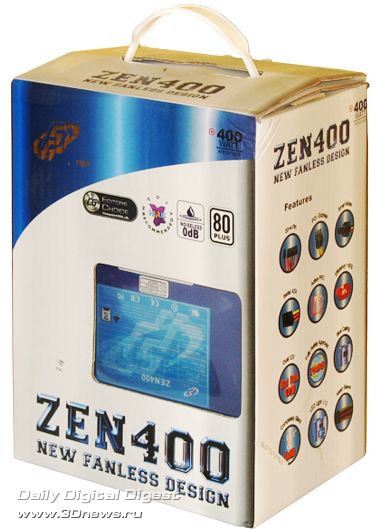
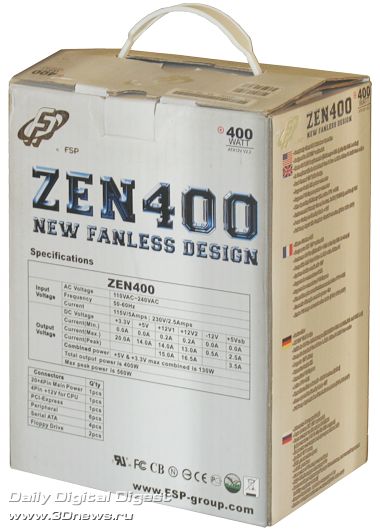
ZEN 400 is shipped in a nice-looking retail package with a handle to carry it around. On the package, there is a window to put up a fine show, with the main specifications on the rear side; on the sides there is a description of the technologies used as well as a brief description of the major advantages in four languages (English, French, German, Russian).
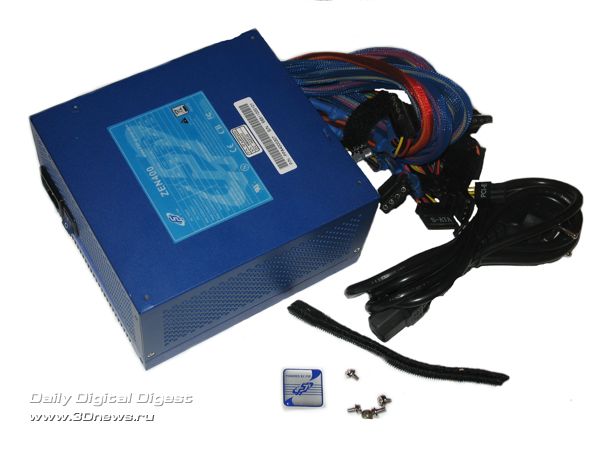
The package bundle of FSP ZEN 400 includes a power cable, a very brief hard-copy user's manual in five languages (English, French, German, Russian, Chinese), fastening screws, proprietary nameplate with the company logo, and a sticker.
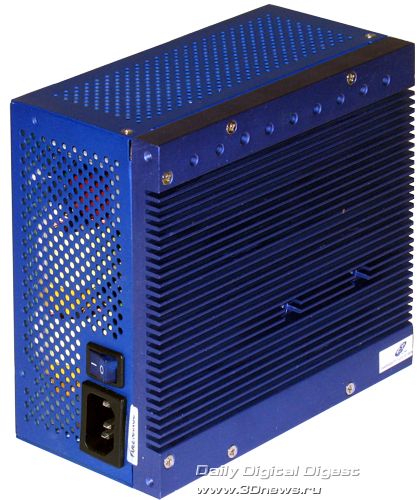
The design of the PSU is delicate - this is a "boxed product": the noble dark blue color of the housing is augmented by the LED highlight on the on-off switch which is of course of glamour blue color!
The weight of FSP ZEN 400 is formidable – as much as three kilos, which is quite normal for the fan-free structure in which nothing else has yet been designed better than a scheme with active PFC and high efficiency as well as good-quality massive radiators.
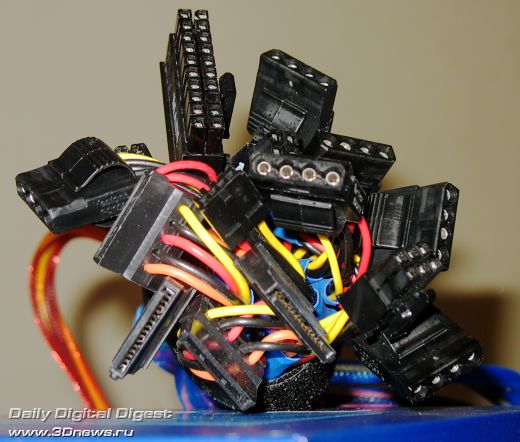
The cable interconnection system is made without the trendy detachable design (which in many ways is absolutely useless) and includes a 24-pin EATX power connector for the motherboard (shared with other devices); a 6-pin power connector for PCI Express devices; two dual power connectors for Serial ATA (2 х 2); a 4-pin 12 V connector, six 4-pin Molex connectors, and one FDD power connector. The cables are packed into a multicolored netlike plastic shield.
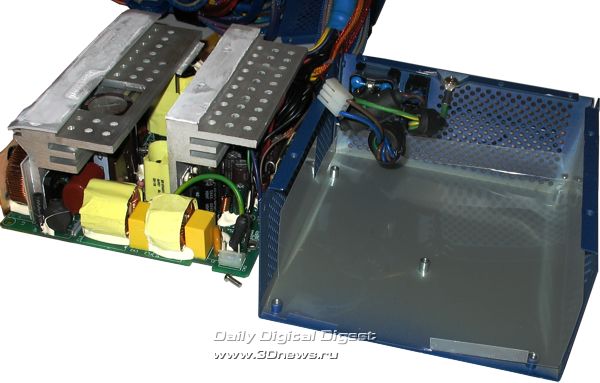
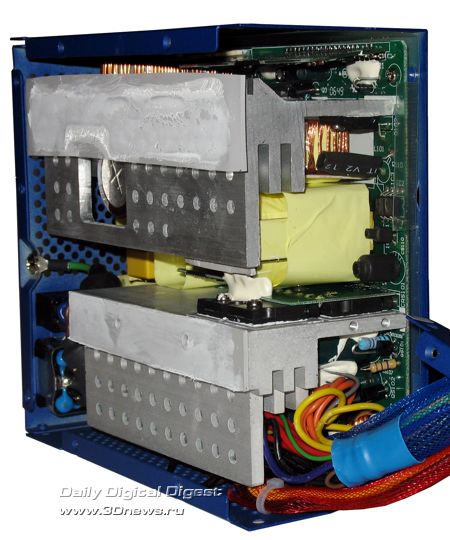
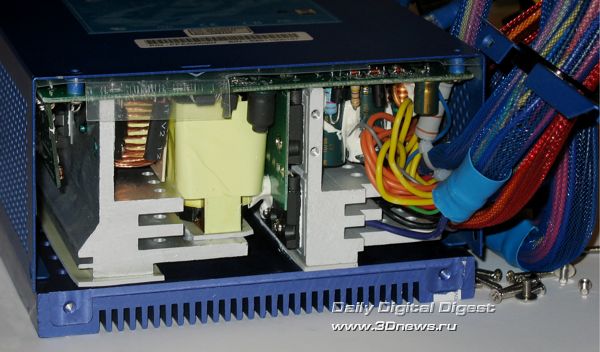
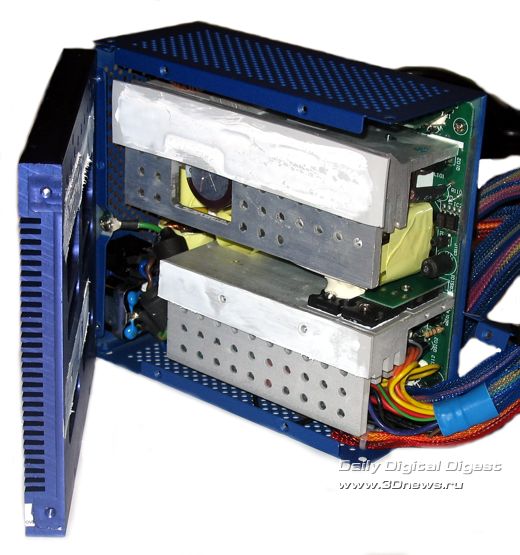
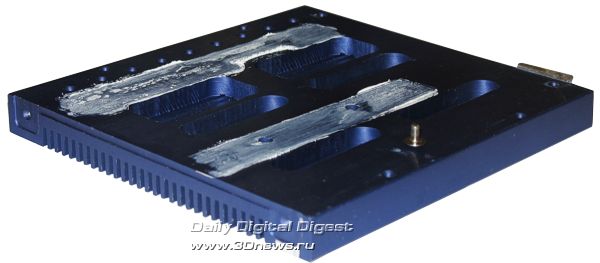
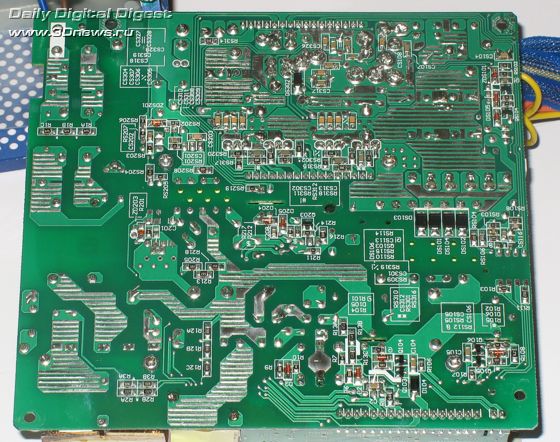
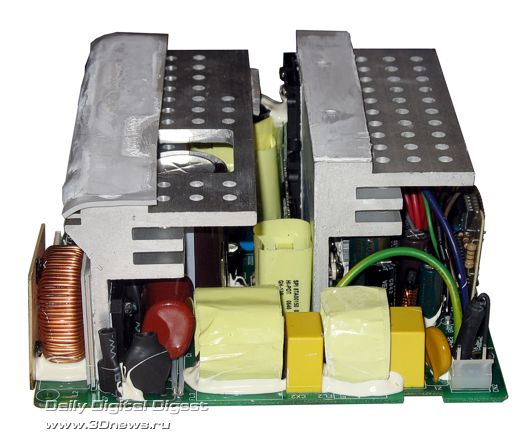
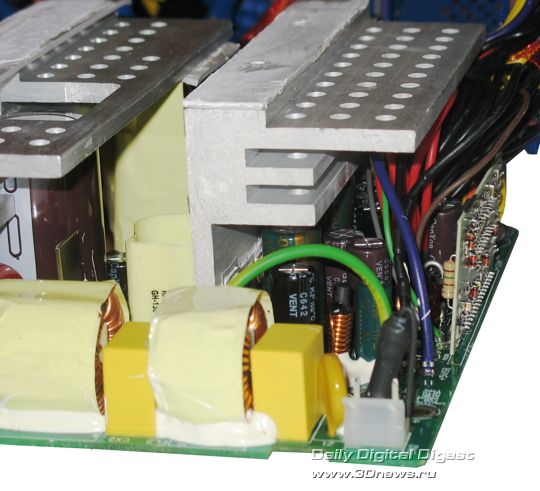
Upon dismantling FSP ZEN 400 down to a screw, you can see the anticipated view – the job of heat absorption and removal is entrusted to powerful radiators which contact the additional heat sink radiator via thermo paste, with the base of the structure used as the radiator.
The base used as a radiator in its turn has a ribbed outer surface with milled recesses inside.
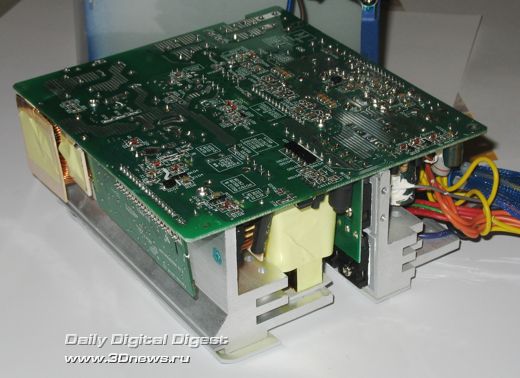
The PSU components are mounted on a single main board, with a few smaller accessory cards soldered into. Unfortunately, I am not an expert at modern circuit technology to present a detailed analysis of the converter circuit used, so I can only suggest that you should feast your eyes with the photos of the system.
 |
Content: |
 |
|
|
Top Stories: |
|
 |
|
MoBo:
|
|
|
|
VGA Card:
|
|
|
|
CPU & Memory:
|
|
|