Debut of AMD AM2: the long-awaited DDR2 on AMD Athlon X2
Date: 23.05.2006 |
|
Let's introduce you to the participants of today's tests. Of course, the AMD Athlon 64 X2 4000+ processor is not a top-end chip in the new line of Socket AM2 processors and is unlikely to break records today. On the other hand, let's look closer at one of the potentially most popular chips – perhaps, it is to the better.
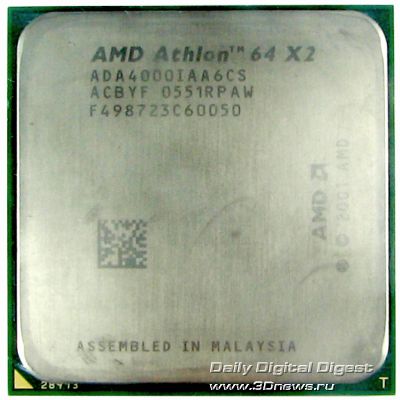
The processor is marked as follows:
AMD Athlon 64 X2
ADA4000IAA6CS
ACBYF 0551RPAW
Let's sort out the OPN of this chip - ADA4000IAA6CS. The first three letters "ADA" which stand for the brand and make, are customary enough, like the four following digits which stand for the PR-rating of the processor. On the other hand, there is no character "I" in the current version of the document "AMD Athlon 64 Processor Power and Thermal Data Sheet". By analogy with the existing notation for this position, where "A" stands for the 754-pin OµPGA packaging, and "D" – the 939-pin OµPGA, we arrive at the conclusion that this time onwards the character "I" has been assigned to 940-pin chips for Socket AM2. The following two characters – "A" and "A" denote the core voltage and the chip package temperature, respectively. Foe both these cases, we find in the tables that "A" stands for "Variable".
That's about all. The table that decodes the value of the following figure like L2 cache size ends with "5", which means 1 MB. This implies that "6" should stand for 2 MB (2 х 1MB). The last two characters stand for the chip's stepping. The official data ends with "CG" – Rev. E4, so "CS" is likely to meet some version of Rev. F.
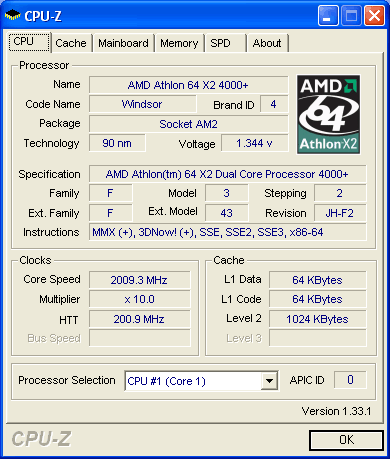
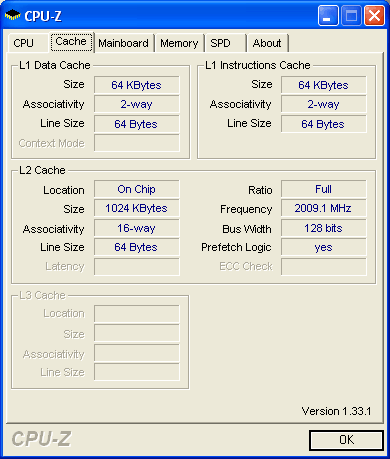
The data acquired with the CPU-Z utility confirms these figures and brings in additional definition on the core's supply voltage and the chip's stepping - Rev. F2.
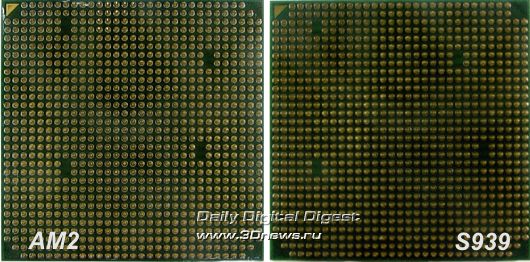
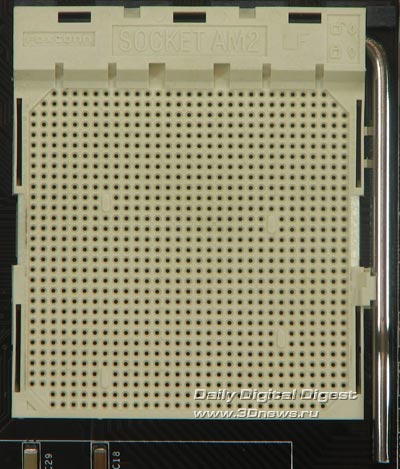
Examination of the exterior of a Socket AM2 processor and Socket AM2 as compared to Socket 939 shows that apart from adding one more pin the positioning of "caps" has been changed, so you won't be able to insert a 939-pin chip into Socket AM2. Some sort of a "fool-tolerance". I mean a fool not armed with a hammer.
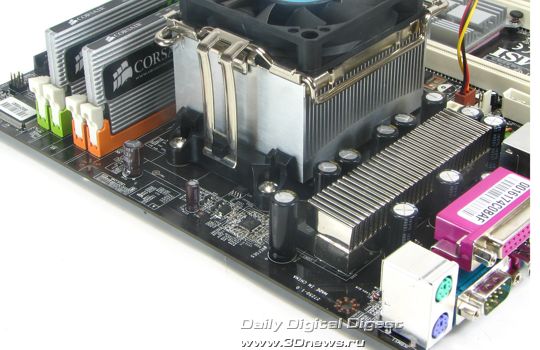
Along with that, of note is the changed fastening of cooling system in systems with Socket AM2. Instead of the customary numerous projections in Socket 754/940/939 systems, in Socket AM2 we find one symmetrically positioned projection to fasten a cooler on each side.
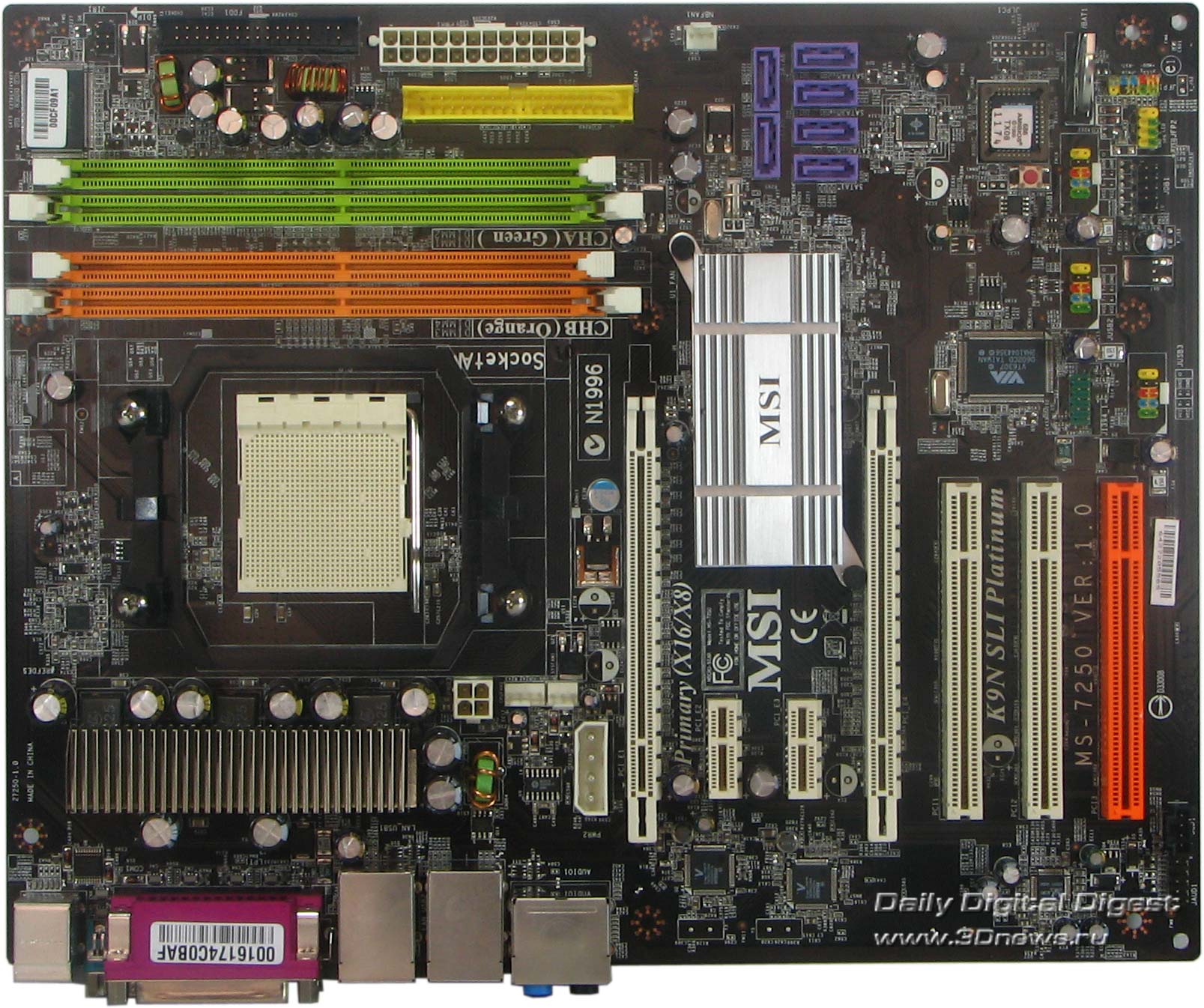
Among the participants of today's test is the MSI K9N SLI Platinum motherboard made in the ATX form factor aimed at operation with Socket AM2 processors AMD Athlon 64/X2/FX.
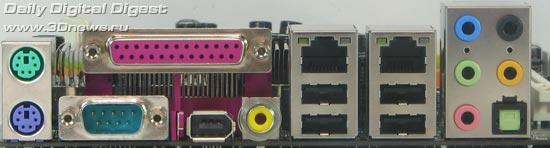
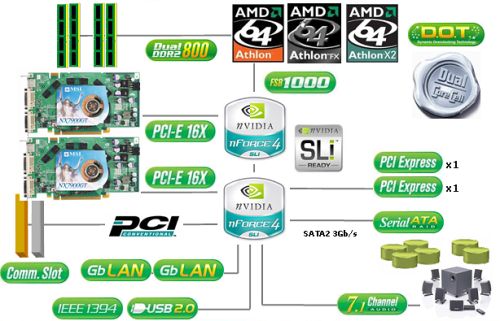
The motherboard is based on the NVIDIA nForce 570 SLI chipset, supports up to four DIMM DDR2-800 modules in the dual-channel mode (up to 8 GB altogether), is equipped with two PCI Express x8 slots (one of them offers support for PCI Express x16), two PCIe x1 slots, three PCI 2.3 slots, four SATA2 interfaces with support for RAID 0, 1, 0+1, and 7.1-channel HD Audio, Dual Gigabit LAN, ten USB 2.0 ports, etc.
The board is also remarkable for its support of the Dual CoreCell technology with the overclocker feature D.O.T. Express and noiseless cooling of components - Silent Heatsink.
On the whole, the new series of NVIDIA nForce 500 chipsets, whose start of deliveries is timed for the announcement of Socket AM2 chips, is made up of four modifications for each market sector where nForce4 SLI X16, nForce4 SLI, nForce4 Ultra, and nForce4 used to dominate.
| NVIDIA nForce 500 |
nForce 590 SLI |
nForce 570 SLI |
nForce 570 Ultra |
nForce 550 |
| Supported processors |
Athlon 64 FX
Athlon 64 X2
Athlon 64 |
Athlon 64 FX
Athlon 64 X2
Athlon 64 |
Athlon 64 FX
Athlon 64 X2
Athlon 64 |
Athlon 64 FX
Athlon 64 X2
Athlon 64
Sempron |
| Components of the chipset |
C51XE + MCP55PXE
|
MCP55P
|
MCP55Ultra
|
MCP55S
|
| Support for SLI |
PCI Express x16 х 2
|
PCI Express x8 х 2
|
-
|
-
|
| Support for LinkBoost |
+
|
-
|
-
|
-
|
| Q-ty of PCI Express lines/ q-ty of buses |
46/9
|
28/6
|
20/5
|
20/5
|
| Max q-ty of PCI slots |
5
|
5
|
5
|
5
|
| SATA/PATA |
6/2 (1 channel)
|
6/2 (1 channel)
|
6/2 (1 channel)
|
4/2 (1 channel)
|
| RAID |
RAID 0/1/10/5
|
RAID 0/1/10/5
|
RAID 0/1/10/5
|
RAID 0/1/10
|
| USB ports |
10
|
10
|
10
|
10
|
| GbE MAC |
2
|
2
|
2
|
1
|
| Support for TCP/IP Offload |
+
|
+
|
+
|
-
|
| Support for Teaming: |
+
|
+
|
+
|
-
|
| Support for FirstPacket |
+
|
+
|
+
|
-
|
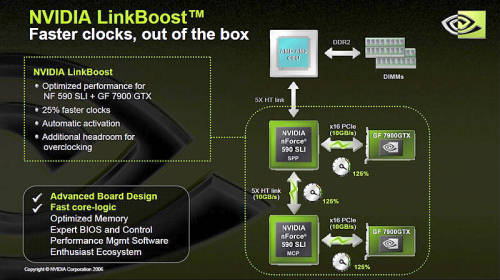
A few brief notes on the specifications of the chipsets. The Link Boost technology implemented in nForce 590 SLI means that in case of using the nForce 590 SLI chipset with the GeForce 7900 GTX graphics the peak performance of the interface goes up by 25% - from 8 GB/s to 10 GB/s.
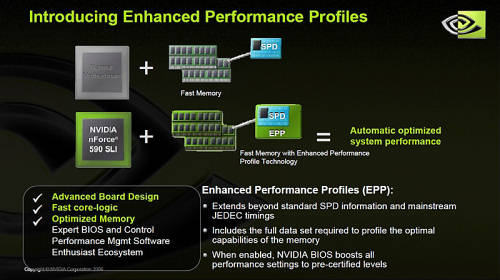
We already wrote about the so-called "SLI Ready" of EPP memory (Enhanced Performance Profiles) in our news and publications. Such memory has already been announced by Corsair Memory, so have to wait till the kits appear in our test labs for running tests.
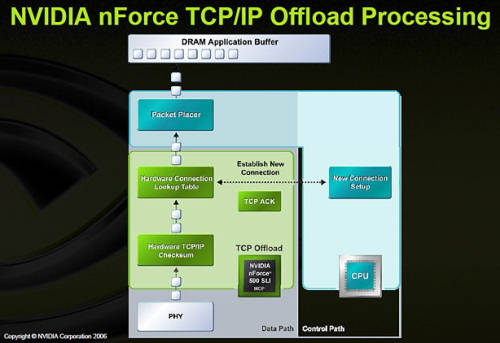
The TCP/IP Offload is familiar to us from versions of chipsets for server applications. It is now available in most chipsets of nForce 500 series, with its operating principle depicted on the slide below.
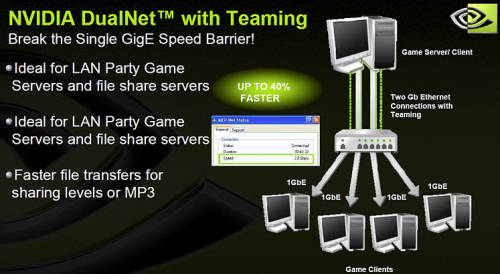
As regards support for the Teaming technology, its idea is about joining two Ethernet MAC levels which are present in chipsets of the new series, to double the bandwidth of the channel. In other words, using two integrated 1Gbps LAN controllers, it is possible to get a unified LAN controller of performance up to 2 Gbps.
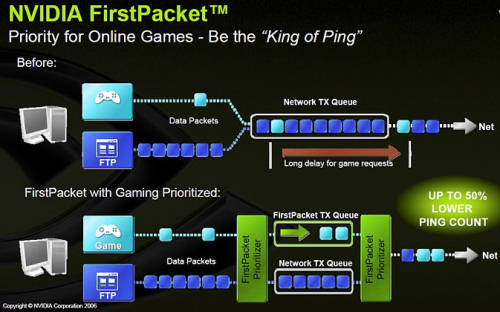
Finally, the FirstPacket feature that optimizes priorities of sending data bursts, including VoIP applications.
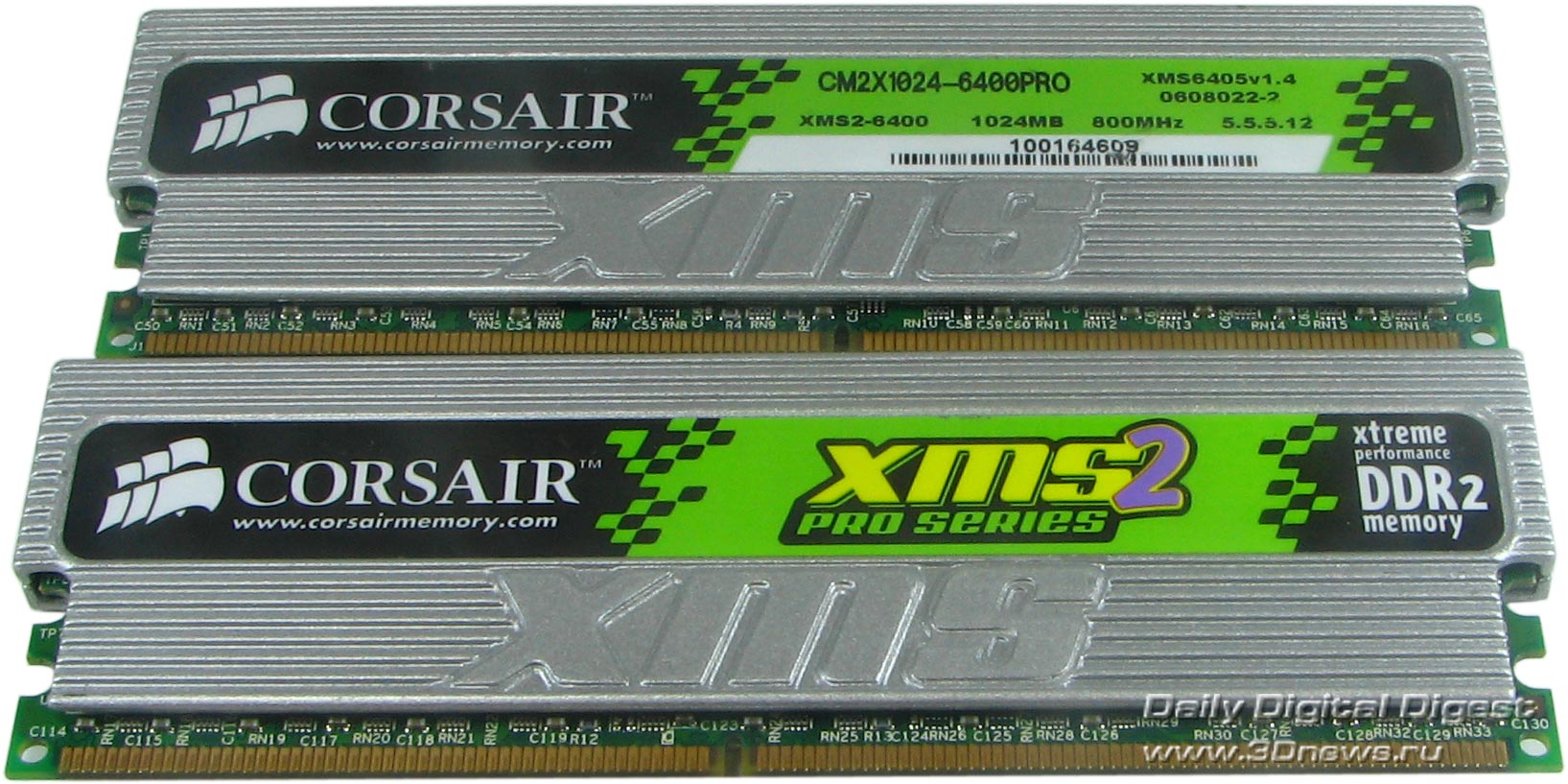
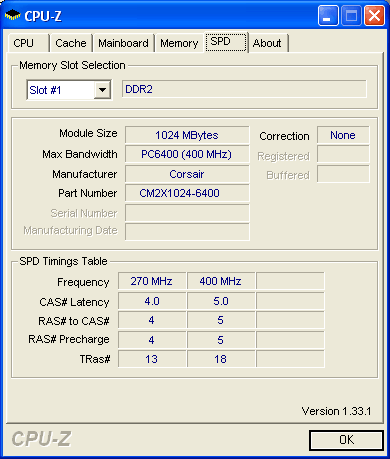
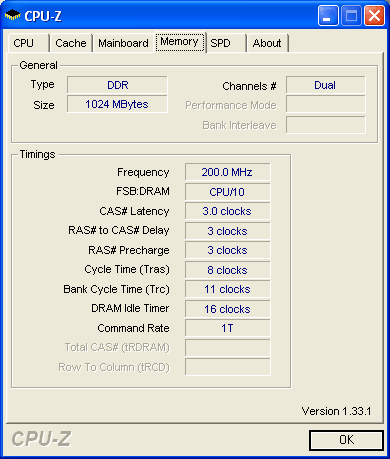
The key item of today's tests is a kit of two 240-pin CM2X1024-6400PRO memory modules of XMS2 6400 series made by Corsair Memory, of 1 GB capacity each, with the latency timings 5-5-5-12.
In the end, we used the following components in the test bench:
Motherboard MSI K9N SLI Platinum (NVIDIA nForce 570 SLI)
Processor Athlon 64 X2 4000+, Socket AM2, 2.0 GHz
Memory Corsair 2 x 1 GB DDR2-800
Video card ATI Radeon X1900XTX 512 MB
As a contender platform, we assembled a system on the following components:
Motherboard MSI K8N Diamond Plus (NVIDIA nForce4 SLI x16)
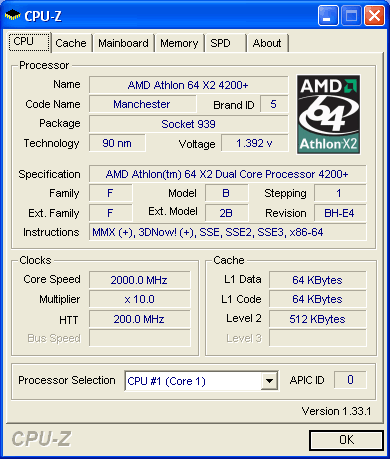
Processor Athlon 64 X2 4200+, Socket 939, nominal clock speed 2.20 GHz
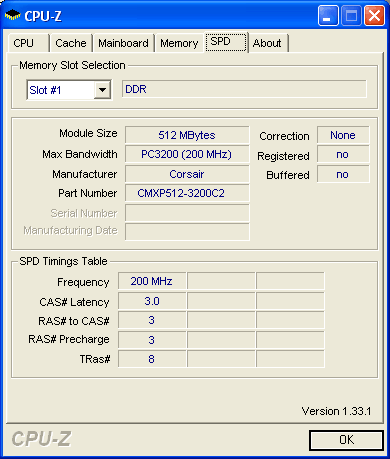
Memory Corsair 2 x 512 MB DDR 400
Video card ATI Radeon X1900XTX 512 MB
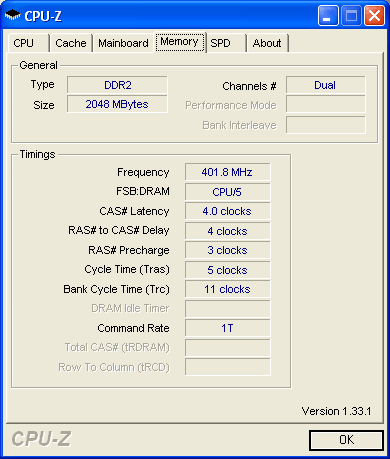
For the purpose of adequate comparison of platforms, we created similar test conditions which were attained as follows: the multiplier of Athlon 64 X2 4200+ is set to 10, that is, the resultant clock speed is set to the same value - 2000 MHz.
 |
Content: |
 |
|
|
Top Stories: |
|
 |
|
MoBo:
|
|
|
|
VGA Card:
|
|
|
|
CPU & Memory:
|
|
|