Tests of Wi-Fi equipment by Hawking Technology

Author:
Date: 25.11.2005
|
|
Hawking Technologies offers a complete line of solutions required for networks at home and small business: from switches, hubs and routers, up to modems, print servers and web cameras.
Hawking do their best to provide users with reliable and modern network solutions, as well as provide high standards of client service and support. To provide maximum customer satisfaction and assert its market standing, Hawking gives highest priority to functionality, ease of use, reliability, and support. The latest developments of the company are aimed at use of the latest networking technologies such as Gigabit Ethernet, ATM, and fiber optics.
In this material, we are reviewing a few wireless network devices 802.11g separately, as well as estimating the worth of the kit both at functionality and the operational speed.
Note that security settings of this equipment allow using various standards and protocols which may put even sophisticated users at a loss, let alone the beginner. Today, it is no longer topical to talk about WEP since its protection has been successfully broken and you can find a lot of materials on that. Therefore, if you wish to secure your network, then you'd better give up WEP in favor of more reliable standards, e.g. WPA. By the way, there are two WPA modes: WPA Enterprise, and WPA-PSK. While the former was developed specially for use in the environment of large organizations and requires using a certificates server and a RADIUS server for user authentication, then WPA-PSK was developed for home users as well as for users at small organizations where there no authentication servers. In case of using the latter, the user has to specify the password to connect to the access point or a router. In case of WPA Enterprise, all that is done automatically. The below reviewed equipment supports two protocols - TLS and PEAP. A certificate issued by the certificate server is required for their operation. In the case of PEAP, the user name and password should also be specified. One of several standards can be used for encryption. Today, the AES (Advanced Encryption Standard) is regarded as the most reliable - to realize it, there is used a special chip which provides reliable data encryption and authentication and is the most efficient in terms of using hardware and software as compared to the previous standards. Note that AES is included in IEEE 802.11i. TKIP is its predecessor and was released as a temporary patch on top of WEP.
HWR54G Router
Hawking suggests using the wireless router HWR54G as the central device of a small network. By the way, a router of such class is rather convenient for use in small office networks to connect computers both via the hardwire and wireless network and granting them access to Internet. In implementing such a scenario, the network will be protected against intruders with the integrated firewall.
Router package bundle
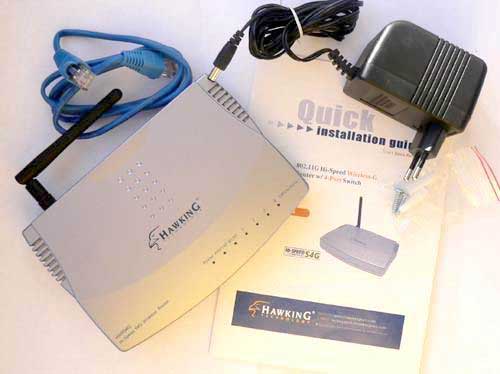
As regards the router's package bundle, all is standard here, there is all it takes to get started with the device: a power supply unit, the router itself, Ethernet cable, detachable antenna, installation and setup guide, a documentation CD, as well as a pack of screws in case you decide to fit the router on a wall.
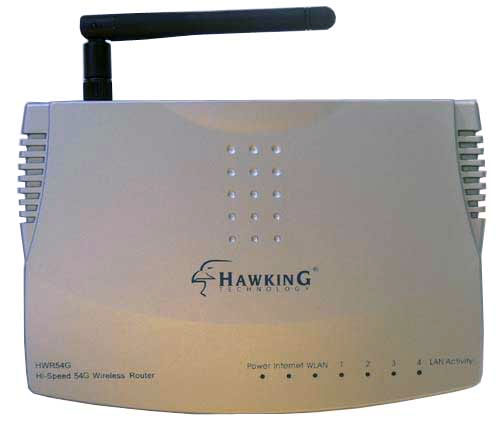
The exterior of the router is quite typical for such devices - a small silvery-grey box about the same size as a 3.5" HDD. All the indicators are positioned on the front side of the router's upper part: Power, Internet (connection and activity of the external channel), WLAN, and four activity indicators of the LAN ports.
HWR54G Router
The rear panel of the router is taken by various connectors. There is a power connector, four LAN ports, a WAN port, a button to reset settings (hidden deep in the housing), as well as a RP-SMA connector to plug in an antenna.
HWR54G router - rear view
On the bottom side, there are four rubber feet under which there are screws fastening the housing panels, two eyes for wall mounting (only in one direction - with the ports upside and the antenna), and stickers with the serial number and device specifications.
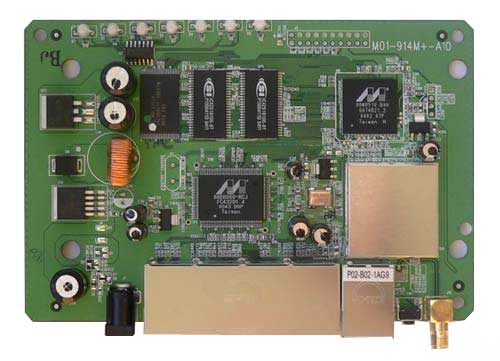
We couldn't help the temptation and dismantled the router. All the components inside were mounted on a single board, including the wireless network module - manufacturers frequently install the wireless module of the miniPCI format.
On the board, two Marvell chips were easy to distinguish. To implement the wireless side, chosen was the 88W8510-BAN chip, and the hardwire side is implemented on the 88E6060-RCJ chip which supports up to six ports, offers a number of features attractive for home-based network devices: auto-detection of the type of connection cable, that is, the user doesn't care which cable should be used to connect a device - direct or cross; a large enough switching table which is able to hold up to 1024 MAC addresses.
.
Router board
|
Overalls
|
|
Make
|
A box that can be fitted as a desktop or a wall-mounted device
|
|
Weight, g
|
280
|
|
Dimensions, mm
|
159 x 128 x 28
|
|
Power supply
|
12 V, 0.8 A
|
|
Operating temperature
|
0 - 40°C
|
|
Specifications of the wireless side
|
|
Standards
|
IEEE 802.11b and 802.11g
|
|
Frequency
|
2.4 GHz
|
|
Maximum distance
|
300 m
|
|
Operational speeds
|
1/2/5,5/6/9/11/12/18/24/36/48/54 Mbit/s
|
|
Manual detection of data transmission speed
|
Yes
|
|
Antenna
|
External, can be turned in two planes
|
|
Antenna features
|
External antenna can be plugged in (via the Reversed-SMA connector)
|
|
Capacity
|
Transmission, 13 dBm
Reception -80 dBm
|
|
Security
|
WEP 64-ex, and 128-, 256-bit
WPA
|
|
Specifications of the hardwire side
|
|
Standards
|
IEEE 802.3 10BaseT Ethernet
IEEE 802.3u 100BaseTX FastEthernet
|
|
WAN interface
|
10BASE-T/100BASE-TX
|
|
LAN interface
|
4 ports for 10BASE-T/100BASE-TX
|
|
Specific features
|
Automatic detection of MDI/MDI-X
|
Set-up and administration
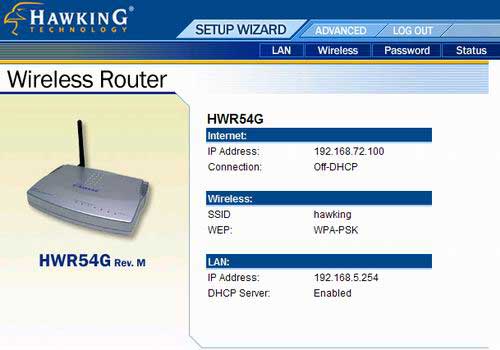
The router is set up only via the Web-interface using the http protocol, and no interfaces other than e.g. telnet are provided. By default, 192.168.1.254 is set as the address of the Web-interface, and to get access to it the computer should be within the network, that is, in the range within 192.168.1.1 to 192.168.1.253, mask 255.255.255.0. Note that the router has an integrated DHCP server, so if IP parameters on your computer are detected automatically, it suffices to refresh them through typing ipconfig /renew in the command line and then move on to the set-up procedure. The interface is made convenient enough and predictable.
First page of the set-up interface
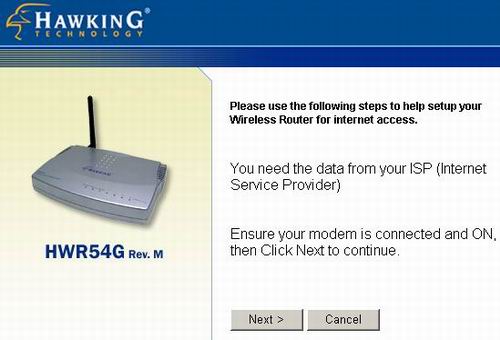
To simplify the set-up, the user is suggested to use a wizard that offers to sequentially set parameters needed to get started.
After launching the wizard there appears a welcome window suggesting to start the step-wise setup. Press Next to select the type of connection for the external interface, then enter the settings appropriate for the selected type. At the final stage the wizard suggests that you should check the operability of connection.
Launching the setup wizard
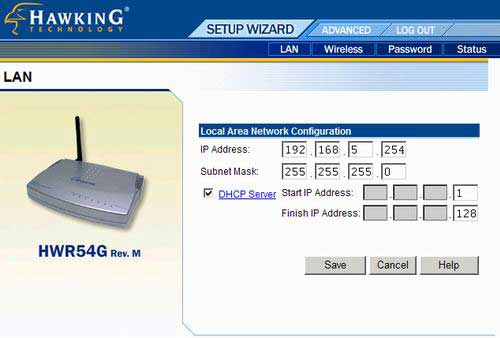
To set up the LAN side, press the "LAN" button in the main interface window. Then the wizard suggests that you should specify the IP address of the router's local interface as well as enable the integrated DHCP server, and set the range of IP addresses.
Setup interface - LAN
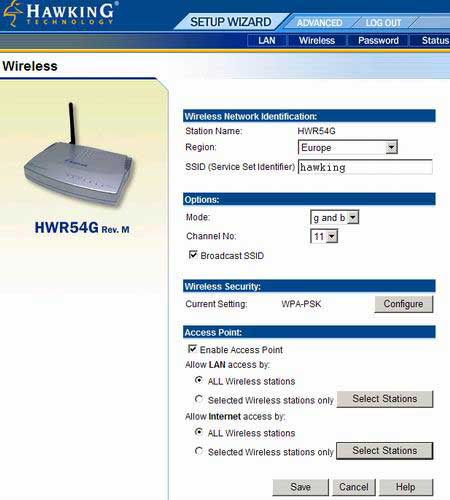
The wireless network setup window is invoked on pressing the following button. There you can specify all the required settings of the wireless interface, starting with the network ID, channel and standard, up to the security and access restriction for wireless clients to the hardwire side of the LAN and to Internet.
Setup interface - wireless network
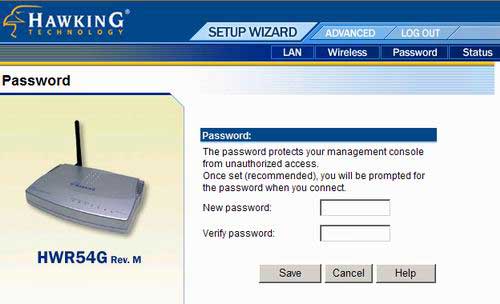
Changing the password is also done via the interface - it's better if you set a reliable password prior to use.
Set-up interface - change of password
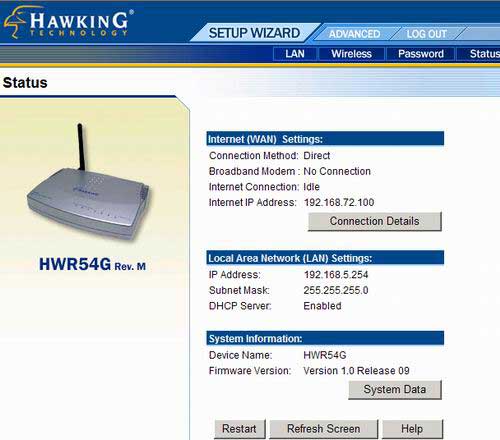
To view the basic system settings, you don't have to go deep into the interface - just press the status button to get the info on parameters and the firmware version.
Setup interface - status
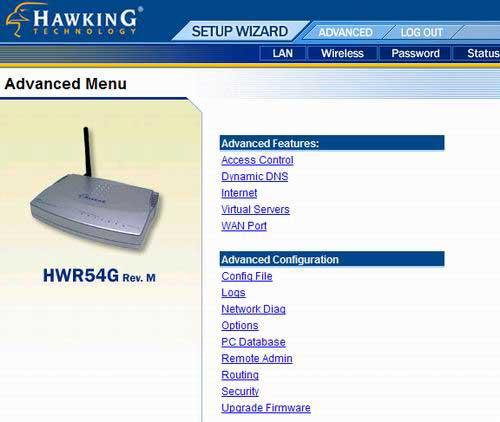
All the remaining settings are hidden in the Advanced section.
Setup interface - advanced
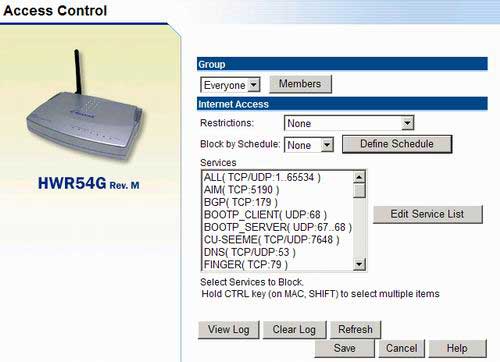
The router provides access control, so you can specify the list of services which will be blocked. Also, it's possible to specify a group of users for which these rules will apply and the schedule for such restriction. The list of predefined services is long enough - nevertheless, you can edit it.
Set-up interface - access restriction
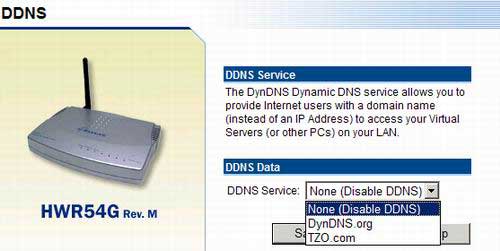
The router supports dynamic DNS, that is, allows publishing your servers in the Internet without having a permanent IP-address. DDNS supports operation with the two services: DynDNS.org and TZO.com.
Setup interface - DDNS
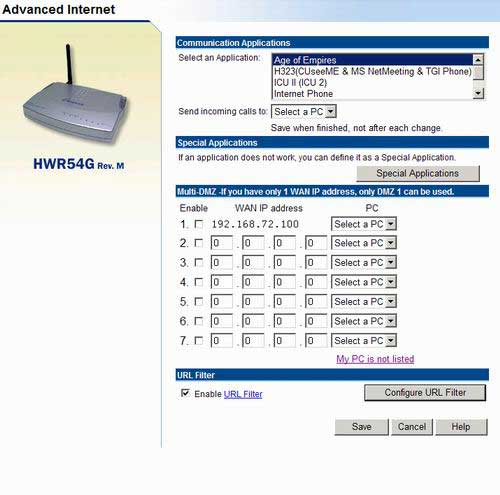
The router is also good enough in terms of support for specific applications - e.g. setting up operation of such applications like IP-telephony, various games, bringing the computer into the DMZ, or simply creating a filter of addresses - all that is a task that any user can easily cope with.
Setup interface - applications
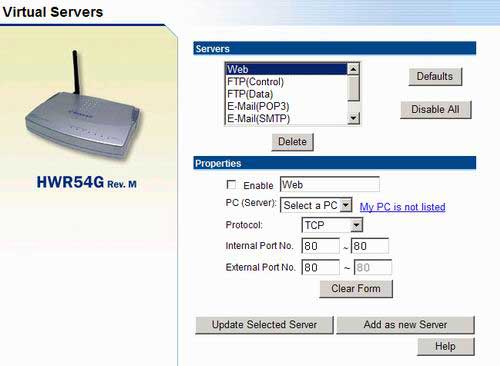
If a server (e.g., Web or FTP) accessible from outside is intended for use within the network, it can be set up in the next section.
Setup interface - virtual servers
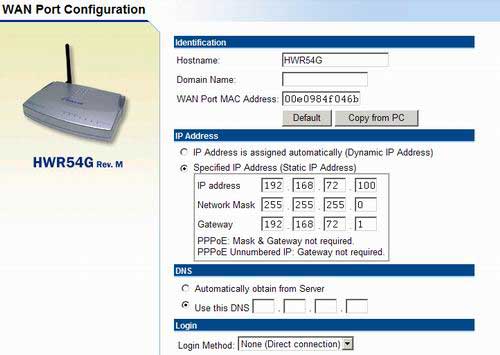
It is not always convenient to use the setup wizard. Manufacturers have always been well aware of that and afforded the opportunity to change settings defined in using the WAN interface setup wizard. There is a separate section for that. There is nothing special in the settings - all that can be changed is seen on the screenshot.
Setup interface - WAN interface
Besides, the router allows setting up a few more parameters: logging, routings, the computer from which administration is possible, and computers that can be connected to the router. As regards the setup, having once tuned the parameters, you don't have to worry about repeated setup after reset since the configuration can always be saved and restored, if necessary.
USB adapter HWU54G
The second device of those that arrived at our test lab is a wireless adapter for the USB interface. Note that apart from the function of a regular adapter, it can be used as an access point. Certainly, its functionality will not be as abundant as in the above reviewed router. Nevertheless, it will let build a wireless network in the "field" conditions without using a dedicated access point.
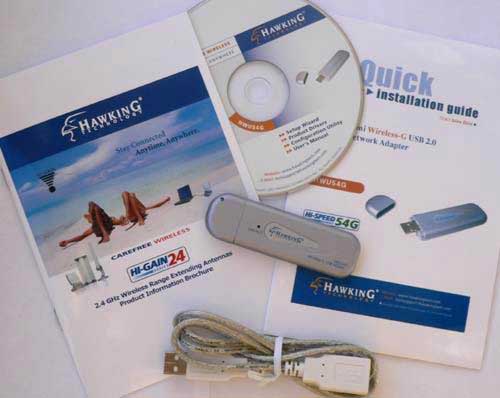
The USB "trinket" is shipped in a stylish package in which you can find the printed version of the quick setup guide, a CD with drivers, software and documentation, as well as a USB extender for convenience of connection to the PC.
USB adapter package bundle
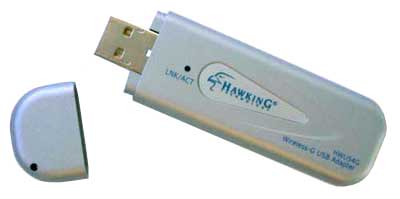
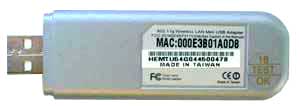
Externally, the adapter looks like a traditional flash storage device as small as cigarette lighter. On the upper part, there is a logo, the model name and the only indicator to display connection/activity. Note that the adapter can be carried around both tied to a string and with keys, that is, used as a trinket. For that, there is a hole in the cap, and you don't have to worry about the loss of the trinket because they are fastened strongly enough, at least, originally.
USB adapter
USB adapter - rear view
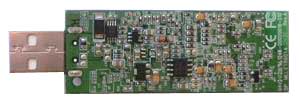
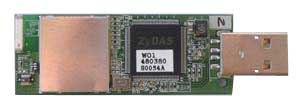
As regards the interior arrangement of the adapter, all is made in a compact and nice way. It's not at all easy to open it up neatly - the halves of the housing are linked with latches which can be broken if overly effort is applied. Inside, there is merely a miniature board with the USB connector firmly attached on it. The adapter is made on the base of the ZyDAS chipset which is in charge of the wireless network.
Adapter board
Adapter board
Next
 |
Content: |
 |
|
|
Top Stories: |
|
 |
|
MoBo:
|
|
|
|
VGA Card:
|
|
|
|
CPU & Memory:
|
|
|