ASRock K7S8XE versus Soltek 75FRN2L ("Golden Flame")
ASRock K7S8XE Board Features
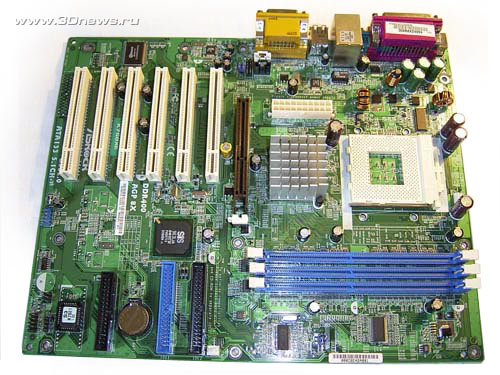
Although the board features only basic functions, it is quite sizeable - 24 x 30cm in dimensions. But that doesn't cause any issues during system assembly. The power socket is positioned in a not quite handy manner though - above the north bridge. As a result, power cables will run above the processor cooler and hinder the air circulation. This is topical for motherboards aimed at overclocking actually, and as we'll see further on, ASRock K7S8XE does not fall within them.
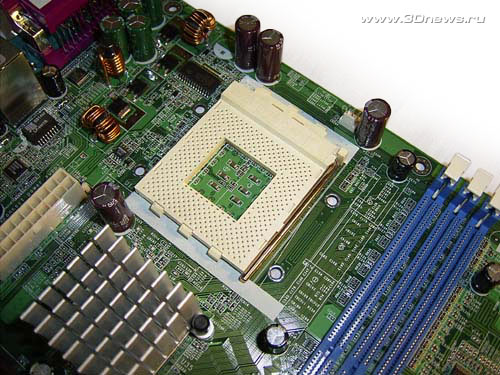
The processor socket is moved off the board's edge at quite a distance, which makes it possible to fit a cooler into already assembled system. But this has to be done very carefully so as not to damage capacitors nearby. Again, since the board is not meant for overclocking, you don't have to worry about its compatibility to nonstandard cooling devices. By the way, there are 4 assembly holes onboard as well as special protective stripes under the socket teeth.
The board features hardware protection against the processor overheating: U-COP (Universal CPU Overheating Protection - sounds very similar to Asus COP :). But the user can't read the core temperature data - only the readings taken from the sensor under the socket.
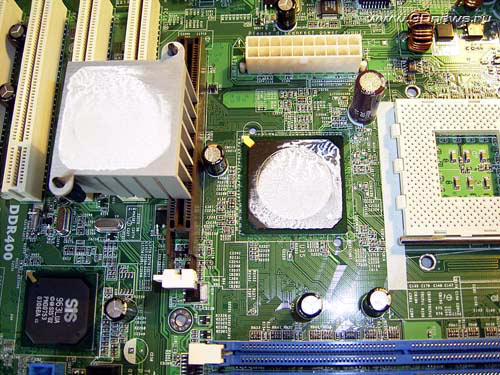
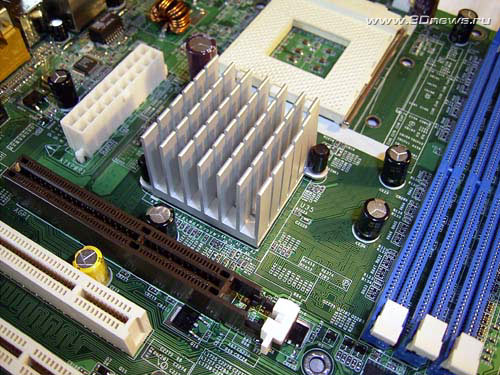
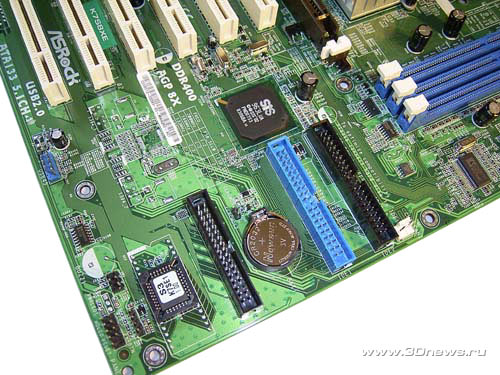
The processor cooler is plugged to the CPU_FAN1 connector. Besides, the board also features the CHA_FAN1 positioned near the IDE connectors. At the same time, the cooling of the chipset is implemented with a passive radiator, which is done in a high quality way:
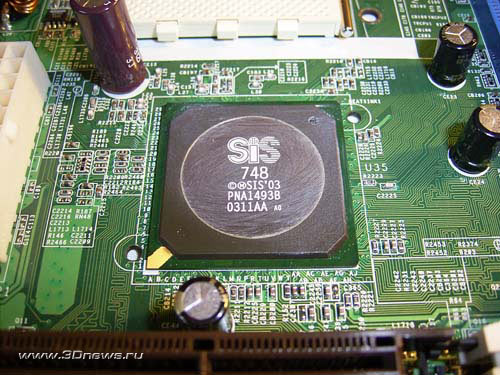
If you scrape off the layer of thermal paste (that's just it on the photo), you will see the chipset - SiS 748.
As for the radiator, it looks very similar to those installed on Asus motherboards.
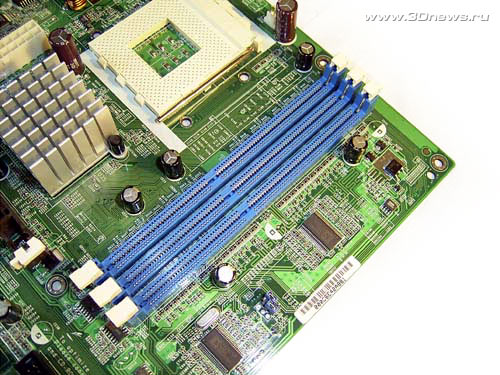
Now regarding the memory configuration. The ASRock K7S8XE board features three DIMM slots. That is, the maximum memory capacity makes up as much as 3 GB provided PC1600/PC2100 modules are used. If PC2700 modules are used, the maximum memory capacity goes down to 2 GB, and to 1GB for PC3200 modules.
Unfortunately, the board lacks a LED to indicate voltage, but actually I didn't expect that from a value board. There is an issue with blocking the DIMM latches by a video card, which comes up in installing a Ti4200 class video card that blocks only the first slot.
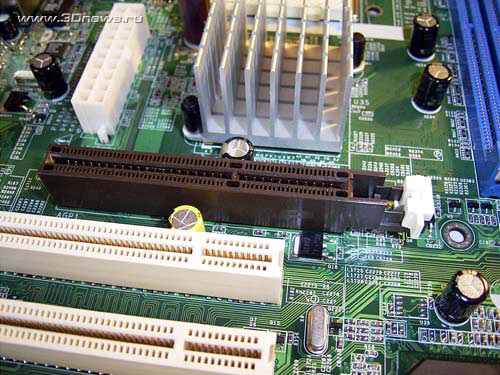
Only 1.5V AGP 4x or AGP 8x video cards can be inserted into the AGP slot. The slot has a small latch to keep a video card fitted firmly in place.
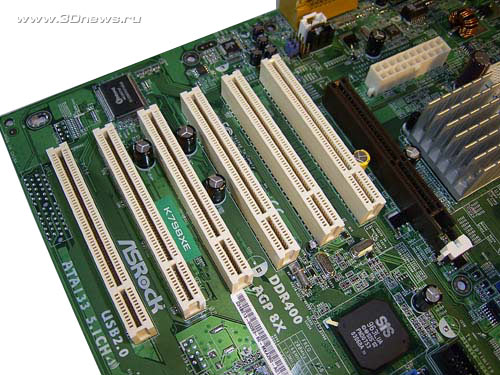
Now on to the expansion options - there are as many as 6 PCI slots onboard. Besides, the wiring provides some space for an AMR slot, but it's not there on the board.
The set of other functions is minimum: the board features AC'97 integrated audio based on the CMI9739A codec. The board also features support for 10/100 Ethernet LAN. Quite decent a set for a value motherboard.
The board offers support for 6 USB 2.0 ports, four of which are mounted on the rear panel, with 2 more ports connected with a header (missing in the package bundle). Besides, there is wiring for IEEE-1394 connectors onboard, although they are not installed. Reminding it again that K7S8XE features a "cut-down" version of the SiS 963L south bridge which lacks support for the Firewire serial bus.
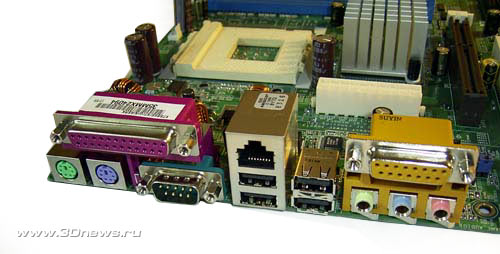
The design of the rear panel is quite out of the ordinary.
First off, the COM2 port is missing, for which only wiring is provided (in the upper right-hand corner). But the main issue is the way the PS/2 connectors are positioned. Normally, assembly operators are used to seeing the keyboard connector in the bottom corner, while K7S8XE offers a mouse connector over there instead. If only ASRock had a notable name and impressive reputation, such a move would be understandable (the way Abit did on MAX series motherboards). But for a novice, such a change of standards looks rather strange.
Anyway, that's not the most critical issue. What's much worse is that the metal limiter on the LAN connector (RJ45) on my board specimen was a bit narrower than it should be as per standards. Therefore, I was unable to plug in the LAN cable at all.
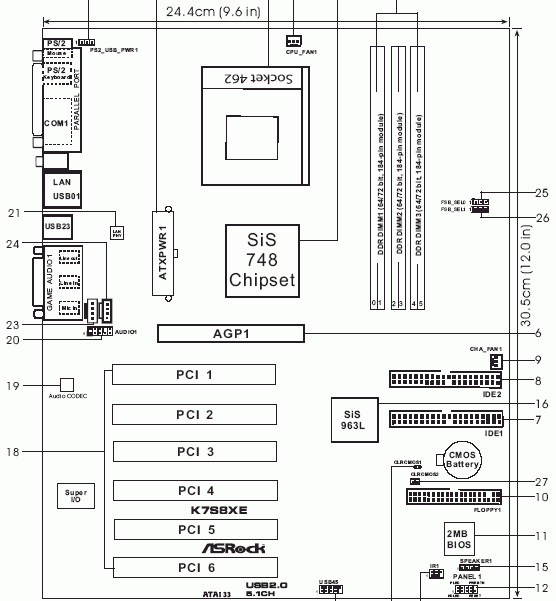
Traditionally, a jumpers layout diagram:
There are not so many jumpers on the board: the PS2_USB_PWR1 is positioned near the PS/2 ports and is meant to enable the "wake-up on keyboard" function, with the CLRCMOS1 near the battery cell to clear the CMOS settings. Besides, the ASRock K7S8XE board offers 2 jumpers with which we can set the base system bus speed. These are the FSB_SEL0 and FSB_SEL1 located under the DIMM slots.
When installing a Barton XP2500 processor with the FSB set to 166 MHz the system simply wouldn't start under the 100/133 MHz combinations. That must have been because of the BIOS flaws of which we'll be talking now.
Next
 |
Content: |
 |
|
- Specifications
- Layout
- BIOS, monitoring
- Overclocking and stability
- Soltek 75FRN2-L Board Features
-
Performance and conclusions
|
Top Stories: |
|
 |
|
MoBo:
|
|
|
|
VGA Card:
|
|
|
|
CPU & Memory:
|
|
|