Biostar TA780G M2+ and ECS A780GM-A: value products of wide capabilities
Author:
Date: 25.04.2008 |
|
BIOS, monitoring, overclocking tools
The BIOS of both the motherboards is based on the AMI BIOS version. The BIOS of the Biostar board has proved surprisingly rich.
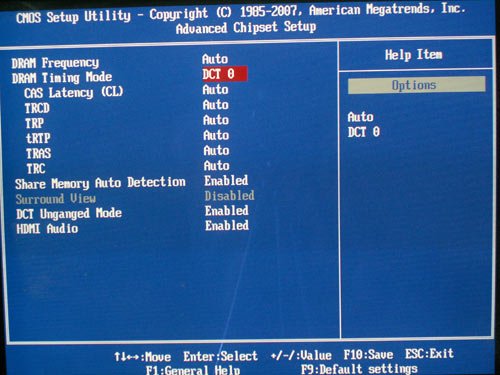
We start with the memory settings. First, the Biostar board offers a wider range of the latency timings:
As regards the setting of memory frequency, both the boards allow setting any available frequency supported by the 780G chipset. Note that the BIOS of the ECS board has not yet polished and does not determine the CPU type (in particular, the frequency DDR2-1066 is not supported by the test processor based on the Orleans core).
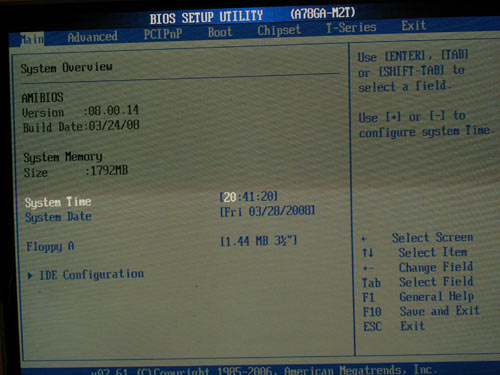
Finishing the talk about the memory, we note that the user can control the memory capacity allocated for the needs of the integrated video core:
Now look at the system monitoring section.
Both the motherboards display the current temperatures for the CPU and the system, rotational speeds of all the two fans, as well as voltage levels. The Biostar board detects all the major voltages, whereas the ECS board keeps track of only the CPU voltage (Vcore) and the memory voltage (Vmem).
Besides, the boards offer support for the Smart Fan feature that allows for a dynamic adjustment of the CPU cooler's rotational speeds depending on the CPU temperature.
We should also note that the Biostar board displays system monitoring info on the POST screen:
As we already stated, the BIOS of the Biostar board is more functional (as compared to the ECS and the previous Gigabyte board). In particular, it offers the integrated RAM test.
There is another integrated utility which allows editing the BIOS firmware.
The program looks for the firmware file on all the accessible disks but unfortunately in the root directory only.
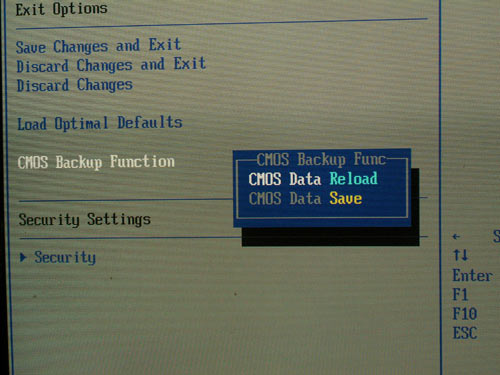
Finally, the Biostar board allows storing and loading sets of BIOS settings as profiles. The user can choose ten profiles like these!
As regards the software part, the Biostar comes bundled with the monitoring utility, as well as a utility to update the BIOS (both the programs are powered by Windows XP/Vista).
There is one more utility aimed at communication with the Biostar support service; and the program (called eHot-Line) collects the system info thus releasing the user from detailed description of all the components and settings.
Overclocking and stability
Before we move on to Overclocking, let's look at the power converters. The PWM of the ECS board uses a 4-phase scheme in which there are six 820 mkF and four 270 mkF capacitors. The PWM of the Biostar uses a 3-phase power scheme, in which there are five 820 mkF and three 330 mkF capacitors.
Now on to the overclocking features.
| Board |
Biostar TA780G M2+ |
ECS A780GM-A |
| Multiplier adjustment |
+
|
-
|
| HyperTransport multiplier adjustment |
+
|
+
|
| HTT adjustable |
within 200 MHz to 600 MHz (1 MHz) |
within 200 MHz to 500 MHz (1 MHz) |
| Vcore adjustment |
within 0.8 to 1.4 V (0.025 V); +0.3V; |
within 0 to +0.252V (0.004V) |
| Vmem adjustment |
within 1.95 to 2.65V (0.1V) |
within 0 to +0.63V (0.01V) |
| GFX frequency adjustment |
within 150 MHz to 1000 MHz (1 MHz) |
within 100 MHz to 999 MHz (1 MHz) |
| Vdd adjustment |
within 1.15 to 1.45V (0.1V) |
- |
| Vht adjustable |
within 1.2 to 1.5V (0.1V) |
- |
We note the following traits of the motherboards at overclocking. First, if the CPU clock speed is deliberately set too high, the Biostar board performs a couple of reboots and starts up at the nominal speed while saving all the custom settings. That is, a chance is given for slight changes. The ECS board can't do that and deadly hangs (you have to clear the CMOS).
Also, as can be seen from the table, the Biostar board offers more overclocking features and wider adjustment ranges. Besides, the board has an overclocking tool specially for "newbies" – "Auto Overclock".
While selecting the maximum value, the HTT rises by 10%, which is no fun. Now let's look at the real results of overclocking.
The Biostar board started up at 286 MHz, which is less than the result for the Gigabyte board based on the 780G chipset. However, this result is much higher than those for the ECS board whose maximum frequency is 220 MHz. Quite possibly, the capability of the ECS board is much higher, but we won't be able to measure it without features for raising voltage on the chipset and multiplier adjustment.
Now let's see how the integrated video core has overclocked. The result for the Biostar board is 860 MHz, that for the ECS board - merely 640 MHz (because of the lack of features for raising the Vdd voltage).
By the way, the Biostar board started up at the frequency of the Radeon HD3200 core set to 950 MHz and was able to pass 3D tests at 900 MHz (albeit with the drop in speed and with artifacts). However, this fact shows that if engineers at Biostar increase the adjustment range for Vdd in the future versions of the BIOS, the results for GPU overclocking will go up.
 |
Content: |
 |
|
|
Top Stories: |
|
 |
|
MoBo:
|
|
|
|
VGA Card:
|
|
|
|
CPU & Memory:
|
|
|