Gigabyte MA790FX-DQ6
Author:
Date: 10.10.2007 |
|
Overclocking and stability
Prior to moving to overclocking, let's look into the power converter. It uses a 10-phase power scheme, in which there are three 330 mkF and fifteen 561 mkF capacitors.
To facilitate the thermal mode of the power supply module, there is quite a massive radiator on the power components.
Now on to the overclocking features.
First off, Gigabyte MA790FX-DQ6 allows adjusting the HTT speed within 200 to 500 MHz in 1 MHz increments.
Of convenience is that you can enter the desired FSB value from the keyboard.
Secondly, Gigabyte MA790FX-DQ6 allows adjusting the CPU voltage (Vcore) within a very wide range: within 0.8V to 2.325 V in 0.025 V increments.
The advanced user can raise the Vmem by 0.5V (in 0.05V-0.1V increments).
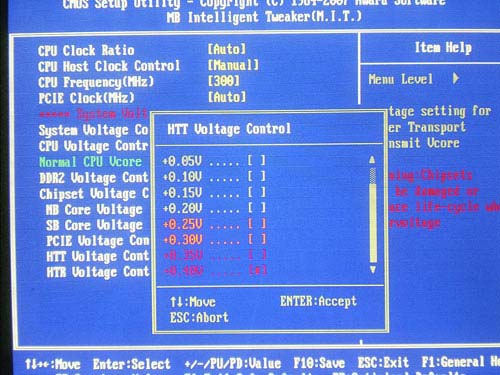
The programmers at Gigabyte have implemented a multi-colored highlighting of values. Safe values are highlighted in customary yellow, with those relatively safe highlighted in pink. And voltage values which may result in a damage to the system components are colored red and are blinking.
We get a feature for raising voltage on the north bridge (by 0.45V in 0.05V increments)
and on the south bridge (by 0.4V in 0.05 V increments).
Besides, the user can raise voltage on the HTT (by 0.4V in 0.05V increments),
and voltage on HTR
and that on the PCI Express bus.
The latter two parameters have similar ranges and allow for the maximum increment = 0.45 V in 0.05 V steps.
It is also possible to adjust the PCI Express bus speed within 100 MHz to 200 MHz:
Also worth noting is the feature for adjusting the multiplier:
Besides, in the sections in charge of setting the chipset, there is a very important feature for adjusting the bus multiplier - HyperTransport:
In the same section, there are also other settings for the HT bus:
This is the section for setting the PCI Express v2.0 bus:
Now let's try the overclocking features in practice. So, Gigabyte MA790FX-DQ6 has demonstrated quite good results: a stable operation at FSB =333 MHz with a 3500+ CPU.
That is of course less than what the best boards based on NVIDIA chipsets and the previous boards based on ATI chipsets demonstrated, but this result is not bad at all indeed for an engineering sample.
The overclocking is possible both from within Windows and using the same EasyTune 5 utility. And it allows overclocking not only the CPU with the memory,
but the video card as well:
At the same time, we got the highest result at overclocking just with this utility. The thing is, when tuning the overclocking parameters from within the BIOS the board ignores adjustment of the multiplier and always starts up with the nominal multiplier. Clearly, this flaw is related to the engineering sample and the debugging version of the BIOS, and the problem will be fixed before the board arrives in the retail. Therefore, we adjusted the multiplier with EasyTune 5 which did that quite well.
 |
Content: |
 |
|
|
Top Stories: |
|
 |
|
MoBo:
|
|
|
|
VGA Card:
|
|
|
|
CPU & Memory:
|
|
|