Intel P35 / X38 Motherboards Roundup
Author:
Date: 21.02.2008
|
|
ASUS Maximus Formula (Intel X38; DDR2)
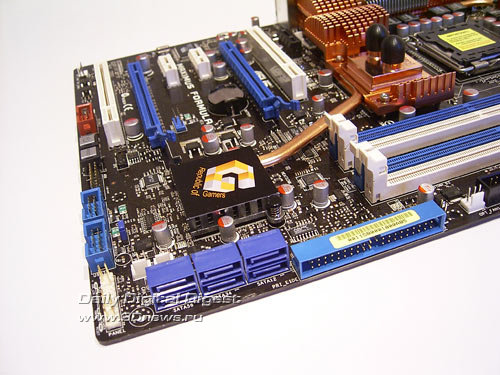
First of all, we note that ASUS Maximus Formula is aimed at DDR-2 memory, which makes it more attractive to the user. Despite the similar naming, this board is not an analog to Maximus Extreme, since it is made on an absolutely different PCB design. In particular, there are 2 (not 3) PCI Express x16 slots as it is on the Extreme version. There are less explicit difference and they are all to the advantage of the Formula version.
The expansion options are powerful, albeit not maximum: two Gigabit LAN controllers, two Firewire ports, and an additional ParallelATA controller.
As the latter, the engineers at ASUS used the JMB368 chip which supports only one PATA link (the Extreme version uses the JMB363 chip which supports 2 SATA II links as well). Therefore, the number of SerialATA links remained the same - 6. We also note support for 12 USB2.0 ports and 8-channel audio subsystem implemented on a separate SupremeFX II board.
Besides, the board uses two PCI Express x16, three PCI Express x1, and two PCI slots.
On the rear panel, there is no LPT port, COM ports and a PS/2 connector to plug in a mouse. On the other hand, there is an optical and coaxial SP-DIF outputs, as well as a Firewire port.
The board also has a button to clear the CMOS settings (works only in a certain position of the CLRTC_SW switch), a connector to plug in the LCD-Poster, with radiators installed instead of the missing ports. There is also a couple of buttons - Power, and Reset.
At the BIOS settings, Maximus Formula is not inferior to the Maximus Extreme version. This applies to both the memory settings,
and the system monitoring section. In particular, the boards display the current values of the CPU and system temperatures, temperatures of the north and south bridges, as well as temperatures from three additional thermo sensors which are available in the package bundle. Besides, the board keeps track of voltages, rotational speeds of all the eight fans, six of which having the (Q-Fan2) feature to adjust the rotational speed of the CPU cooler depending on the temperature of varied components.
Also, ASUS Maximus Formula is able saving all the BIOS settings into memory and loading them on demand. It supports two independent profiles:
The overclocking options suffer from some non-critical flaws which will be fixed in the forthcoming BIOS versions:
ASUS Maximus Formula allows adjusting the FSB within 200 to 800 MHz, raising the CPU voltage to 2.4V, on the memory - to 3.4V, on the north bridge - to 1.85V, on the south bridge - to 1.225V, and on the FSB bus - to 2.0V. While running the tests, we were able attaining a stable operation at the maximum possible FSB=558MHz.
Although the ASUS Maximus Extreme version is superior over the Formula version in many ways, in our view - the Formula version is more attractive: its support for the cheaper DDR2 memory fully makes up for the other shortcomings. I am sure at 350$ the user can raise the functionality of the Formula version to that of the Extreme version and even buy rarely available external thermo sensors. The only thing which can't be made available for this money (and even greater amount) is the third PCI Express x16 slot.
Pros:
- High stability and performance;
- 8-phase CPU power scheme;
- 2-phase memory power scheme;
- Two PCI Express x16 v2.0 slots;
- Support for SerialATA II/RAID ( 6 links; ICH9R);
- Support for one P-ATA link (JMB368);
- Two LAN controllers (Gigabit Ethernet);
- Support for USB2.0 (12 ports) and IEEE-1394 (Firewire, 2 ports);
- A wide selection of ASUS' proprietary technologies (PC Probe II, EZ Flash 2, CrashFree BIOS 3, MyLogo2, Q-Fan 2, etc.);
- Additional set of AI Proactive technologies (AI Overclock, OC Profile, AI Net 2, etc.);
- Fluid passive/active system for cooling the chipset and the power supply module;
- Power and Reset buttons;
- Reasonable price;
Cons:
- The package bundle does not match the level of a high-end product;
- Some flaws in the overclocking part;
The board's specific features:
- 8-channel audio subsystem is on the SupremeFX II board;
- On the rear panel, there are six USB 2.0 ports and a button to clear the CMOS; no LPT and COM ports, no PS/2 for the mouse;
For a detailed review, read ASUS Maximus Formula
 |
Content: |
 |
|
|
Top Stories: |
|
 |
|
MoBo:
|
|
|
|
VGA Card:
|
|
|
|
CPU & Memory:
|
|
|