MSI P7N Diamond vs. MSI P7N SLI Platinum
Author:
Date: 17.03.2008 |
|
BIOS
The BIOS of both the motherboards is based on the AMI BIOS version and is similar in many ways.
The section in charge of memory operation settings looks like this:
The next important parameter that affects the performance is setting the memory operating frequency.
The boards allow adjusting the memory frequencies within DDR2-400 to DDR2-1400, but only in the Manual (Unlinked) mode. There is no kit of preset multipliers in the Linked mode (the way it is on ASUS' and Gigabyte's boards). As regards compatibility to various RAM modules, we found no issues about that with the boards.
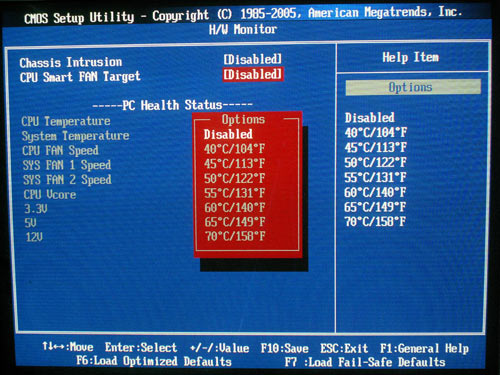
Now look at the system monitoring sections which are almost similar.
The boards display the current temperature values for the CPU, system (in the Diamond version, this temperature is detected with an error) and offer the feature for adjusting the rotation of the CPU cooler depending on the CPU temperature (SmartFAN).
Both the boards are able storing and loading the BIOS settings as profiles (two profiles are supported).
All the settings done from within Windows are gathered in the MSI Dual CoreCenter utility.
There is also MSI LiveUpdate which is aimed at updating the BIOS firmware, drivers and utilities via Internet.
Overclocking and stability
Before we move on to Overclocking, let's look at the power converters. The PWM of MSI P7N Diamond offers 8-phase scheme, without customary capacitors. The PWM of the MSI P7N Platinum uses a 4-phase power scheme, in which there are ten 820 mkF and four 470 mkF capacitors.
All the overclocking tools are gathered in the "Cell Menu" section:
| Board |
MSI P7N Diamond |
MSI P7N SLI Platinum |
| Multiplier adjustment |
+ |
+ |
| FSB adjustment |
within 100 MHz to 625 MHz (1 MHz) |
within 100 MHz to 625 MHz (1 MHz) |
| Vcore adjustment |
+0.3875V (0.0125V) |
+0.3875V (0.0125V) |
| Vmem adjustment |
within 1.8V to 2.8V (0.05-0.1V) |
within 1.8V to 3.1V (0.05-0.1V) |
| Vdd adjustment |
within 1.2V to 1.6V (0.025-0.05V) |
within 1.2 V to 1.6V (0.04-0.08V) |
| Vsb adjustment |
within 1.5V to 2.0V (0.025-0.05V) |
within 1.5V to 1.7V (0.03-0.04V) |
| Vsb-io adjustment |
- |
- |
| Vtt adjustment |
+ |
within 1.2 V to 1.6V (0.025-0.05V) |
| PCI-E adjustment |
within 100 MHz to 200 MHz (1 MHz) |
within 100 MHz to 200 MHz (1 MHz) |
We should also note the MSI D.O.T. - a utility for dynamic overclocking:
Now let's look at the practical results of overclocking. The maximum stable FSB speed in MSI P7N Diamond equals 400 MHz; in MSI P7N Platinum – 333 MHz.
The problem is that MSI P7N Platinum started at ~350 MHz and reported that on the POST screen. But once the Windows boot-up was complete, the FSB was equal to the nominal.
 |
Content: |
 |
|
|
Top Stories: |
|
 |
|
MoBo:
|
|
|
|
VGA Card:
|
|
|
|
CPU & Memory:
|
|
|