Intel P35 Motherboards Roundup Review
Author:
Date: 27.12.2007 |
|
ASUS Blitz
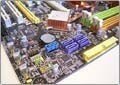
While developing motherboards of the Blitz series, engineers at ASUS created a new PCB design which makes a big difference from that of the P5K series boards. The most substantial difference is about the Crosslinx chip which allows symmetrically distributing 16 PCI Express bus lanes over the two PCI-E x16 slots. In the end, 8 lanes are allocated to each slot, which allows for a more efficient use of the Crossfire technology. We even started two NVIDIA video cards in the SLI mode, but for that we had to use unofficial drivers.
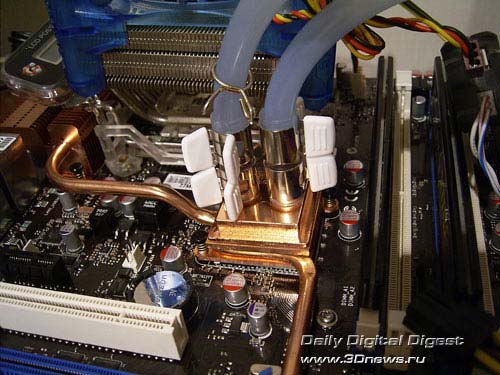
The second major distinction is the water block which is installed on the north bridge and connected to the radiators on the south bridge and the power supply module using heat pipes.
We should also mention that the Blitz series includes the two motherboards: Extreme with support for DDR3, and Formula with DDR2. Both the products fall within the "Republic of Gamers" series which is aimed at overclockers and computer enthusiasts. That is seen from the water block and the additional DVD with the S.T.A.L.K.E.R. game, as well as varied nice bonus items in the package bundle (rubberized washers, clamps, external thermal sensors (3 pcs), LCD Poster).
At the same time, the expansion options are really powerful (unlike the Commando version): two Gigabit LAN controllers, two Firewire ports, and an additional SerialATA/ParallelATA/RAID controller. Although both the boards are based on the same PCB, we anyway found some slight differences. In particular, the Extreme model uses the JMB363 controller which supports 2 additional SerialATA II and one ParallelATA links. The Formula version uses the cheaper JMB368 which supports only one ParallelATA link.
The remaining parameters are close to standard: 12 USB2.0 ports, 8-channel audio on a separate SupremeFX II board, two PCI Express x16 slots, three PCI Express x1, and two PCI slots.
As we can see, engineers at ASUS have completely given up support for the LPT port and COM ports. Missing is also a PS/2 connector to plug in a mouse. On the other hand, USB 2.0 ports are in abundance; there are two SerialATA II (on the Extreme version only) and a Firewire, as well as an optical and coaxial SP-DIF output.
Besides, the special trait of the rear panel is in the button for clearing the CMOS settings, as well as a special connector to plug in the LCD Poster diagnostic device:
The second trait of these boards is about the Power, and Reset buttons).
The third trait is very interesting - on the board, there are five groups of LEDs onboard: CPU LED, Memory LED, NB LED, SB LED, and FSB Frequency LED. The first four include three LEDs: red, yellow, and green. Depending on the voltage applied to each of the components, one of the LEDs lights up. For example: if Vcore is within 1.1V to 1.5V, the green one lights up (i.e., the voltage is normal), if it is within 1.5125V to 1.69375V - yellow LED is on (the voltage is increased), and finally, if within 1.7V to 1.9V, the red LED is on, thus signaling to the potentially dangerous voltage. The FSB Frequency LED group is made up of five blue LEDs which indicate an approximate FSB range during overclocking.
At the functional specifications, the board also has no bottlenecks either. In particular, the board can boast excellent compatibility to memory modules (although the list of accessible latency timings is not vast).
Both the models display the current values of the CPU and system temperatures, temperatures of the north and south bridges, as well as temperatures from two additional thermo sensors. Besides, the board keeps track of voltages, rotational speeds of all the eight fans, six of which having the (Q-Fan2) feature to adjust the rotational speed of the CPU cooler depending on the temperature of varied components. For the processor cooler, there is a separate kit of Q-FAN 2 settings, and for the coolers plugged in to CHA_FAN1 - CHA_FAN3 there is one kit of common settings. The settings of QFan2 for coolers plugged in to OPT_FAN1 and OPT_FAN2 are independent.
Both the motherboards are able retaining all the BIOS settings in the memory and loading them on demand. The boards support two independent profiles:
The overclocking tools have no shortcomings at all:
ASUS Blitz allows adjusting the FSB speed within 200 to 800 MHz, raising the CPU voltages to 1.9V, on the memory - to 3.04V(for DDR3) and up to 3,4V (for DDR2), on the north bridge - up to 2.03V, on the south bridge - to 1.225V, and on the FSB bus - to 1.8V. During the tests, we attained a stable operation at the maximum possible FSB speed =566 MHz (Extreme) and FSB=560 MHz (Formula). These results were attained without plugging in a water-powered cooling system.
After plugging in a water-powered cooling system, the results were not improved: perhaps, we came up against the FSB Wall.
Before the emergence of motherboards based on Intel X38, the price of these boards used to be really high (~300$) but it was beyond any competition at its capabilities. However, with the emergence of first products based on X38 the price for the Blitz series did not go down as was expected. Meanwhile, ASUS Maximus supports 2 PCI Express x16 slots (16 lanes per each), has a water block combined with a massive radiator, almost the same package bundle and costs 320$ ! Therefore, before the moment of substantial reduction in the retail prices for the Blitz series they don't look attractively enough.
Pros of all these boards:
- High stability and performance;
- 8-phase CPU power scheme;
- 2-phase memory power scheme;
- Two PCI Express x16 slots + ASUS Crosslinx technology;
- The Extreme version: Support for SerialATA II/RAID ( 8 lines; ICH8R + JMB363);
- The Formula version: Support for SerialATA II/RAID ( 6 lines; ICH9R);
- Support for one P-ATA link (Extreme - JMB363, Formula - JMB368);
- Two Integrated LAN controllers (Gigabit Ethernet);
- Support for USB2.0 (12 ports) and IEEE-1394 (Firewire, 2 ports);
- A wide selection of ASUS' proprietary technologies (PC Probe II, EZ Flash 2, CrashFree BIOS 3, MyLogo2, Q-Fan 2, etc.);
- Additional set of AI Proactive features (AI Overclock, N.O.S., AI Net 2, etc.);
- Fluid passive/active system for cooling the chipset and the power supply module;
- Power and Reset buttons;
- Rich package bundle (including the full version of S.T.A.L.K.E.R), and a sensible price;
Cons:
The boards' specific features:
- 8-channel audio subsystem is on the SupremeFX II board;
- On the rear panel, there are six USB 2.0 ports and a button to clear the CMOS; no LPT and COM ports, no PS/2 for the mouse;
- The Extreme model: On the rear panel, there are two SerialATA II ports;
- The Extreme model: Support for DDR3-1333 memory;
- The Formula model: Support for DDR2-1066 memory;
 |
Content: |
 |
|
|
Top Stories: |
|
 |
|
MoBo:
|
|
|
|
VGA Card:
|
|
|
|
CPU & Memory:
|
|
|