Dual-core Pentium D 805 (Smithfield)

Author:
Date: 15.05.2006
|
|
Heat emission and overclocking
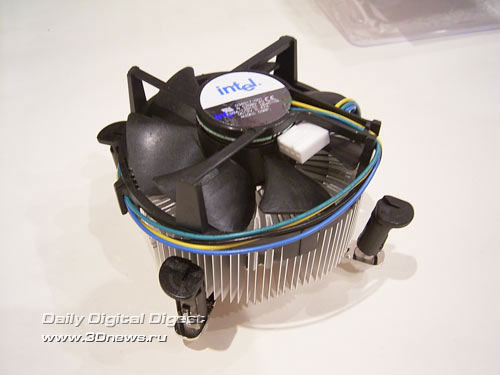
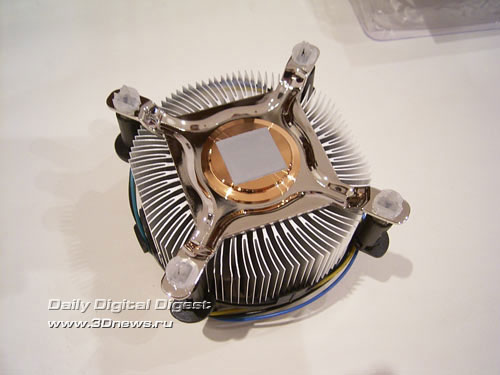
Let's start with the heat emission. The new stepping, albeit has reduced this part but insignificantly, so we didn't any substantial difference as compared to the previous Smithfield. The two cores are as hot as braziers in hell, so to harness this "oven", the user would have to buy quite an expensive cooler. If we restrict to a boxed cooler, then we get quite a noisy system.
The only advantage of a boxed cooler is the copper insert in the base and quite a convenient installation procedure.
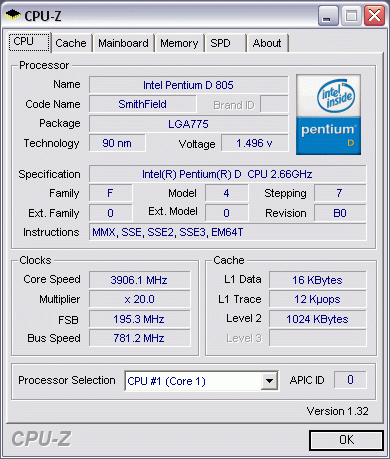
Now let's talk about the overclocking capability. Let's start with the most important: as some inquisitive readers have noticed, the multiplier of Pentium D 805 equals 20. Therefore, the high multiplier suggests the ease of overclocking. For instance, as the FSB speed is raised by 5 MHz, the processor's clock speed goes up by as high as 100 MHz. Such a high value of the nominal multiplier is directly related to the low frequency of the system bus, which equals 133 MHz (533 MHz QPB). Therefore, in overclocking the FSB from 133 MHz to 200 MHz, all the system components run in the nominal mode (modern motherboard can fix values of the PCI, PCI Express buses, and SATA). It turns out that even with the most cheap motherboard with the feature for adjusting the FSB within this range we can squeeze out the most of any Pentium D 805. Upon attaining the maximum, the user gets a performance comparable to Intel's top-end desktop processors. We also note that the multiplier in Pentium D 805 is fixed and can't be changed even towards the reduction. Unfortunately, this fact will not allow setting the bus to 266 MHz (1066 MHz QPB) and thus turning the "ugly duckling" into an Extreme Edition costing as high as 800 - 1000$.
There is one point, though: the BIOS of the motherboard must detect the new processor. For example, with ABIT AS8 (i865PE) the system wouldn't start and re-booted upon the video initialization.
It's now time we moved on straight to the overclocking. We used ASUS P5WD2 Premium and easily attained a stable system operation at 195 MHz. In the end, the test processor was able running at 3.9 GHz (almost a 50% performance boost)!
Actually, the system did start up at 4.0 GHz either, which shows that successful specimens of 805 processors may overcome the barrier provided there is matching cooling. We stress it out once again that the new stepping Smithfield B0 has seriously increased the overclocking capability from 3.2-3.4 GHz (of stepping A0) to 4.0 GHz!
 |
Content: |
 |
|
|
Top Stories: |
|
 |
|
MoBo:
|
|
|
|
VGA Card:
|
|
|
|
CPU & Memory:
|
|
|