MSI Megabook S271- a firstling on AMD Turion 64 X2
Author:
Date: 09.05.2006
|
|
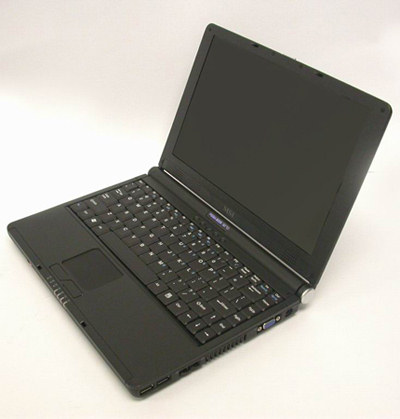
Our today's material is some sort of a unique investigation for two reasons at a time. First, this is a report on reviewing a new generation of MSI notebooks of the Ultra Portable series which includes the 12.1 inch Megabook S271 currently being prepared for release.
Secondly, this is the first device in our test lab which is equipped with a mobile dual-core new-generation processor built on the AMD Turion 64 platform - AMD Turion 64 X2 ML-50 which in turn offers an integrated DDR-2 memory controller and support for a number of new technologies.
In fact, the Turion 64 X2 platform can be surely positioned as a logical counterbalance to the line of notebooks built on the Intel Centrino Duo technology, in particular, 2-core Core Duo processors. It's just this perspective we are going to review all the pros and cons of Turion 64 X2 from in today's article. In this material, we are also running a comparison of the mobile computer based on AMD X2 64 ML-50 versus competitor models from the same price category.
Since the notebook that arrived at our test lab is a pre-sales (engineering) specimen, in this material you won't find the traditional description of the device usability and the retail package bundle. You can get a rough idea of the usability aspects of Megabook S271 through reading our article on its predecessor Megabook S270. Here we are dwelling on the architecture of the new AMD platform.
But first there goes the traditional table of characteristic declared by the manufacturer.
|
MSI Megabook S271
|
| Platform |
AMD Turion 64 X2 |
| Chipset |
ATI Radeon Xpress 200M (RS485M + SB460) |
| Processor |
AMD X2 Mobile Technology 64 ML-50 (1.6 GHz), 2 х 256 K L2 cache |
|
System memory
|
1 GB DDR2-533 |
| Display |
12.1" TFT WXGA (1280x800) |
| Video system |
The graphic system integrated into the ATI Radeon Xpress 200M chipset uses the system memory for graphics (adjustable within 64 to 256 MB in the BIOS Setup) |
| Audio system |
Realtek High Definition Audio (AC'97 2.2). Stereo speakers. Integrated microphone missing |
| HDD |
Fujitsu MHV2040H, real capacity – 37.2 GB |
| Optical drive |
DVD-RW, with support for double-sized recording |
| Card reader |
3 in 1: SD/MMC/MS |
| PC Card |
PCMCIA 2.1, Type II |
| Communication facilities |
56K V.92 modem;
Gigabit Ethernet (Realtek RTL8168/8111 PCI-E);
802.11g miniPCI Wireless Network Adapter;
Bluetooth |
| Ports |
VGA Output (D-Sub 15)
3 USB 2.0 ports
FireWire IEEE1394
Microphone input
Output to earphones / external speakers
Modem port RJ-11
LAN port RJ-45 |
| Dimensions |
303 x 225 x 26~28 mm |
| Weight |
1.9 kg |
| Power supply system |
Power supply adapter: 100-240V~, 50/60 Hz; 1.5А.
Li-Ion battery, 4 cells, 2200 mA*hr, 65 W.
About 3 hrs standalone operation (Mobile Mark 2002) |
Architecture overview of AMD Turion 64 X2
The idea of 2- (and more) core processors is not new - desktop analogs by both giants of "processor-building" arrived at the retail long time ago and are of some success on the market. The success is justified at least due to the possibility of simultaneous execution of a number of threads, which attracts many users of both workstations and home-based computers. But is is really worth resorting to such method of boosting performance in mobile computers?
Let's review a number of possible options.
-
Hi-End systems as a "replacement to desktop PC" which are sizeable and offer short time of standalone operation but are in fact full-featured and fully functional workstations.
-
Mid-end notebooks (which are in majority) – moderately mobile, powerful and functional. The purchase of a notebook with 2-core processor is highly questionable1. For instance, use of multiple cores in modern gaming applications gives a poor performance boost (there is support for dual-core processing implemented in ID Software's DooM III and games based on its engine) and in regular work with office applications – even if the two cores give a boost, it is minor.
-
Portable notebooks among which is our today's test specimen. In my view, their use as full-featured workstations is highly disputable - it is up to the amateurs. Such computers are an ideal match for a "permanent companion" rather than a replacement for the desktop PC. Therefore, the chances of high demand for multitasking in these systems tend to zero. There are exceptions to this rule... albeit rare.
This is the situation for today, and in the nearest future it will change. Improved tools for developers are emerging, and hopefully Windows Vista will make use of improved algorithms for partitioning applications into threads etc., so the multicore processing simply won't remain just unclaimed exotics.
We start getting familiarized with the notebook through a review of the capabilities of the Turion 64 platform because the design and functional capabilities of the model were explored by my colleague in the material on MSI S270, and model S271 is made in an identical housing.
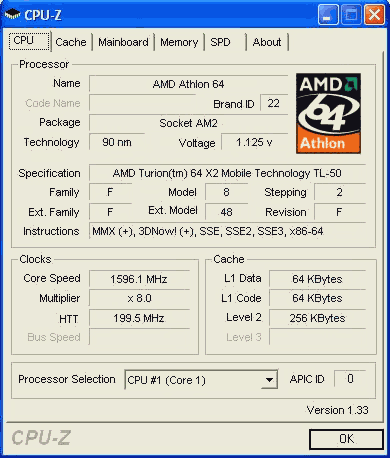
To explore the processor's capabilities, we used the CPU-Z.
The processor being tested was detected as a not yet officially announced AMD Turion 64 X2 ML-50 with Socket AM2. In fact, the socket for the new-generation mobile AMD platform will be dubbed Socket S1, which in the context of tests is not really important.
The dual-core architecture having the working name Taylor (Rev. F) on which the AMD Turion 64 X2 TL-50 processor is built is manufactured following the 90-nm process technology, runs at the nominal clock speed 1.6 GHz, offers two L2 caches - 256 K per each core, supports memory up to DDR2-667.
Let me remind it that the AMD Turion 64 X2 family with the Taylor core will be made up of 4 chips for the first time. Besides the above mentioned Turion 64 X2 ML-50, the family includes TL-52 of clock speed 1.6 GHz, TL-56 of clock speed 1.8 GHz and TL-60. All the three chips offer 2 х 512 K of L2 cache, that is, twice as more than in today's Turion 64 X2 ML-50 being tested, but all the four chips are normed for power consumption in the same way – with TDP about 35 W.
In future, these chips may be replaced by the 2-core mobile core Tyler (Rev. G) with 65-nm process technology, as well as for Socket S1 with 2 х 512 K L2 cache, with support for DDR2-800, and TDP 35 W.
As regards the chip Turion 64 X2 ML-50 that offers 1.125 V operating voltage, we can say that transition to 2-core computing along with the 90-nm process technology and new revision of the core with an integrated DDR-II memory controller has not in fact affected the power consumption and heat emission. The new core fully supports AMD64, SSE3, and PowerNow!
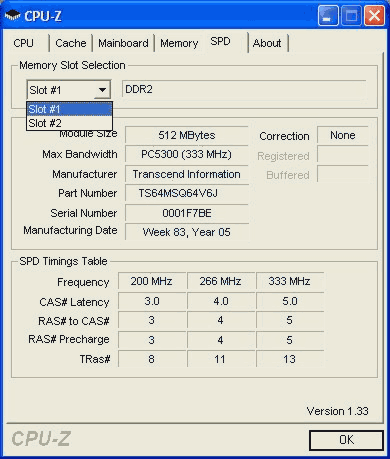
The memory is made by Transcend Information. Inc.
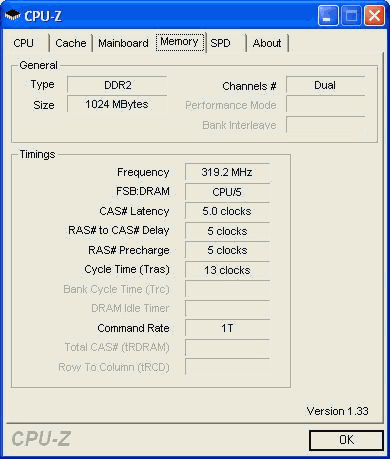
The DDR-II memory operating frequency is 533 MHz, and the memory runs in the dual-channel mode.
 |
Content: |
 |
|
|
Top Stories: |
|
 |
|
MoBo:
|
|
|
|
VGA Card:
|
|
|
|
CPU & Memory:
|
|
|