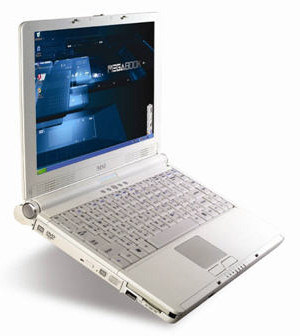
MSI Megabook S271- a firstling on AMD Turion 64 X2
Author:
Date: 09.05.2006
|
|
Impressions
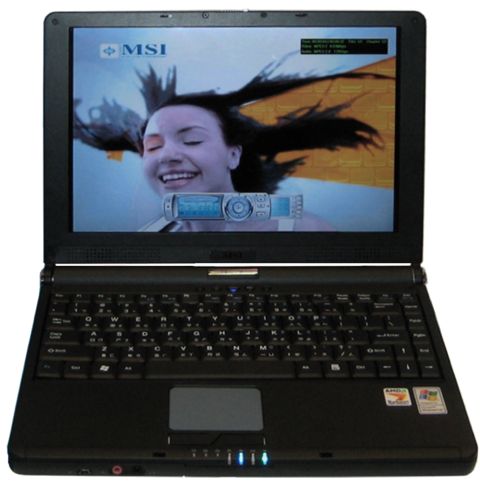
The major advantage of MSI S271 is of course its mobility. Almost three and a half hours of normal operation, impressive viewing angles horizontally and vertically, minimum heating of the housing, low noise level...
Among the shortcomings is not quite convenient touchpad of some degraded sensitivity. The keyboard has neither special features nor issues. The tested pre-sales specimen has no Cyrillic characters engraved on the keys, but in any case this model will be shipped to the Russian market as a "localized" version.
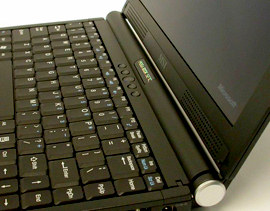
The model is equipped with three USB ports, which is quite enough for a device of this class, but the relative distance between them is not enough – once a massive USB device (e.g. a flash disk, a player...) is plugged in, access to the other port is hindered. Interfaces of the audio adapter are brought over to the front panel of the notebook, which is convenient enough if head-phones with a limited cable length are plugged in.
Benchmarking
Performance of the combination "AMD X2 ML-50 + 1 GB RAM + Radeon Express 200M" is impressive. Needless to say, it makes no sense to expect peak results from the graphics integrated into the chipset at demanding 3D applications, which was confirmed in 3DS Max 7 – while displaying a scene more or less filled with polygons, the FPS dropped below the comfortable level. At other application suites, the operation of the notebook had nothing to complain about.
Let's look at the results of tests run in SiSoftware Sandra 2005 SP3. We'll be comparing it versus the kindred model MSI S270 which is based on the combination Mobile AMD Sempron 3000+ (1.8 GHz) and the chipset ATi RS480M + ATi SB400.
|
Test name
|
MSI Megabook S271 (AMD Athlon 64 X2 ML-50)
|
MSI Megabook S270 (AMD Sempron 3000+)
|
| Sandra CPU Arithmetic Benchmark, Dryhstone ALU; MIPS |
14316
|
8278
|
| Sandra CPU Arithmetic Benchmark, Whetstone iSSE3 (iSSE2 for Sempron 3000+); MFLOPS |
6552
|
3637
|
| Sandra CPU Multimedia Benchmark, Integer x4 aEMMX/aSSE; it/s |
30085
|
17070
|
|
Sandra CPU Multimedia Benchmark, Floating-Point x4 iSSE2; it/s
|
32817
|
18361
|
| Sandra Memory Bandwidth Benchmark, RAM Integer Buffered iSSE3(2); MB/S |
3741
|
2217
|
| Sandra Memory Bandwidth Benchmark, Float Buff'd iSSE2; MB/S |
3712
|
2216
|
Evidently, that at synthetic applications Athlon 64 X2 Mobile Technology ML-50 is pre-eminent over the younger brother Sempron. At the memory bandwidth tests, it is the undisputable advantage of DDR-II and integrated dual-channel memory controller which make themselves felt.
Let's move on to Futuremark PCMark benchmarking suites. This time, we'll be comparing it versus the no less interesting model – Acer Aspire 5670 based on the Intel Centrino Duo platform (core clock speed – 1.66 GHz, L2 cache – 2 MB, the system bus speed – 667 MHz, RAM – 1 GB). Remember that the cores of Athlon 64 X2 ML-50 run at 1.6 GHz clock speed.
|
Test name
|
MSI Megabook S271 (AMD Athlon 64 X2 ML-50)
|
Acer Aspire 5670 (Intel Centrino Duo 1,66 GHz)
|
| PCMark 2004 |
4173
|
5019
|
| PCMark 2005 |
2463
|
3245
|
While in PCMark 2004 Athlon 64 X2 ML-50 just a little bit lags behind its immediate competitor, in PCMark 2005 the difference becomes more pronounced. Evidently, it is the architecture and the L2 cache size which affect that.
3D synthetics - Futuremark 3DMark'03 and '05. Again we are comparing it versus Acer Aspire 5670, but for better "obviousness we don't expect something special from Radeon X200M, especially if compared versus the modern discrete mobile graphics of ATI Mobility Radeon X1400 installed in Acer Aspire 5670.
|
Test name
|
MSI Megabook S271 (AMD Athlon 64 X2 ML-50)
|
Acer Aspire 5670 (Intel Centrino Duo 1,66 GHz)
|
| 3DMark 2003 |
1305
|
3339
|
| 3DMark 2005 |
655
|
1618
|
The superiority of ATI Mobility Radeon X1400 in Acer Aspire 5670 is evident. Well, MSI Megabook S271 is not a high-end gaming platform, but nobody expected that from a model with integrated graphics.
We are finishing the tests with the traditional Battery Eater 2005. The time of standalone operation amounted to 188 minutes (3 hrs 8 min), which is a very good result for such a compact mobile system equipped with a 2200 mA*hr battery.
Final Words
The conclusions we are making are made up of two parts - one related to the new line of AMD processors and the other regarding the notebook which has been to our test lab.
We start with the line of 2-core AMD processors built on the Taylor core. Of course, it has proved a success for AMD – there has been achieved a new frontier of power consumption and heat emission, and the superbly operating power management system PowerNow! has been implemented at an outstanding level. Take for instance the 3 hours of uninterrupted operation with a 2200 mA*hr battery. The performance is a little bit behind Intel Centrino Duo, but let's not make hasty judgments – that was just a single model on this platform. It seems like the Napa platform will soon see a matching rival.
Regarding the second part, we note that a notebook by MSI is almost an ideal of modern mobile computer regardless of the modest capabilities at 3D operation.
Pros:
- Good design
- Superb quality of the TFT matrix
- High performance outside 3D
- Long battery operation time
- Almost no noise and heating of the housing
Cons:
- Not the most convenient layout of USB ports
 |
Content: |
 |
|
|
Top Stories: |
|
 |
|
MoBo:
|
|
|
|
VGA Card:
|
|
|
|
CPU & Memory:
|
|
|