Abit AN7 (nVidia nForce II 400 Ultra) Review
Expansion options
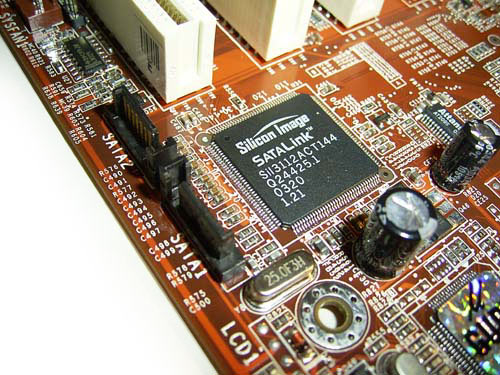
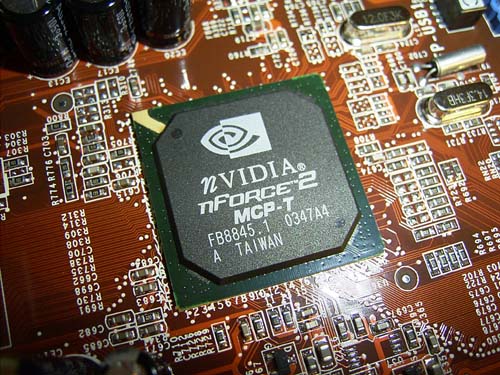
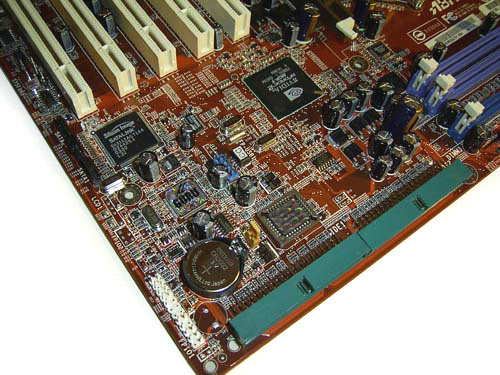
Since the south bridge MCP-T lacks support for the SerialATA, engineers at Abit implemented the interface in a traditional way - through installing an additional controller.
This is a quite popular dual-channel SerialATA/RAID Sil3112 controller made by Silicon Image with support for RAID of levels 0 and 1.
Anyway, the MCP-T south bridge can't boast other advantages. The most essential of them is the integrated audio of superb quality with support for the SoundStorm technology.
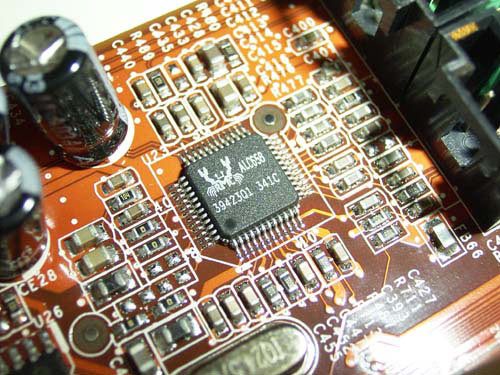
In practice, this gives audio quality comparable to Creative Live 5.1, as well as the minimum performance drop with the EAX enabled. As the codec, the latest ALC658 chip is used (on the Abit NF7-S, the outdated ALC650 codec was installed).
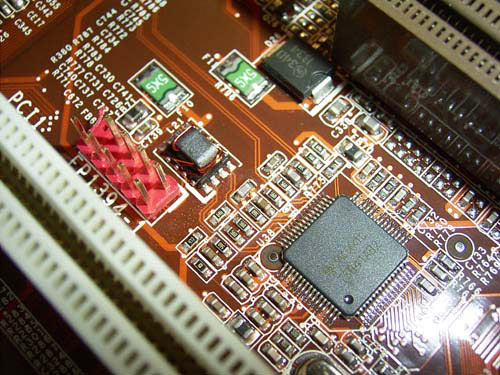
Besides, use of the MCP-T south bridge gives support for the IEEE1394 ("Firewire") bus. As a result, Abit AN7 offers two respective ports: one mounted on the board's rear panel, with the other connected through a header (missing in the package bundle).
As the physical interface, the TSB41AB2 chip is used which is positioned between the AGP and PCI1 slots. The FP1394_1 connector to which a header is plugged in is also positioned here.
The board also offers support for the USB 2.0 bus. There are six USB 2.0 ports altogether, four of which are mounted on the rear panel, with 2 more connected through a header (missing in the package bundle).
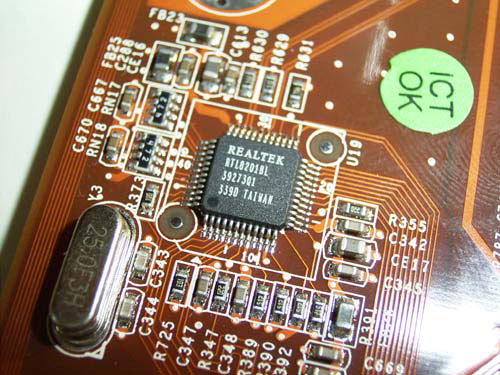
The remaining expansion options are the RTL8201BL network controller (physical interface of the MCP-T).
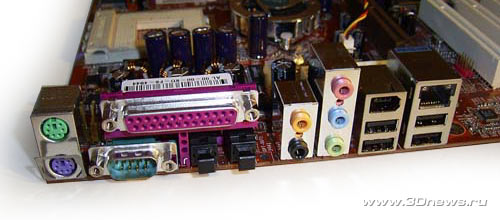
The board's rear panel has an unusual configuration, with the COM2 port missing. Instead it, there are SPDIF in/out connectors.
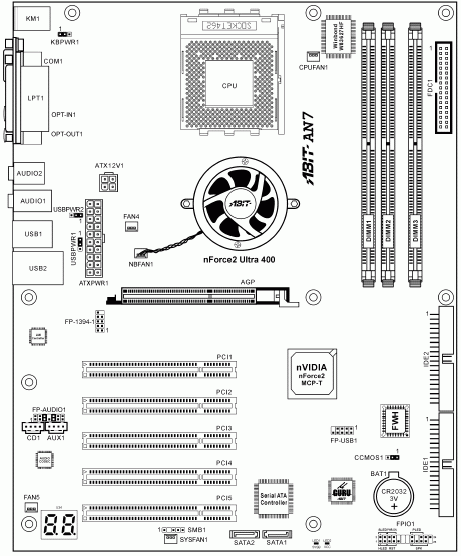
Traditionally, a jumpers layout diagram:
There are quite a number of jumpers on Abit AN7: the CCMOS1 is used for clearing the CMOS (positioned near the battery), the KBPWR1 is used for waking up the system on a keyboard pulse, the USBPWR1 and USBPWR2 are used to wake up the system on USB response (positioned not in the best way, near the main power supply). All the jumpers have plastic tails to make the installation more amenable.
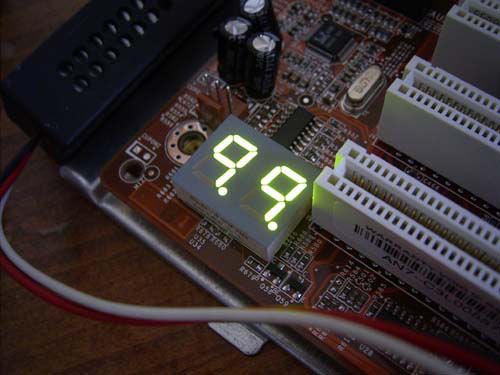
Of additional features, note the 7-stage POST indicator which proved to be an integral part of any Abit motherboard.
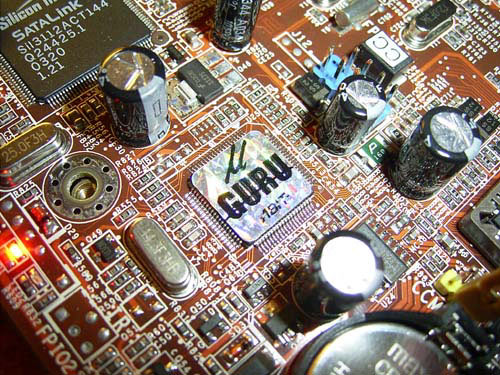
All the other additional features are gathered in the mGuru chip installed near the battery.
In fact, the mGuru chip supports only two useful functions. These are monitoring the rotational speed of the fans, and storing the BIOS setting profiles (the latter will be referred to in the next section). The remaining "mGuru technologies" are merely marketing toys.
 |
Content: |
 |
|
|
Top Stories: |
|
 |
|
MoBo:
|
|
|
|
VGA Card:
|
|
|
|
CPU & Memory:
|
|
|