Asus P4P800-E Deluxe (i865PE Springdale)
Overclocking and stability
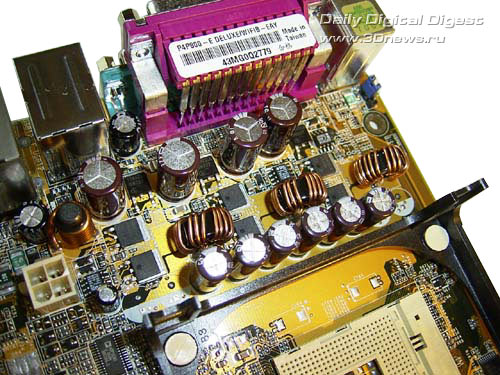
There was nothing to complain about the stability of the board during the tests: the board was running round the clock both in the nominal and overclocked modes. As regards the power supply module, it is implemented following the 3-channel scheme (there are six 1500 mkF and four 1200 mkF capacitors, as well as nine MOSFETs).
Now let's list the overclocking tools.
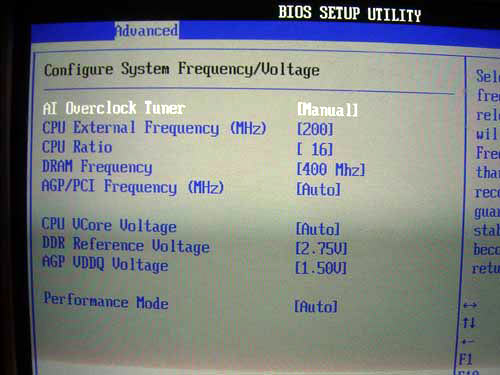
Let's first look at the FSB speed variation range, which is between 100 and 400 MHz. In so doing, the variation increment = 1MHz due to the SFS - Stepless Frequency Selection technology.
Clearly, speed variation in 1MHz increments allows overclocking the processor in a very fine-tuned way and reaching the maximum possible values. But to select the right frequency, we would have to scroll through all the interim values repeatedly, which is inconvenient.
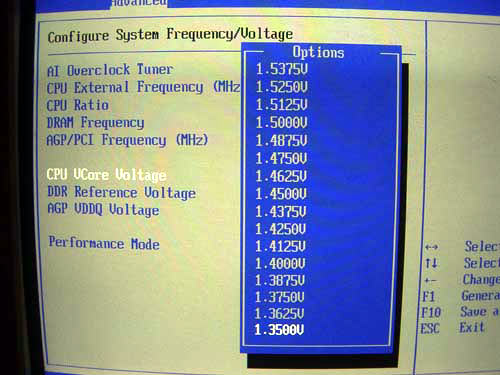
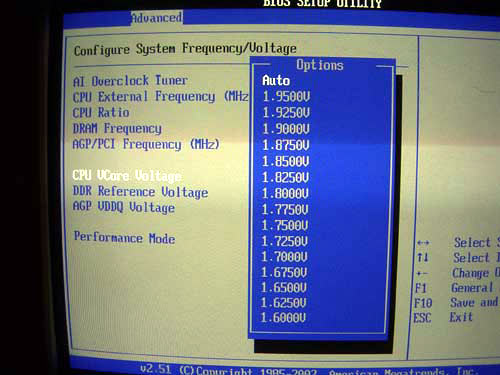
The next important item is raising the processor voltage (Vcore). The Vcore variation range is within 1.35V to 1.95V in 0.025V increments.
As a result, this range becomes quite sufficient for hardcore overclocking of stepping D1 & C1 Northwood processors (to overclock B0 stepping processors, it is advisable the Vcore be increased to 1.85V and higher). But to overclock Prescott processors, such a wide range of Vcore selection is absolutely unnecessary. Since processors of this type emit much heat, it is important to raise voltage with the least increment (in some boards, the increment is 0.0025V !) in order to overclock them.
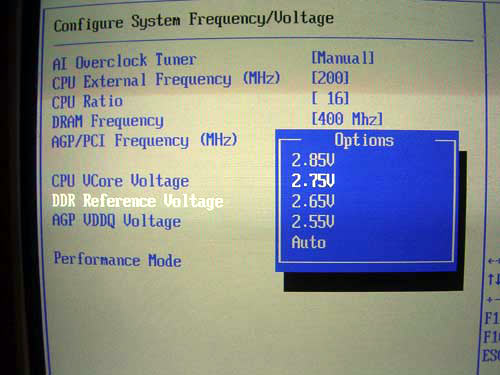
The next item allows raising the memory voltage (Vmem). Its variation range is between the nominal 2.55V and 2.85V (in 0.1V increments).
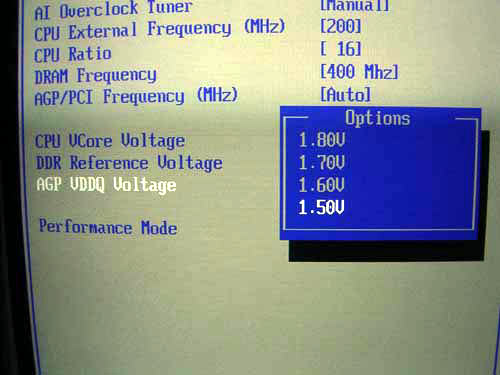
Besides, the overclocker gets a useful function for raising the AGP bus voltage.
The variation range is between the nominal 1.5V and 1.8V.
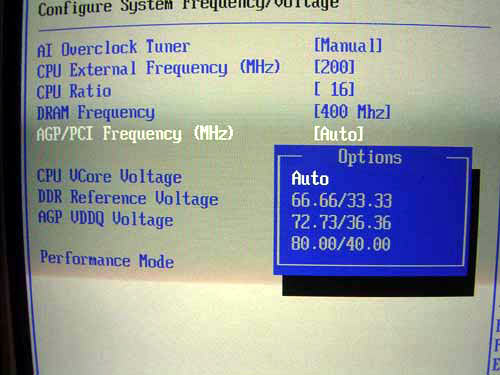
At increased speeds, it is important that the PCI and AGP bus speeds not depart from the standard 33 and 66 MHz, respectively, if possible. It is primarily important for correct HDD operation (and much more important for motherboards having support for RAID). So, the Asus P4P800-E board allows setting a fixed speed at the PCI and AGP buses. This parameter is adjustable within 33/66 to 40/80 MHz, respectively.
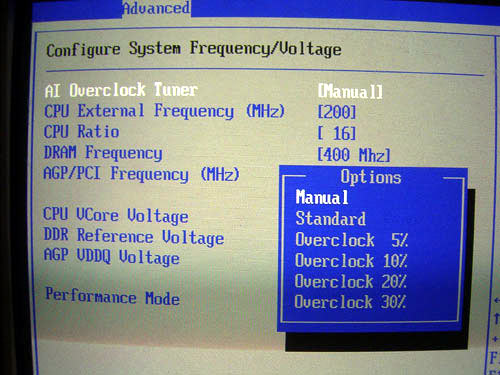
And lastly: especially for inexperienced users who are anxious to boost the performance for free, programmers at Asus have implemented the "AI Overclocking" feature.
All you have to do is to select the parameters in series and check for the operational stability.
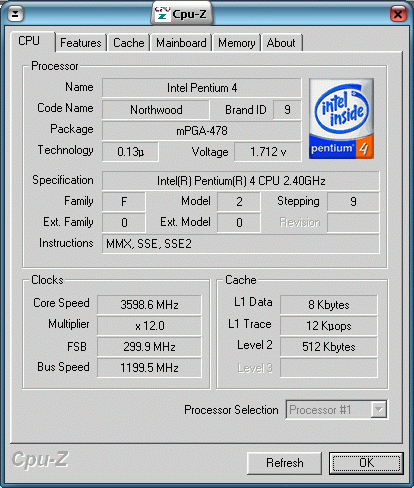
General finding: the Asus P4P800-E features the most powerful overclocking tools. But I was really surprised by the practical experiment: the system was unable to run stably at FSB=300 MHz; the maximum stable FSB amounted to only 290 MHz.
Basically, if we used a Prescott processor, then 290 MHz would be sufficient: the lowest-end processor of the family (2.8E) offers the multiplier = 14, which gives the resultant frequency 14x290=4060 MHz that is much higher than the technological limit for stepping C (~3.6 GHz). And if you come across a 2.4A processor (also based on the Prescott processor), its multiplier is even higher than that = 18.
Remember that P4P800 Deluxe was the first board in our test lab which was able to cope with FSB=300 MHz. After it, the following boards were able to attain such high result: Abit IC7-G, Abit IC7-MAX3 and MSI 865PE Neo2-FIS2R.
 |
Content: |
 |
|
|
Top Stories: |
|
 |
|
MoBo:
|
|
|
|
VGA Card:
|
|
|
|
CPU & Memory:
|
|
|