Gigabyte X38-DQ6 (Intel X38)
Author:
Date: 02.10.2007 |
|
Performance
When determining the starting FSB speed, it turned out that the board overstated it by as much as 2.0 MHz.
In our test setup, we used the following hardware:
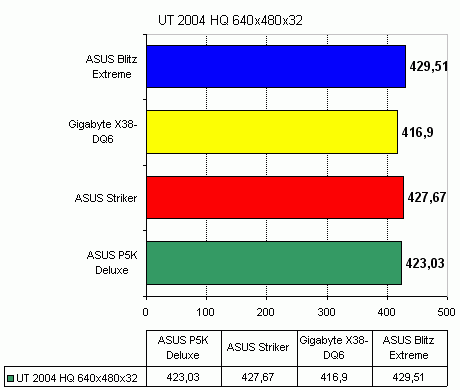
First, let's look at the results of synthetic tests (other motherboards are based on the following chipsets: ASUS Striker (NVIDIA nForce 680i SLI (DDR2)), ASUS P5K Deluxe (DDR2), and ASUS Blitz Extreme (DDR3) (Intel P35).
Now on to the gaming programs.
Final Words
The review of Gigabyte X38-DQ6 has not changed our original opinion of the Intel X38 chipset. This product is aimed at extreme overclockers and/or user of a couple of AMD video cards running in the Crossfire combination. For other user categories, the motherboard based on X38 will be not much better than similar based on P35.
However, if together with the chipset X38 Intel releases one or more CPUs of FSB = 400 MHz (1600 QPB), then X38 will be the only product offering official support for these processors. In the end, X38-based motherboards will have no alternative for users who prefer maximum performance and are not short for funds.
As regards the Gigabyte X38-DQ6 itself, it is well engineered for a pre-release sample. The performance level is high enough for a test specimen that uses a debug version of the BIOS. That means the final version of the board (the one which will be shipped to the retail) will be better. The chipset X38 simply must demonstrate the top speed among the other competitor solutions. We'll be testing all that closer to the end of the year once a comparative test of motherboards based on P35 and X38 will be released.
It is highly probable in that test there will take part the final version of Gigabyte X38-DQ6 ? with the finally polished BIOS version.
Among the board's specific features, we should point to the powerful and well-made power converter and a noiseless system for cooling the major components. The cooling system includes massive radiators on the reverse side the board. Of note also is the configuration of the rear panel which has got rid of the outdated ports (they are supported by the bracket), but on the other hand it offers support for a great number of USB2.0 and Firewire ports.
The new software (Gigabyte EasyTune Center) which facilitates system tuning and configuration merits a separate mention.
The overclocking tools have been well implemented. In particular, the board demonstrated one of the best overclocking results and allowed making the most of the CPU test specimen.
In fact, the board has no shortcomings. The only thing which is annoying a bit is that the package bundle does not meet the top-end level.
ConclusionPros:
- high stability;
- 12-phase power scheme;
- Two PCI Express v2.0 x16 slots (16+16);
- Support for SerialATA II/RAID ( 8 lines; ICH9R + Gigabyte SATA2);
- support for one P-ATA line (Gigabyte SATA2);
- Integrated 8-channel audio and two LAN (Gigabit Ethernet) controllers;
- support for USB2.0 (12 ports) and IEEE-1394 (Firewire, 3 ports);
- a rich selection of Gigabyte's proprietary technologies (DualBIOS, C.I.A2, EasyTune Center, FaceWizard, @BIOS, etc.);
- passive system for cooling the chipset and the power supply module;
- functional rear panel.
Cons:
- the board's package bundle does not meet the top-end level.
The board's specific features:
- excellent results of overclocking the processor and memory.
- Discuss the material in a conference
 |
Content: |
 |
|
|
Top Stories: |
|
 |
|
MoBo:
|
|
|
|
VGA Card:
|
|
|
|
CPU & Memory:
|
|
|